01Facts
The wife filed an application under s.125 Cr.P.C. (A.C.M. 251 of 2022) against the husband before the Judicial Magistrate, 9th Court, Alipore.
¶ 2Her Affidavit of Assets and Liabilities (5.4.2022) left the income and bank-account columns blank.
¶ 2 · ¶ 18(iv)The husband sought the missing bank statements and income-tax returns by application dated 21.9.2022, which remained undisposed through listings on 1.2.2023, 28.7.2023, 16.1.2024 and 7.2.2024.
¶ 2–3 · ¶ 18(v)Under s.23 PWDV Act, an interim order of ₹20,000 per month was passed on 18.5.2022; it was set aside by the Appellate Court on 20.5.2023, and the High Court's interim direction in CRR 3164 of 2023 was disposed of after the s.125 order was disclosed.
¶ 4–5On 30.3.2024, the Magistrate fixed ₹45,000 per month as interim maintenance from 5.4.2022 without, according to the husband, hearing him or deciding his objections, and the date was allegedly fixed behind his back.
¶ 5–7 · ¶ 18(vi)The wife had claimed hacking of her accounts; the police investigation (Cyber PS Case 22/2023) found no hacking and treated it as a mistake of fact under s.66 r/w s.43 IT Act.
¶ 9 · ¶ 18(vi)The husband's supplementary affidavit disclosed the wife's employment at Wipro with income of about ₹1,30,000 per month at the time of filing.
¶ 8The wife, now at Wipro (Bengaluru), attributed her "not earning" submission to miscommunication with her trial-court advocate and produced a salary certificate.
¶ 12, 15–17The husband's undertaking to pay ₹20,000 per month (order of 10.1.2025) was given by his counsel without instructions, and he claims double-recovery exposure from two pending execution cases.
¶ 9, 1102Issues
i.1. Whether the interim maintenance order dated 30.3.2024 under s.125 Cr.P.C., passed without hearing the husband or deciding his pending objections and based solely on the wife's affidavit, is sustainable in law.
¶ 7, 19, 21ii.2. Whether the wife's suppression of her income in her Affidavit of Assets and Liabilities, and the plea of miscommunication with counsel, constitute an abuse of the process of law justifying quashing of the s.125 proceeding.
¶ 18, 22–23iii.3. Whether the s.125 proceeding can be quashed in exercise of inherent powers under s.482 Cr.P.C. (now s.528 BNSS) read with s.397 Cr.P.C.
¶ 2403Law Applied
Section 482 Cr.P.C. (now s.528 BNSS) and s.397 Cr.P.C., under which inherent power is exercised to prevent abuse of process and secure the ends of justice.
¶ 24Section 125 Cr.P.C., whose purpose is to prevent vagrancy and destitution of a deserted spouse without means of her own.
¶ 20Rajnesh v. Neha (MANU/SC/0833/2020), which requires parties to file an Affidavit of Assets and Liabilities so the court can determine entitlement and quantum of maintenance, particularly at the interim stage, and which requires full and accurate disclosure.
¶ 20–21 fn. 1Where prima facie abuse of process or malice in initiating proceedings appears, the court must scrutinise the surrounding circumstances with greater caution.
¶ 18A sustainable order must rest on hearing the parties and consideration of objections.
¶ 19–21Provisions in the judgment · 15 · Linked ones open on LawLens
Code of Criminal Procedure, 1973 Section 482Section 397Section 125
Bharatiya Nagarik Suraksha Sanhita, 2023 Section 528Section 438
Protection of Women from Domestic Violence Act, 2005 Section 23Section 3Section 4
Indian Penal Code, 1860 Section 323Section 406Section 34
Information Technology Act, 2000 Section 66Section 43
04Reasoning
The court examined the sequence of events and found that the wife's affidavit left her income blank, that she maintained a "no income" stance until 7.2.2024, and that her claimed hacking was investigated and found false.
¶ 18(iv)–(vi)Given her B.Tech/MCA qualifications, the court held it unbelievable that she did not understand her affidavit and concluded that she intended to suppress income to obtain maintenance.
¶ 21The court rejected the miscommunication plea, noting that the counsel's "no objection" did not explain the sustained suppression and that the wife had accepted her higher earnings.
¶ 16, 22–23On the Magistrate's conduct, the court found the ₹45,000 order was passed in haste, relied only on the wife's affidavit, ignored the husband's objection and detailed bank disclosures, and gave no reasons.
¶ 19, 21Applying Rajnesh, the court held that a wife earning more than the husband cannot sustain a s.125 claim, so continuation would be a gross abuse of process, especially given the litigation since 2022.
¶ 23–24The court quashed the proceeding under inherent power rather than merely setting aside the interim order.
¶ 24–2505Holding
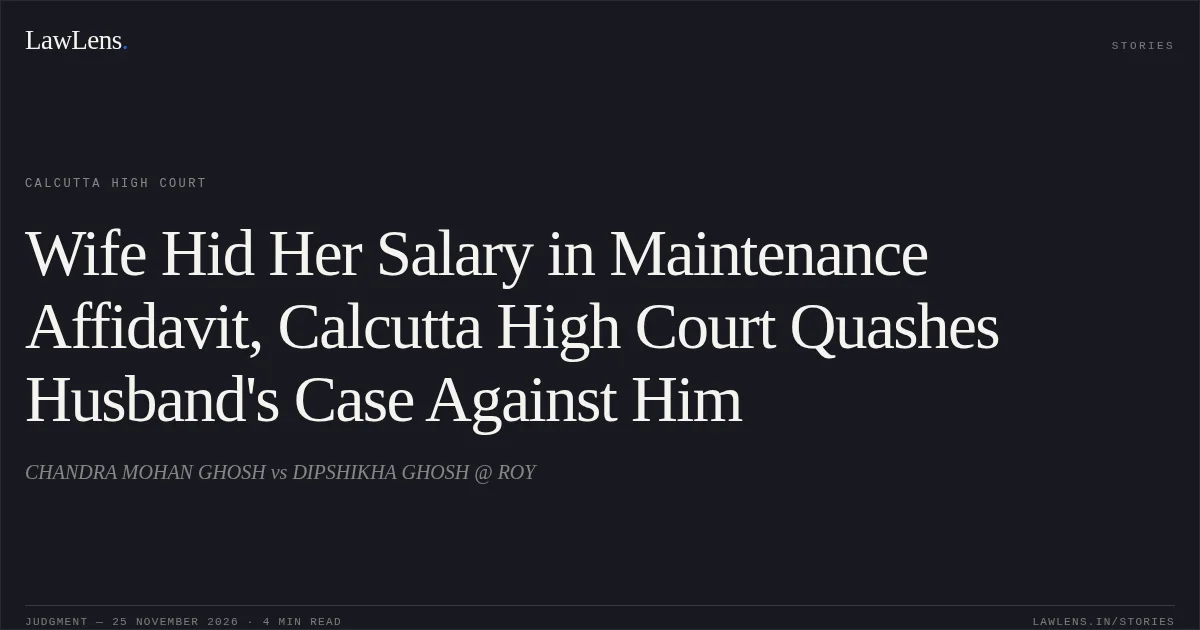
The s.125 proceeding was an abuse of process because the wife suppressed her income, and the 30.3.2024 interim order was passed without hearing and without consideration of the husband's objections.
¶ 18–23The entire proceeding in A.C.M. 251 of 2022 is quashed along with the order dated 30.3.2024.
¶ 25The wife is directed to pay costs of ₹20,000 into the Juvenile Justice Fund maintained by the State Legal Services Authority, West Bengal, within 10 days of uploading the judgment, with a receipt to the Registrar General.
¶ 24, 26All connected applications stand disposed of.
¶ 27Original Court PDF
CHANDRA MOHAN GHOSHvsDIPSHIKHA GHOSH @ ROY
Click to open original judgment
Original judgment, available to read, download and summarize on LawLens.in