01Facts
The wife applied under Section 12 of the Protection of Women from Domestic Violence Act, 2005, alleging abuse and seeking relief for herself and their minor daughter.
p. 2The Magistrate directed the husband to pay monthly maintenance of ₹5,500 to the wife and ₹6,500 to the daughter, and directed the wife to reside in the shared household.
pp. 2–5The husband’s appeal was dismissed.
pp. 2–5In revision, he challenged the maintenance order, including on the ground that his income and liabilities had not been properly assessed.
pp. 2–5The High Court noted that the parties had not filed affidavits of assets and liabilities and that the wife had not been able to enjoy the shared household as directed.
pp. 2–502Issues
i.Whether the maintenance order could stand where the parties had not filed affidavits of assets and liabilities to enable an assessment of their financial circumstances.
pp. 4–5ii.Whether interim payment and accommodation directions were necessary pending fresh assessment by the Magistrate.
p. 603Law Applied
Section 12 of the Protection of Women from Domestic Violence Act, 2005 provides the basis for an application seeking relief under the Act.
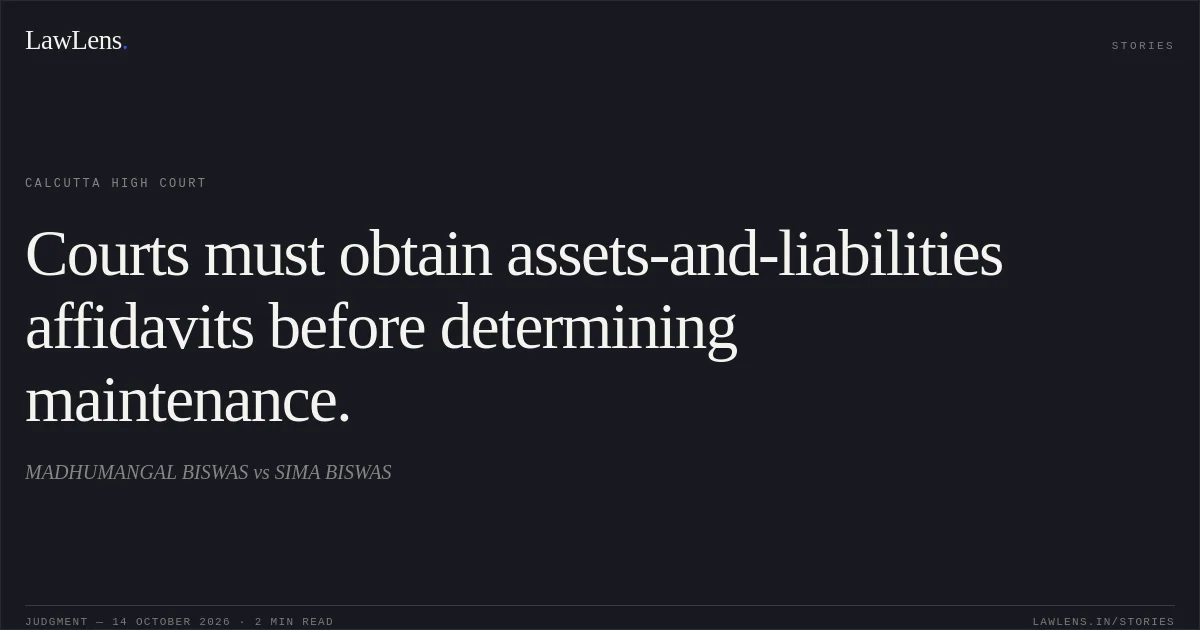
p. 2, 5The Court relied on Rajnesh v. Neha & Ors., MANU/SC/0833/2020, for the principle that parties claiming or contesting maintenance must submit affidavits of assets and liabilities so the court can assess their financial circumstances.
pp. 4–5Provisions in the judgment · 1 · Linked ones open on LawLens
Protection of Women from Domestic Violence Act, 2005 Section 12
04Reasoning
The Magistrate had finally disposed of the proceeding on the basis of the application and written objection, without directing the parties to file the affidavits contemplated by Rajnesh.
pp. 4–6Although the husband’s income was within his special knowledge, the Court considered that the maintenance amount had been set without adequately ascertaining the parties’ financial circumstances.
pp. 4–6The appellate court had also failed to address the absence of the affidavits and the wife’s inability to reside in the shared household.
pp. 4–6The Court therefore set aside the lower-court orders and directed a fresh hearing based on affidavits, while providing interim financial and accommodation arrangements.
pp. 4–605Holding
The revision was allowed in part.
p. 6The High Court set aside the orders of the Magistrate and appellate court, directed both parties to file affidavits of assets and liabilities, and ordered the Magistrate to hear the matter afresh.
p. 6Pending that determination, the husband was directed to pay ₹11,000 per month for the wife and daughter, clear arrears in six equal instalments, and pay an additional ₹5,000 per month towards rent.
p. 6The wife may proceed with execution if he fails to comply.
p. 6Original Court PDF
MADHUMANGAL BISWASvsSIMA BISWAS
Click to open original judgment
Original judgment, available to read, download and summarize on LawLens.in