01Facts
The parties married on 21.02.2009 and have two children, born in 2014 and 2017.
¶ 2The wife alleges she was driven out of the matrimonial home on 19.07.2020 and lodged criminal proceedings under Sections 498A/406/420/467/468/471 IPC, which are pending trial.
¶ 3The husband filed a cross-complaint alleging misappropriation of Rs. 75 lakhs by the wife's father, which remains unresolved; he also filed a custody-related case, and a divorce petition is stayed pending the wife's alimony application.
¶ 4The wife filed a maintenance application under Section 125 CrPC (M 383/2020) and a monetary relief application under Section 12 of the DV Act (C1436/2020).
¶ 5On 20.06.2022, the trial court granted interim relief of Rs. 20,000 to the wife, Rs. 15,000 to each child, and Rs. 25,000 towards alternative accommodation, reasoning that the wife had no steady income despite having some funds in her bank accounts.
¶ 5, 17–18On 11.04.2023, the Additional Sessions Judge set aside the wife's interim maintenance, enhanced the children's maintenance to Rs. 25,000 each per month, and directed payment of arrears in five instalments.
¶ 6–7, 19–22The lower appellate court found that the wife held substantial funds, including accounts with Bandhan Bank and HDFC Bank, interest income, and a controlling stake in Habile Minds Informatics Pvt. Ltd.
¶ 19–21The wife contends she is unemployed, that her funds were largely the husband's money routed through her accounts, and that her monthly household expenses are about Rs. 86,000.
¶ 8–12The husband contends that the wife suppressed income, has access to the company account and her Income Tax portal, and holds about Rs. 1.41 crores of his money.
¶ 13–16, 23–2502Issues
i.1. Whether the lower appellate court was justified in setting aside the wife's interim maintenance/monetary relief under Section 125 CrPC and Section 12/23 of the DV Act, where the wife's income, assets, and access to funds are disputed.
¶ 22, 26–27ii.2. Whether the enhanced interim maintenance of Rs. 25,000 per month for each child is excessive or perverse.
¶ 28–3003Law Applied
The Court applied Section 125 CrPC, under which maintenance is payable where a person is unable to maintain themselves, and the monetary relief provisions of the Protection of Women from Domestic Violence Act, 2005 (Sections 12 and 23), which permit interim monetary relief pending final adjudication.
¶ 5, 22, 27The Court relied on the husband's argument, based on Rajnesh v. Neha, (2021) 2 SCC 324, that a maintenance claimant must disclose income tax returns and assets, so that non-disclosure is treated as suppression.
¶ 23The Court also noted the husband's reliance on Section 58 of the Indian Evidence Act, under which admitted facts need not be proved, but treated this only as a submission.
¶ 13(ii)The governing principle is that interim relief depends on a prima facie assessment of the claimant's financial position, and where disputed facts such as concealment of income or access to funds arise, these must be resolved through examination and cross-examination on documentary and oral evidence.
¶ 26–27The Court further applied the principle that the quantum of child maintenance must reflect the children's reasonable needs, including education, and the paying parent's capacity to pay.
¶ 29–30Provisions in the judgment · 13 · Linked ones open on LawLens
Code of Criminal Procedure, 1973 Section 125
Protection of Women from Domestic Violence Act, 2005 Section 2Section 12Section 23
Indian Penal Code, 1860 9 provisions
Section 34Section 328Section 379Section 406Section 420Section 467Section 468Section 471Section 50604Reasoning
The Court noted that the lower appellate court had found the wife's interest income, bank balances, and control over the company's funds relevant to her ability to maintain herself, and that the wife had not disclosed these matters fully.
¶ 19–21, 23–25The High Court held that the disputed questions, namely whether the wife suppressed her income in its entirety and whether she could access her accounts and tax portal, could not be resolved on affidavits and required evidence.
¶ 26On that basis, the High Court found no perversity or impropriety in the lower court's view that non-disclosure amounted to an attempt to mislead the court, and that the wife's entitlement required evidentiary determination.
¶ 27As to the children, the Court rejected the husband's objection that the children's school admissions were unilateral and excessive. It accepted the school fee record, showing monthly education costs of about Rs. 30,000 for both children, and held that as an able-bodied parent the husband must meet these costs in the children's interest.
¶ 28–3005Holding
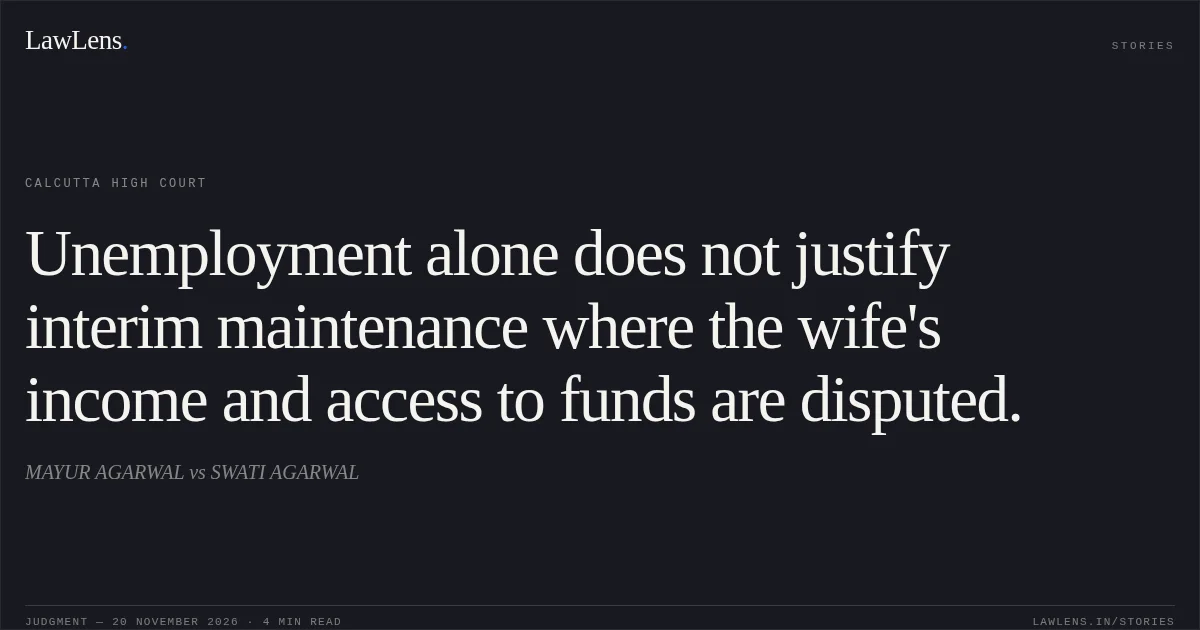
The High Court held that the lower appellate court's order dated 11.04.2023 did not call for interference, as the wife's entitlement and access to funds could only be determined on evidence.
¶ 26–27, 31The Court also upheld the enhanced interim maintenance of Rs. 25,000 per month for each child as neither perverse nor excessive.
¶ 28–30All four revisions (CRR 2303, 2304, 2180, and 2181 of 2023) were disposed of.
¶ 31The observations are confined to interim relief and are not final. The trial court was directed to decide the Section 125 CrPC and Section 12 DV Act applications within six months, without unnecessary adjournment and solely on the evidence led by the parties.
¶ 32Original Court PDF
MAYUR AGARWALvsSWATI AGARWAL
Click to open original judgment
Original judgment, available to read, download and summarize on LawLens.in