01Facts
The petitioner married the son of Opposite Party No. 2 and lived with him at the Kasba property, which she claimed as her shared household.
¶ 2–5After her husband’s death and her alleged eviction, she sought relief under the Protection of Women from Domestic Violence Act, 2005 (“PWDV Act”).
¶ 2–5The Magistrate granted her interim use of a separate room, kitchen and bathroom at the property.
¶ 2–5Opposite Party No. 2 later relied on a registered gift deed in favour of her niece and asserted that she lacked authority to admit the petitioner.
¶ 2–5The Sessions Court set aside the residence order and awarded ₹2,000 per month for alternative accommodation, citing limited space and hostility between the parties.
¶ 2–5The petitioner challenged that decision in revision.
¶ 2–502Issues
i.1. Whether a woman’s right of residence in a shared household under Sections 17 and 19 of the PWDV Act could be defeated or replaced by monetary relief because of a pendente lite transfer and limited space.
¶ 8(I)ii.2. Whether Opposite Party No. 2 was estopped from denying the petitioner’s residence after stating before the Magistrate that she had no objection and seeking time to arrange accommodation.
¶ 8(II)iii.3. Whether the appellate court could substitute a residence order with ₹2,000 per month for alternative accommodation based on hostility and spatial constraints.
¶ 8(III)iv.4. Whether the appellate order suffered from illegality, perversity or jurisdictional error warranting revisional or inherent intervention.
¶ 8(IV)03Law Applied
Sections 2(s), 17 and 19 of the PWDV Act govern the definition of a shared household, the right of residence and residence-related relief; Section 19(1)(f) permits an order securing alternative accommodation or payment for it where circumstances require.
¶ 9–10In Satish Chander Ahuja v. Sneha Ahuja, (2021) 1 SCC 414, the Supreme Court held that a shared household need not be owned or rented by the husband and that the statutory residence entitlement does not depend on the woman having a proprietary interest.
¶ 9–10S. Vanitha v. Deputy Commissioner, (2021) 15 SCC 730, was relied on for the principle that third-party transfers or eviction measures cannot be used to defeat the PWDV Act’s protective purpose.
¶ 11The Court also relied on Prabha Tyagi v. Kamlesh Devi, (2022) 8 SCC 90, and Satish Chander Ahuja for treating alternative accommodation as a measure requiring adequate, equivalent provision rather than a nominal substitute for residence.
¶ 15–16It referred to Section 52 of the Transfer of Property Act, 1882, concerning transfers during pending litigation; Section 115 of the Indian Evidence Act, 1872, concerning estoppel; and the revisional and inherent powers under Sections 397/401 and 482 CrPC.
¶ 12–13, 18Provisions in the judgment · 16 · Linked ones open on LawLens
Code of Criminal Procedure, 1973 Section 397Section 401Section 482
Bharatiya Nagarik Suraksha Sanhita, 2023 Section 438Section 442Section 528
Protection of Women from Domestic Violence Act, 2005 Section 2Section 17Section 18Section 19Section 23Section 29
Indian Penal Code, 1860 Section 406Section 34
Transfer of Property Act, 1882 Section 52
Bharatiya Sakshya Adhiniyam, 2023 Section 121
04Reasoning
The Court held that the gift deed, executed while the domestic-violence proceedings were pending, could not be used to extinguish the petitioner’s statutory claim to residence; it also considered Opposite Party No. 2’s earlier statement before the Magistrate that she had no objection to the petitioner residing there, and her subsequent reliance on the gift deed, inconsistent conduct supporting estoppel.
¶ 12–14However, the Court accepted that the limited space in the two-room premises and the interests of the senior citizen made physical cohabitation there impracticable.
¶ 15–17, 20That conclusion did not justify the Sessions Court’s award of only ₹2,000 per month, which the Court found inadequate to secure accommodation of a comparable standard in Kolkata.
¶ 15–17, 20These errors warranted revisional intervention.
¶ 18–1905Holding
The revision was partly allowed and the appellate order was modified.
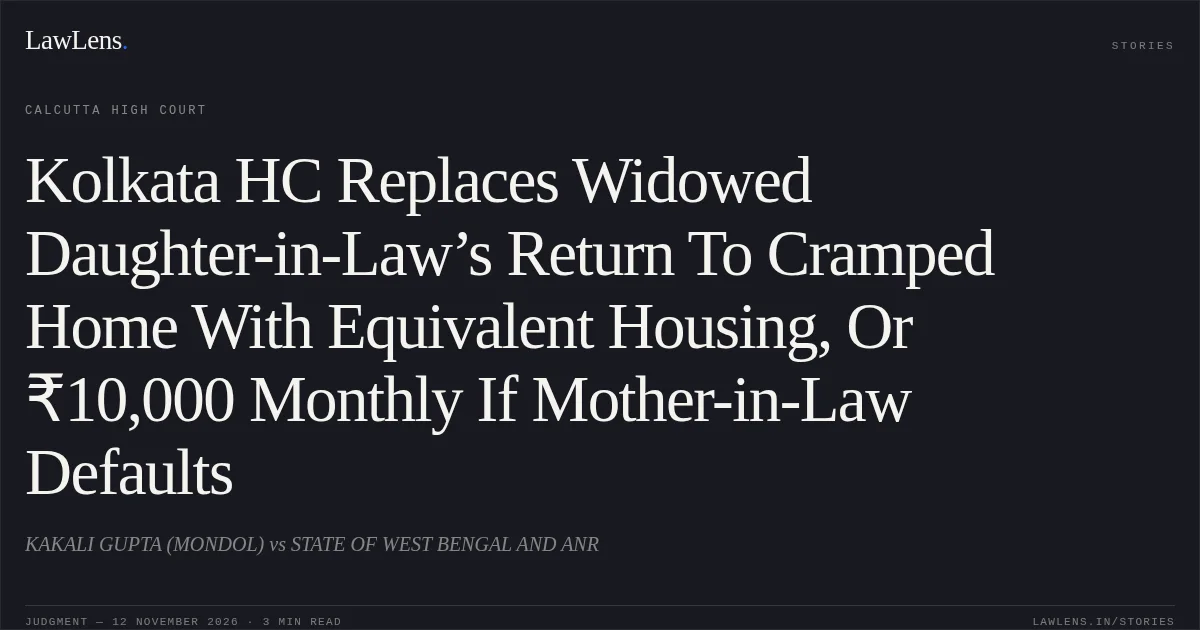
¶ 20–22The petitioner was not granted physical cohabitation in the premises; instead, Opposite Party No. 2 was directed to provide fully self-contained, respectable alternative accommodation of a similar standard in the immediate locality and pay the rent and maintenance charges.
¶ 20–22If she failed to do so, she was directed to pay ₹10,000 per month, effective from the filing of the original PWDV Act application.
¶ 20–22The Magistrate was requested to conclude the proceedings expeditiously, and the Protection Officer was directed to monitor compliance.
¶ 20–22Original Court PDF
KAKALI GUPTA (MONDOL)vsSTATE OF WEST BENGAL AND ANR
Click to open original judgment
Original judgment, available to read, download and summarize on LawLens.in