Facts
The petitioner and respondent were married in 2017 and began living separately in February 2021.
Source reference: para. 2–6The wife filed a petition under Section 125 CrPC in 2022, claiming that she had no income and seeking maintenance.
Source reference: para. 2–6The Magistrate initially awarded interim maintenance, later enhanced in revision.
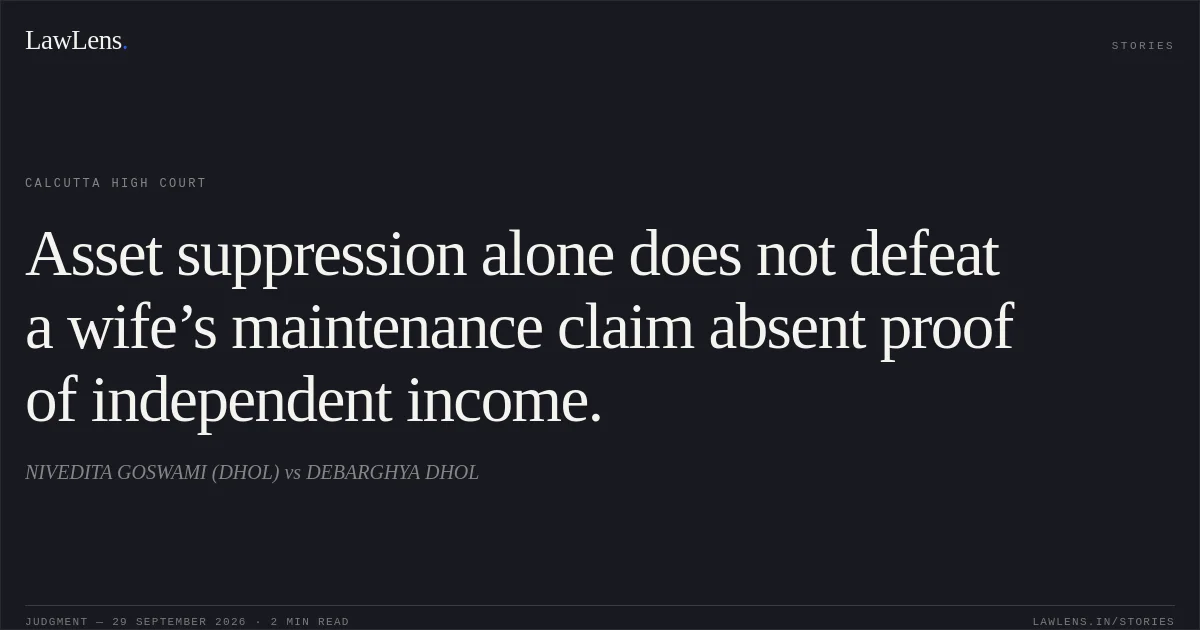
Source reference: para. 2–6After trial, the Magistrate dismissed the maintenance petition, finding that the wife had suppressed funds held in a joint bank account and other deposits, and directed her to repay the interim maintenance.
Source reference: para. 14–18The wife challenged that judgment.
Source reference: para. 21–27The High Court noted both the suppression and the absence of evidence establishing that she had personal income; it also observed that the husband had not filed the required assets-and-liabilities affidavit.
Source reference: para. 21–27Issues
1. Whether the wife’s suppression of financial assets in her maintenance application justified rejecting her claim for maintenance under Section 125 CrPC.
Source reference: para. 21–262. Whether, given the absence of evidence establishing the wife’s own income and the husband’s failure to provide the required financial disclosure, the Magistrate’s outright dismissal of the maintenance petition could stand.
Source reference: para. 25–30Law Applied
Section 125 CrPC provides a summary remedy of social justice for a wife unable to maintain herself; under Section 125(4), a wife is disentitled to maintenance in specified circumstances, including leaving her husband without sufficient reason.
Source reference: para. 19, 22–23Rajnesh v. Neha (2021) 2 SCC 324 requires parties in maintenance proceedings to disclose their assets and liabilities and recognizes maintenance as protection against destitution.
Source reference: para. 7, 22–23, 27–28Shamima Farooqui v. Shahid Khan (2015) 5 SCC 705 emphasizes the financial and emotional hardship addressed by Section 125 CrPC, while Bhagwan Dutt v. Kamla Devi (1975) 2 SCC 386 states that a wife must be unable to maintain herself to claim maintenance under that provision.
Source reference: para. 22–23A spouse’s education or the financial position of her parents does not, by itself, disentitle her from maintenance.
Source reference: para. 7, 23–24The Court also considered the principle that a party seeking relief must make full and truthful disclosure.
Source reference: para. 13Reasoning
The wife had failed to disclose a substantial balance in a joint account and other deposits, and the Court agreed with the Magistrate’s criticism of that conduct.
Source reference: para. 16–18, 21, 29However, the record did not establish that she had personal income, and the husband had not filed the assets-and-liabilities affidavit required by Rajnesh or otherwise established his actual income.
Source reference: para. 23, 25–27The Court therefore held that the wife’s suppression, although material, did not justify outright denial of the statutory remedy without a proper assessment of both parties’ finances and the circumstances of their separation.
Source reference: para. 26–29It considered a fresh proceeding with full financial disclosure necessary to determine entitlement and quantum.
Source reference: para. 28Holding
The High Court allowed the revision and set aside the Magistrate’s order dismissing the maintenance petition.
It directed the wife to file a fresh application under Section 125 CrPC within four weeks and serve it on the husband; the Magistrate was directed to decide it in accordance with law after the parties filed complete assets-and-liabilities affidavits.
Source reference: para. 32Any maintenance awarded would take effect from the date of the fresh application.
Source reference: para. 32Acts & Sections Cited
2 provisions across 1 statute referred to in this judgment. Each provision opens on LawLens.
Code of Criminal Procedure, 19732
Original Court PDF
NIVEDITA GOSWAMI (DHOL)vsDEBARGHYA DHOL
Click to open original judgment
Original judgment, available to read, download and summarize on LawLens.in