Facts
The petitioner-company was awarded a contract for construction and dredging work relating to the Flood Spill Channel across Hokersar Wetland pursuant to an e-NIT issued on 17 July 2018. Its bid was accepted, a Letter of Intent was issued on 15 September 2018, and the work was completed in 2020.
Source reference: p.1–2, paras. 2–3On 18 April 2025, the Anti-Corruption Bureau registered FIR No. 7/2025 under Section 5(1)(d) of the Jammu and Kashmir Prevention of Corruption Act and Section 120-B of the RPC in connection with the project.
Source reference: p.2, para. 2The petitioner separately challenged the FIR in CRM(M) No. 580/2025, in which the Court directed the ACB not to file a charge-sheet without its permission.
Source reference: p.2, para. 3During the pendency of those proceedings, the Directorate of Enforcement issued summons dated 17 September 2025 under Section 50 of the Prevention of Money Laundering Act, 2002 (PMLA), requiring the company’s Director to appear in relation to the FIR.
Source reference: p.2–3, para. 4The Enforcement Directorate had also registered ECIR No. SRZO/08/2025 dated 30 July 2025.
Source reference: p.5, para. 11The petitioner challenged the summons, the ECIR, and the underlying PMLA proceedings on the ground that the alleged predicate offence was not a scheduled offence after Section 13(1)(d) of the Prevention of Corruption Act, 1988 was omitted by the 2018 amendment.
Source reference: p.3–5, paras. 5–10Issues
1. Whether, after the omission of Section 13(1)(d) of the Prevention of Corruption Act, 1988, there remained no provision in the Central Act corresponding in pari materia to Section 5(1)(d) of the J&K Prevention of Corruption Act?
Source reference: p.6, para. 13(i)2. Whether, after the Prevention of Corruption (Amendment) Act, 2018, the proceedings initiated by the Enforcement Directorate under the PMLA could be sustained on the basis of the alleged offence under Section 5(1)(d) of the J&K Prevention of Corruption Act?
Source reference: p.6, para. 13(ii)Law Applied
The Court applied Sections 2(1)(u), 2(1)(y), 2(2), and 3 of the PMLA. “Proceeds of crime” under Section 2(1)(u) must be property derived or obtained, directly or indirectly, from criminal activity relating to a scheduled offence, and the commission of a scheduled offence is therefore essential to a money-laundering prosecution.
Source reference: p.7, paras. 15–17Under Section 2(2), where a Central enactment is not in force in a particular area, references to that enactment in the PMLA Schedule are construed as references to the corresponding law in force in that area.
Source reference: p.9, para. 18The Court relied on Vijay Madanlal Choudhary v. Union of India, 2022 SCC OnLine SC 929, which held that PMLA action requires a registered or otherwise legally pending scheduled offence and cannot continue where the person is finally discharged, acquitted, or the scheduled offence is quashed.
Source reference: p.7–8, para. 16It further held that amended Section 7 of the Central Prevention of Corruption Act, which criminalises a public servant obtaining or accepting an undue advantage by abusing official position or through corrupt or illegal means, substantially covers the conduct formerly addressed by Section 13(1)(d) and is a scheduled offence under Paragraph 8 of the PMLA Schedule.
Source reference: p.13–18, paras. 24–32Reasoning
The Court compared Section 5(1)(d) of the J&K Prevention of Corruption Act with the former Section 13(1)(d) of the Central Act and accepted that the latter had been omitted in 2018.
Source reference: p.10–11, paras. 21–22However, it examined the Statement of Objects and Reasons and the amended Section 7, concluding that Section 13(1)(d) was deleted because its subject matter had been incorporated into the broader offence of bribery under amended Section 7.
Source reference: p.11–15, paras. 23–28Unlike Section 4-A of the J&K Act, amended Section 7 covers obtaining an undue advantage for oneself or another by abusing public office or by corrupt or illegal means, thereby corresponding to Section 5(1)(d) of the J&K Act.
Source reference: p.16–17, paras. 29–30Since amended Section 7 appears in Paragraph 8 of the PMLA Schedule, Section 2(2) operated to treat the corresponding J&K offence as a scheduled offence.
Source reference: p.18, paras. 31–32Consequently, the existence of a scheduled predicate offence enabled the Enforcement Directorate to register the ECIR and issue summons under Section 50 of the PMLA.
Source reference: p.18–19, paras. 31–33Holding
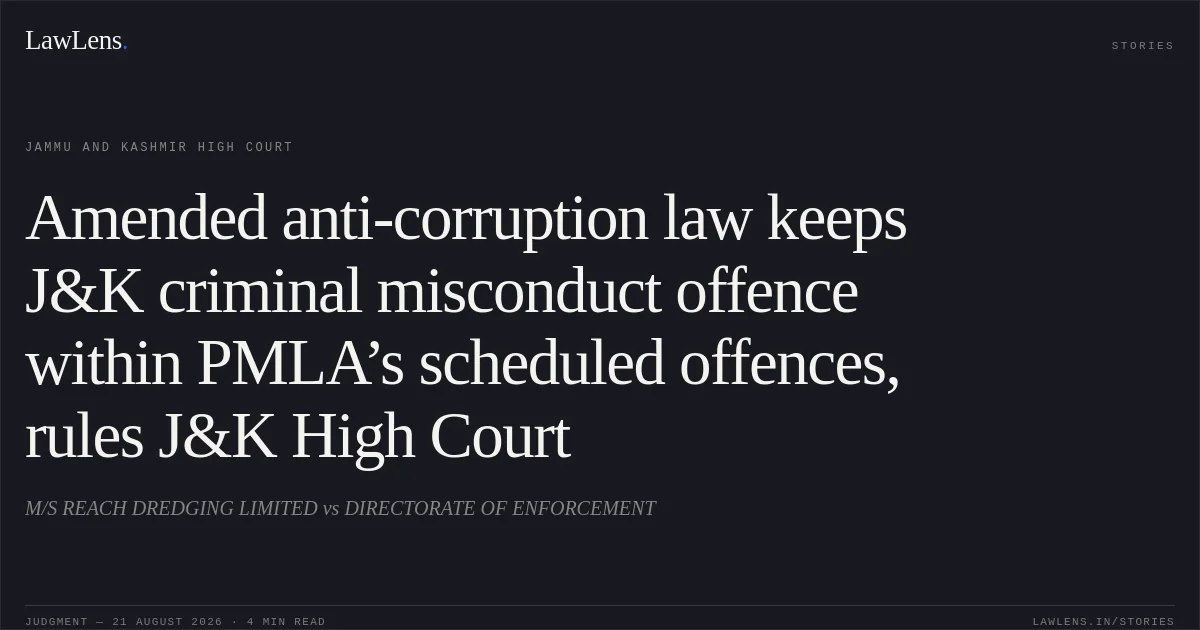
The Court answered the first issue in the negative, holding that amended Section 7 of the Central Prevention of Corruption Act is the provision corresponding to Section 5(1)(d) of the J&K Prevention of Corruption Act.
Accordingly, the alleged offence qualified as a scheduled offence through Section 2(2) of the PMLA, and the Enforcement Directorate had jurisdiction to register the ECIR and issue the impugned summons.
Source reference: p.19, para. 34The petition challenging the summons, ECIR, and underlying PMLA proceedings was dismissed for lack of merit.
Source reference: p.19, para. 34Acts & Sections Cited
14 provisions across 3 statutes referred to in this judgment. Each provision opens on LawLens.
Bharatiya Nagarik Suraksha Sanhita, 20231
Prevention of Money-Laundering Act, 20024
Prevention of Corruption Act, 1988
Original Court PDF
M/S REACH DREDGING LIMITEDvsDIRECTORATE OF ENFORCEMENT
Click to open original judgment
Original judgment, available to read, download and summarize on LawLens.in