Facts
The prosecution arose from Bodhgaya P.S. Case No. 109 of 2017.
Source reference: paras. 4–5; p. 2–4The victim’s mother alleged that on 15 February 2017, the appellant lured her approximately six-year-old daughter from near Tola Sevak School by offering her money and chocolate, took her to the bank of a pyne, and committed rape.
Source reference: paras. 4–5; p. 2–4The appellant was chargesheeted and tried under Section 376 IPC and Section 6 of the POCSO Act.
Source reference: paras. 7, 26–29; pp. 4–16The trial court convicted the appellant under Section 376 IPC and Section 6 of the POCSO Act and sentenced him to twenty years’ rigorous imprisonment with a fine of ₹10,000, with six months’ rigorous imprisonment in default.
Source reference: paras. 2–3, 12; pp. 1–2, 6Issues
Whether the prosecution proved beyond reasonable doubt that the appellant committed aggravated penetrative sexual assault/rape upon the minor victim, notwithstanding the alleged inconsistencies, absence of an eyewitness, and the medical opinion that rape was not certain?
Source reference: paras. 22–35; pp. 8–19Whether the trial court could impose the amended minimum sentence of twenty years under Section 6 of the POCSO Act when the occurrence took place before the amendment came into force?
Source reference: paras. 36–40; pp. 20–22Law Applied
The Court applied Section 376 IPC and Section 6 of the POCSO Act to the alleged rape and aggravated penetrative sexual assault of the minor.
Source reference: no citationSection 29 of the POCSO Act requires a presumption against the accused once the foundational facts establishing the commission of the offence are proved, shifting the evidentiary burden to the accused to rebut the presumption on a preponderance of probability.
Source reference: para. 34; p. 19Section 42 of the POCSO Act governs overlapping punishment under the IPC and the POCSO Act, thereby avoiding a separate sentence for the IPC offence in the present case.
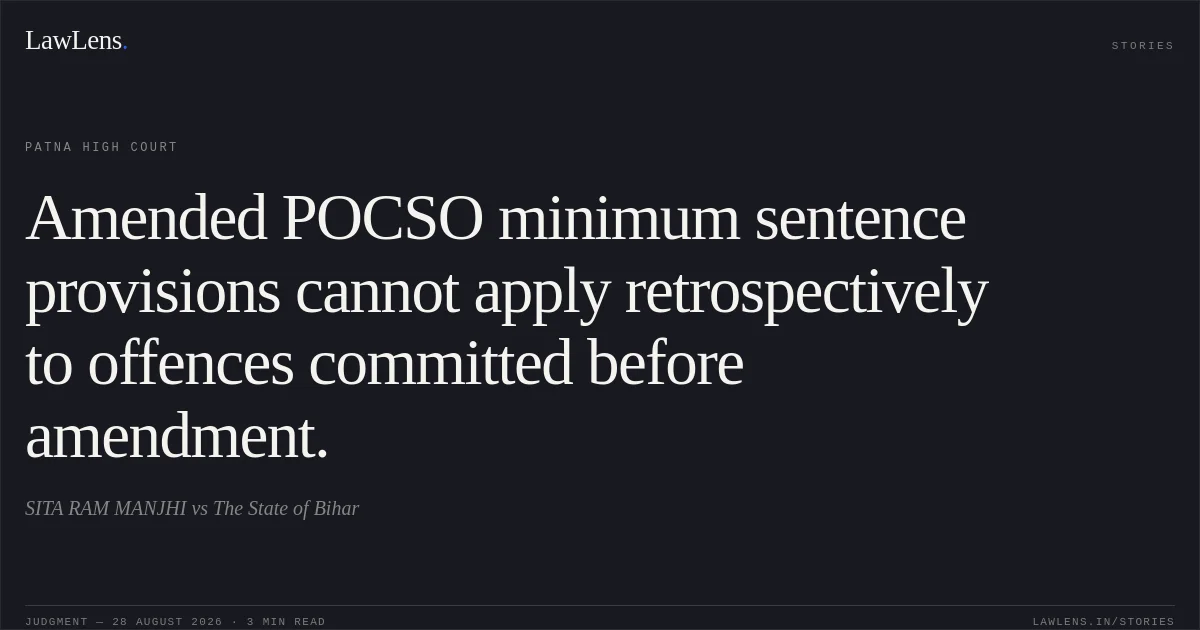
Source reference: para. 36; p. 20The Court further applied the principle that an amended penal provision increasing the minimum punishment cannot be retrospectively applied to an offence committed before the amendment; consequently, the pre-amendment version of Section 6, prescribing a minimum of ten years’ rigorous imprisonment, governed the case.
Source reference: paras. 36–40; pp. 20–22Reasoning
The Court found the victim competent to testify and treated her identification of the appellant and account of the “dirty act” as credible and substantially consistent.
Source reference: paras. 30–31; pp. 16–18Her evidence was corroborated by the mother’s testimony regarding the child’s immediate return while crying and bleeding, by PW-4’s evidence placing the appellant near the school where the victim was playing, and by the medical and FSL evidence showing genital injury/inflammation, blood, and semen on the victim’s frock.
Source reference: paras. 23, 28–29, 33–35; pp. 9–19The Court held that minor discrepancies concerning how the child returned home were immaterial and that the defence’s inconsistent cross-examination did not create a credible alternative version or rebut the Section 29 presumption.
Source reference: paras. 32–35; pp. 17–19However, because the offence occurred on 15 February 2017, before the 16 August 2019 amendment raising the minimum sentence under Section 6 to twenty years, the trial court’s sentence was legally excessive.
Source reference: paras. 36–40; pp. 20–22Considering the applicable statutory minimum of ten years and the circumstances urged on behalf of the appellant, the Court reduced the sentence to twelve years’ rigorous imprisonment.
Source reference: paras. 36–40; pp. 20–22Holding
The conviction under Section 376 IPC and Section 6 of the POCSO Act was upheld.
No separate sentence was imposed under Section 376 IPC in view of Section 42 of the POCSO Act.
Source reference: paras. 35–36, 41–42; pp. 19–22The sentence under Section 6 of the POCSO Act was modified from twenty years to twelve years’ rigorous imprisonment, with a fine of ₹10,000; in default of payment, the appellant must undergo a further six months’ rigorous imprisonment.
Source reference: para. 40; p. 22The appeal was partly allowed.
Source reference: paras. 35–36, 41–42; pp. 19–22Acts & Sections Cited
6 provisions across 3 statutes referred to in this judgment. Each provision opens on LawLens.
Indian Penal Code, 18601
Protection of Children from Sexual Offences Act, 20123
Code of Criminal Procedure, 19732
Original Court PDF
SITA RAM MANJHIvsThe State of Bihar
Click to open original judgment
Original judgment, available to read, download and summarize on LawLens.in
![Courts will not interfere with transfers absent mala fides or violation of statutory rules.. M Ramya vs EMPLOYEES STATE INSURANCE CORPORATION (ESIC). CAT - ['Chennai']. LawLens](/stories/thumbnails/courts-will-not-interfere-with-transfers-absent-mala-fides-or-violation-of-statutory-rules-a6845e9ca6f548fca284c51c8351957f.webp)
![Courts cannot direct one-time recruitment age relaxation absent authority in the governing rules or advertisement.. UT OF PUDUCHERRY vs M ANDAL. CAT - ['Chennai']. LawLens](/stories/thumbnails/courts-cannot-direct-one-time-recruitment-age-relaxation-absent-authority-in-the-governing-895d78fde47143e2a8ed0207c4b6a44f.webp)
![A review cannot correct an allegedly erroneous decision absent an error apparent on the record.. Ajit Kumar Jha vs RAILWAY BOARD. CAT - ['Delhi']. LawLens](/stories/thumbnails/a-review-cannot-correct-an-allegedly-erroneous-decision-absent-an-error-apparent-on-the-re-8ac952fd4eba470c92f7da20af72a220.webp)