Facts
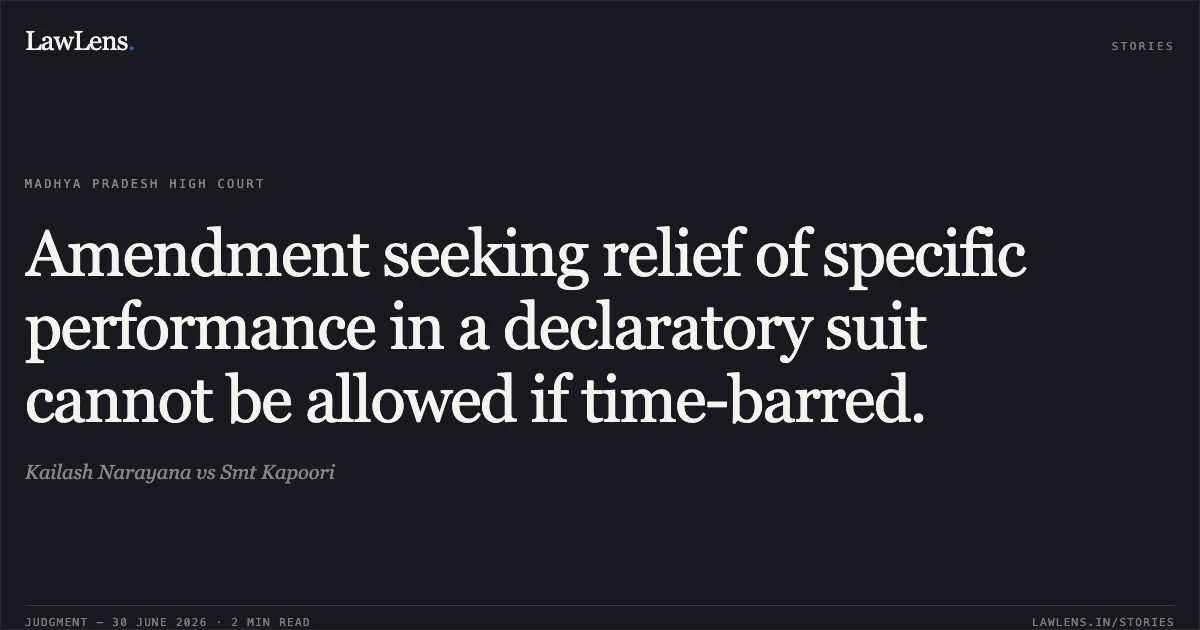
The petitioner filed a civil suit on October 15, 2015, seeking a decree for declaration of ownership, possession, and permanent injunction regarding certain lands.
Source reference: para 2.1The suit was based on an agreement to sell dated October 10, 2005, which stipulated that a registered sale deed be executed by August 30, 2006 (later extended by a subsequent agreement to February 20, 2010).
Source reference: para 2.1, 7During the evidence stage on February 7, 2023, the petitioner filed an application under Order VI Rule 17 of the CPC to amend the plaint to include the relief of specific performance of the agreement.
Source reference: para 3The Trial Court rejected the application on February 16, 2023, citing the change in the nature of the suit, valuation issues, and the belated stage of the application.
Source reference: para 5Issues
1. Whether the proposed amendment seeking the relief of specific performance after a period of nearly seven years from the filing of the suit and over a decade after the cause of action is permissible under Order VI Rule 17 of the CPC.
Source reference: para 11, 122. Whether the amendment would fundamentally change the nature and character of the original suit for declaration and possession.
Source reference: para 12Law Applied
Order VI Rule 17 of the Code of Civil Procedure, 1908, which governs the amendment of pleadings, emphasizing that while amendments necessary for determining the real controversy should be allowed, they must not cause injustice or introduce time-barred claims.
Source reference: para 10Principles culled out in LIC v. Sanjeev Builders (P) Ltd. (2022), which dictate that amendments should be disallowed if they introduce a time-barred claim [Rule 71.4.1], change the nature of the suit [Rule 71.4.2], or set up an entirely new case foreign to the original plaint [Rule 71.10].
Source reference: no citationArticle 54 of the Limitation Act, 1963, which prescribes a three-year limitation period for filing a suit for specific performance.
Source reference: para 7, 11Reasoning
The Court observed that according to the agreement to sell, the sale deed was to be executed by 2009-2010; however, the amendment seeking specific performance was only moved in 2023, making the claim prima facie barred by limitation.
Source reference: para 11Applying the Sanjeev Builders test, the Court found that the introduction of a time-barred claim is a valid ground for refusal.
Source reference: para 11The original suit was for declaration of ownership and possession, whereas specific performance is a distinct cause of action; allowing the amendment would fundamentally alter the character of the suit from a title-based claim to a contract-based claim.
Source reference: para 12The court also noted the petitioner’s failure to explain the seven-year delay in seeking the amendment, concluding that such a late introduction would cause irreparable prejudice to the respondents.
Source reference: para 12Holding
The Court answered the issues in the negative, holding that the Trial Court did not commit any jurisdictional error or perversity in rejecting the amendment application.
The High Court affirmed that the proposed amendment was both time-barred and altered the nature of the suit. Consequently, the petition was dismissed, and the Trial Court's order dated February 16, 2023, was upheld.
Source reference: para 11, 12, 17Acts & Sections Cited
3 provisions across 1 statute referred to in this judgment. Each provision opens on LawLens.
Code of Civil Procedure, 19083
Original Court PDF
Kailash NarayanavsSmt Kapoori
Click to open original judgment
Original judgment, available to read, download and summarize on LawLens.in