Facts
The prosecution alleged that accused No. 3, the deceased Gurappa’s wife, instigated accused No. 1, with the assistance of accused No. 2, to murder Gurappa because of their alleged relationship.
Source reference: pp. 3–6It alleged that accused Nos. 1 and 2 abducted Gurappa in a vehicle, strangled him with wire and left his body in a sugarcane field.
Source reference: pp. 3–6The Sessions Court acquitted all three accused of offences under Sections 109, 120(B), 364, 302 and 201 read with Section 34 of the IPC, finding the prosecution had not proved its case beyond reasonable doubt.
Source reference: pp. 7–10The State appealed against the acquittal under Section 378(1) and (3) of the Cr.P.C., corresponding to Section 419(1) and (3) of the BNSS.
Source reference: pp. 3, 10Issues
Whether the State proved that the Trial Court’s acquittal was reached without proper appreciation of the evidence.
Source reference: p. 12, para. 11Whether the evidence established an unbroken chain of circumstances proving the accused’s guilt for the charged offences.
Source reference: pp. 26–29, paras. 38–43Law Applied
In an appeal against acquittal under Section 378 Cr.P.C. (corresponding here to Section 419 BNSS), the appellate court considers whether the Trial Court’s view was a possible one on the evidence; the presumption of innocence is reinforced by acquittal, and interference requires scrutiny on accepted legal principles.
Source reference: p. 30, para. 46In a case based entirely on circumstantial evidence, guilt must be established through an unbroken chain of circumstances; doubtful recoveries or seizures may undermine that chain.
Source reference: pp. 26–27, paras. 39–40The Court also treated an alleged confession made while the accused was in police custody as inadmissible under Section 26 of the Indian Evidence Act.
Source reference: p. 23, para. 31Reasoning
The Court found that the prosecution case rested on circumstantial evidence and that no witness testified to seeing the abduction or murder.
Source reference: p. 28, para. 41; p. 29, para. 43The father’s account was inconsistent as to when and how he learned of the murder, and the alleged confession attributed to accused No. 3 was inadmissible.
Source reference: pp. 14–16, paras. 15–17; p. 23, para. 31Other evidence was also unreliable or insufficient: a witness to the inquest had not seen the body; the alleged recovery and seizure evidence was questioned; clothes were seized before the FIR was registered; and the prosecution did not explain the delay in lodging the complaint.
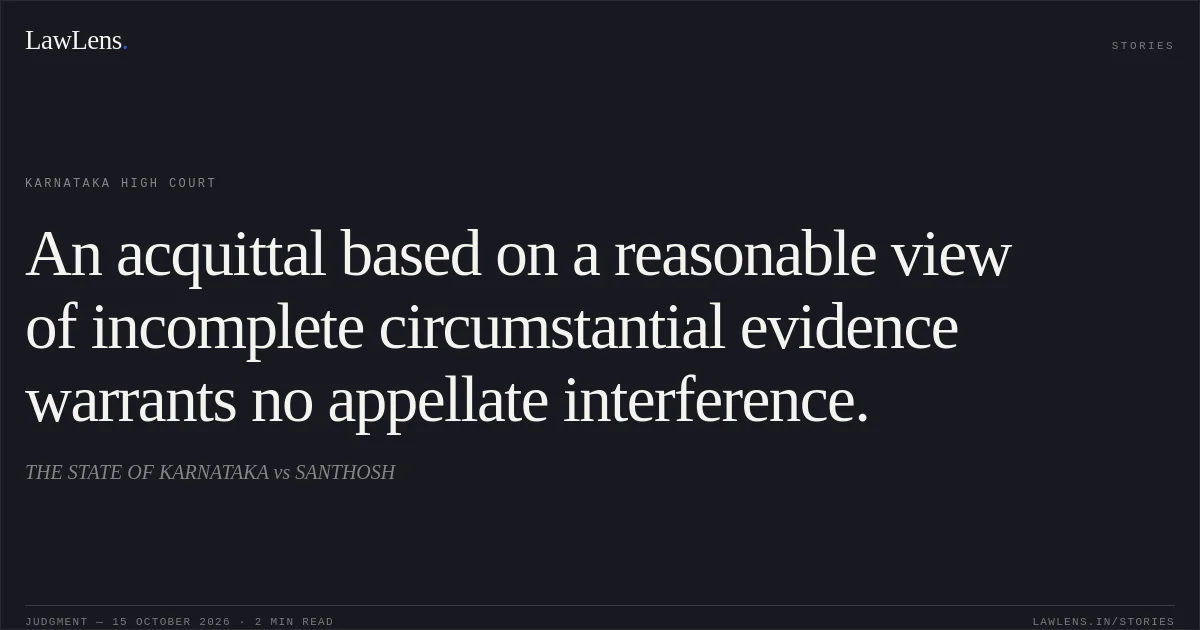
Source reference: pp. 16–18, paras. 18–22; pp. 26–28, paras. 38–42In those circumstances, the Court held that the prosecution had not established the required chain of circumstances and that the Trial Court’s acquittal was a permissible view of the evidence.
Source reference: pp. 28–31, paras. 43–47Holding
The High Court answered the issues against the State, found no error warranting interference with the acquittal, and dismissed the appeal.
It confirmed the judgment and order of acquittal dated 13 December 2024 in Sessions Case No. 6/2023.
Source reference: pp. 31–32, paras. 47–48 and OrderActs & Sections Cited
9 provisions across 3 statutes referred to in this judgment. Each provision opens on LawLens.
Bharatiya Nagarik Suraksha Sanhita, 20231
Code of Criminal Procedure, 19733
Indian Penal Code, 18605
Original Court PDF
THE STATE OF KARNATAKAvsSANTHOSH
Click to open original judgment
Original judgment, available to read, download and summarize on LawLens.in