Facts
The prosecution alleged that on 14 July 2018, a police party apprehended Sandeep near Sadhupul and recovered 1 kg of charas from a carry bag in his possession. He was charged under Section 20 of the Narcotic Drugs and Psychotropic Substances Act, 1985 (NDPS Act).
Source reference: paras. 3(a)–(d), 4–8, 27–35The Special Judge acquitted Sandeep, and the State appealed against that acquittal.
Source reference: paras. 8–10Issues
Whether the Trial Court’s acquittal rested on a reasonable, possible view of the evidence or was perverse so as to warrant appellate interference
Source reference: paras. 15–21Whether the prosecution proved beyond reasonable doubt that Sandeep was in conscious possession of charas, given the discrepancies in the witness testimony and the independent witness’s failure to support the recovery
Source reference: paras. 27–36Law Applied
Section 20 of the NDPS Act prescribes punishment for the relevant cannabis-related offence; the prosecution must prove the accused’s guilt beyond reasonable doubt.
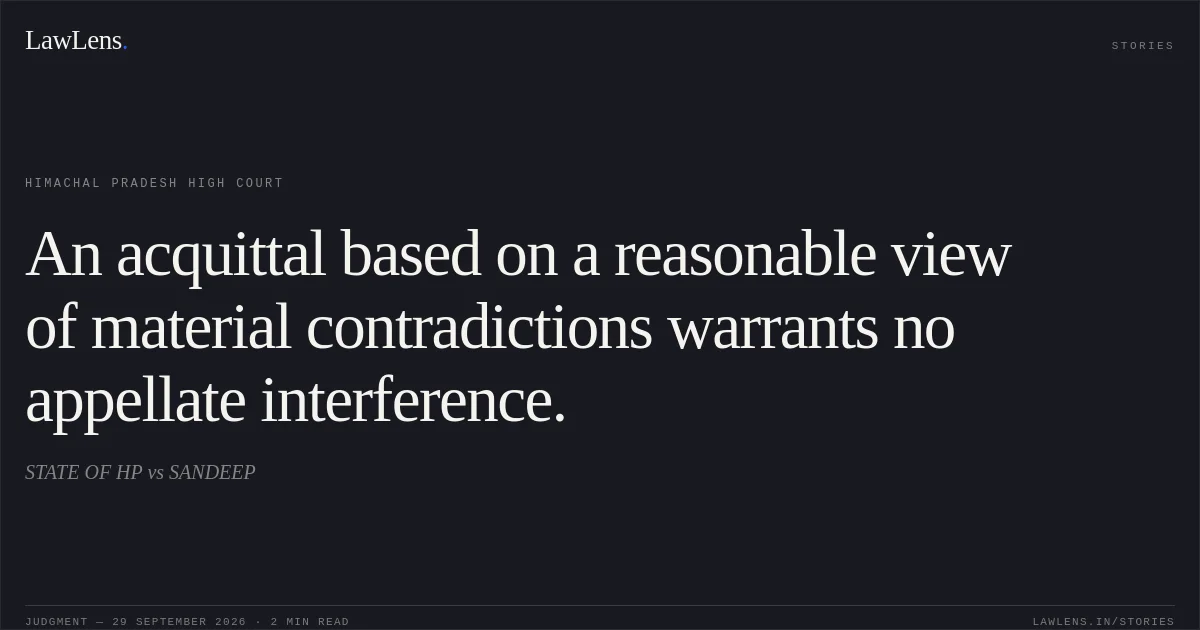
Source reference: paras. 2, 22In an appeal against acquittal, the appellate court may reappraise the evidence but must give weight to the strengthened presumption of innocence and the Trial Court’s assessment. If the Trial Court’s view is reasonably possible, acquittal cannot be reversed merely because another view is available; interference is warranted where the acquittal is perverse, rests on a misreading or omission of material evidence, or no reasonable view other than guilt is possible.
Source reference: paras. 16–21, applying Muralidhar alias Gidda v. State of Karnataka, (2014) 5 SCC 730; Rajesh Prasad v. State of Bihar, (2022) 3 SCC 471; H.D. Sundara v. State of Karnataka, (2023) 9 SCC 581; Jafarudheen v. State of Kerala, (2022) 8 SCC 440; and Surendra Singh v. State of Uttarakhand, (2025) 5 SCC 433Reasoning
Applying the acquittal-appeal standard, the Court found that the Trial Court’s assessment was a possible view of the evidence.
Source reference: paras. 23–36The independent witness did not corroborate the prosecution’s account of the recovery and seizure, while the police witnesses gave materially inconsistent accounts of their movements, the alleged apprehension, and related timings. The discrepancies concerning the rukka and FIR further weakened the prosecution’s account. The Court therefore concluded that the evidence did not establish the alleged possession beyond reasonable doubt and that the Trial Court’s acquittal was not perverse or otherwise fit for appellate interference.
Source reference: paras. 23–36Holding
The Court held that the State had not shown grounds to disturb the acquittal.
The appeal was dismissed, leaving the Trial Court’s acquittal of Sandeep under Section 20 of the NDPS Act undisturbed. The Court also directed the appellant to furnish bail bonds under Section 437-A of the Code of Criminal Procedure, 1973, within four weeks, effective for six months.
Source reference: paras. 36–38Acts & Sections Cited
9 provisions across 3 statutes referred to in this judgment. Each provision opens on LawLens.
Narcotic Drugs and Psychotropic Substances Act, 19852
Code of Criminal Procedure, 19736
Bharatiya Nagarik Suraksha Sanhita, 20231
Original Court PDF
STATE OF HPvsSANDEEP
Click to open original judgment
Original judgment, available to read, download and summarize on LawLens.in