Facts
The appellant married Lata in January 2008. The prosecution alleged that, after marriage, the appellant and his mother and sisters subjected Lata to cruelty, harassment, insufficient food, and dowry-related demands. Lata allegedly consumed poison in November 2009 and died during treatment. The appellant was charged with offences under Sections 498-A and 306 of the Indian Penal Code, 1860 (“IPC”), along with the other accused.
Source reference: pp. 1–3, paras. 1–2The Sessions Court found that the prosecution evidence was general, largely hearsay, and affected by omissions and improvements; it also noted the absence of injuries, prior complaints, or proof of unlawful demands, and acquitted all accused.
Source reference: p. 3, para. 3; pp. 10–11, para. 11On the State’s appeal, the High Court upheld the acquittal of the appellant’s mother and sisters but reversed the appellant’s acquittal and convicted him under Sections 498-A and 306 IPC, sentencing him to concurrent terms of four years’ and two years’ rigorous imprisonment respectively, along with fines.
Source reference: p. 4, para. 4Issues
1. Whether the High Court was justified in reversing the appellant’s acquittal without establishing that the Sessions Court’s view was perverse, impossible, or unsupported by the evidence?
Source reference: pp. 7–8, paras. 7, 12–132. Whether the prosecution proved cruelty or harassment punishable under Section 498-A IPC, including any unlawful dowry demand, beyond reasonable doubt?
Source reference: pp. 8–11, paras. 8–113. Whether the evidence established the appellant’s specific abetment, as required by Sections 306 and 107 IPC, of Lata’s suicide?
Source reference: pp. 13–14, paras. 14–15Law Applied
The Court applied Sections 498-A, 306, and 107 IPC. Cruelty under Section 498-A must be proved through legally reliable evidence of wilful conduct or harassment of the statutory nature; mere general allegations or ordinary matrimonial discord are insufficient.
Source reference: pp. 13–14, para. 14Conviction under Section 306 IPC requires proof of specific abetment within the meaning of Section 107 IPC, including intentional aid, instigation, or active participation connected with the suicide.
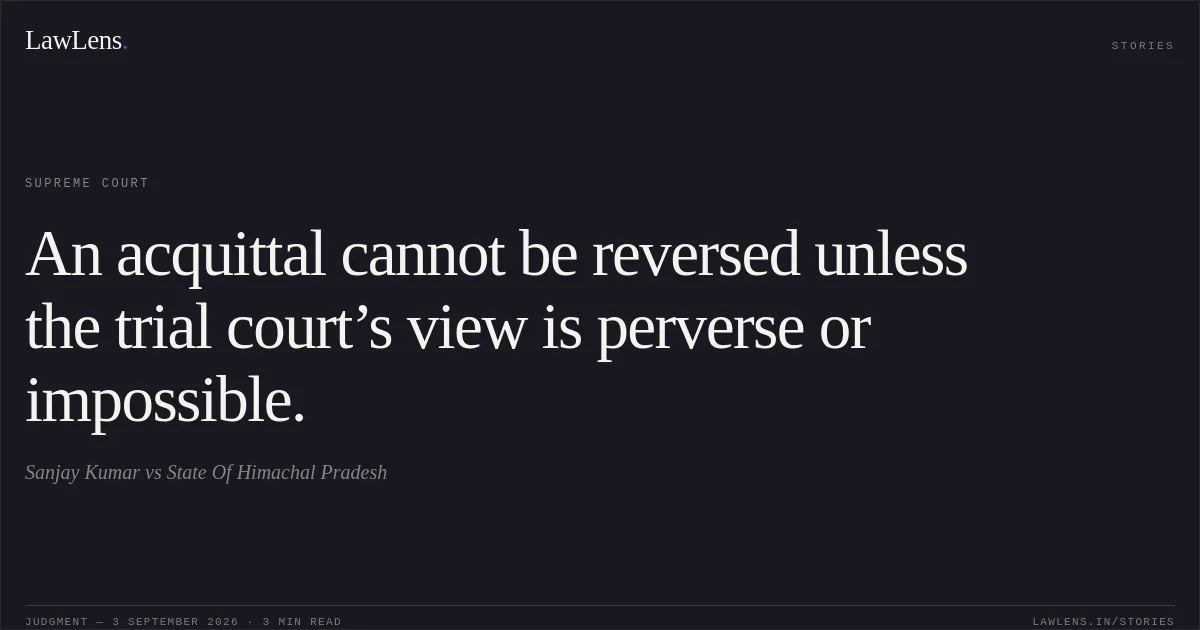
Source reference: pp. 13–14, para. 14In an appeal against acquittal, an appellate court has power to reappreciate the evidence but must give due weight to the trial court’s assessment of witness credibility, the accused’s reinforced presumption of innocence, the benefit of reasonable doubt, and the trial judge’s opportunity to observe witness demeanour. An acquittal should not be reversed unless the trial court’s view is perverse or impossible.
Source reference: pp. 11–13, paras. 12–13*Sheo Swarup v. King-Emperor*, AIR 1934 PC 227(2); *Bhubneshwar Mandal v. State of Bihar*; *State of U.P. v. Samman Dass*, 1972 INSC 11; *Madan Mohan Singh v. State of Gujarat*, 2010 INSC 521.
Source reference: pp. 11–13, paras. 12–13Reasoning
The Supreme Court held that the prosecution witnesses, principally the victim’s relatives, made only general allegations of torture and did not identify specific incidents of cruelty, harassment, or dowry demands. Their testimony contained material omissions and improvements, and they admitted that the appellant and the victim appeared happy during visits and that the victim was treated properly during and after pregnancy.
Source reference: pp. 8–9, paras. 8–9The surrounding evidence also weakened the prosecution case: the neighbour had not heard of matrimonial disputes, no injuries were found, and there was no prior complaint to any authority.
Source reference: pp. 9–10, paras. 10–11In contrast, the appellant promptly sought medical assistance, obtained the pharmacist’s help, arranged transport, and took the victim to hospital after she ingested poison.
Source reference: p. 10, para. 10; p. 14, para. 15The High Court’s conclusion that the appellant had abused and dragged the victim was unsupported by the record and failed to engage with the detailed reasons given by the Sessions Court.
Source reference: p. 11, para. 12Even assuming some matrimonial discord, the evidence did not establish the specific intention, instigation, aid, or other conduct required to constitute abetment of suicide under Sections 107 and 306 IPC.
Source reference: pp. 13–14, paras. 14–15Holding
The Supreme Court answered the issues in favour of the appellant. It held that the prosecution failed to prove either cruelty under Section 498-A IPC or specific abetment of suicide under Sections 107 and 306 IPC beyond reasonable doubt.
The High Court had erred in reversing a reasonably possible acquittal without finding the Sessions Court’s view to be perverse or impossible.
Source reference: pp. 14–15, paras. 16–17The High Court’s judgment dated 17 August 2016 was quashed and set aside; the appellant was acquitted of all charges, and his bail bonds were cancelled.
Source reference: p. 15, paras. 17–18Acts & Sections Cited
2 provisions across 1 statute referred to in this judgment. Each provision opens on LawLens.
Indian Penal Code, 18602
Original Court PDF
Sanjay KumarvsState Of Himachal Pradesh
Click to open original judgment
Original judgment, available to read, download and summarize on LawLens.in