Facts
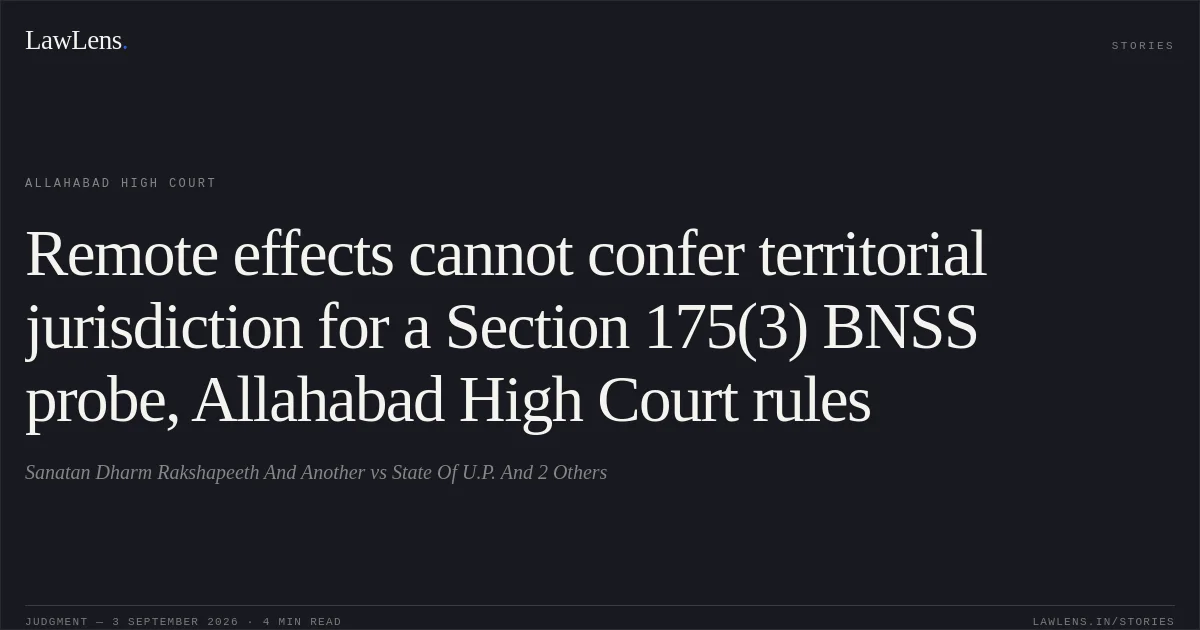
The revisionists challenged the order dated 6 June 2025 by which the Special Judge, Mathura rejected their application under Section 175(3) of the Bharatiya Nagarik Suraksha Sanhita, 2023 (BNSS), seeking registration of an FIR against opposite party no. 2, a Cabinet Minister, for allegedly interfering with and delaying an investigation arising from an earlier FIR dated 7 April 2022.
Source reference: para. 2–3, 14–15The earlier FIR, investigated by the Vigilance Department at Meerut, concerned alleged fraudulent mutation and use of a forged will relating to property situated at Vrindavan, Mathura, and was registered against, inter alia, opposite party no. 3.
Source reference: para. 11The revisionists alleged that opposite party no. 2 forwarded, from Lucknow, a representation submitted by the wife of opposite party no. 3, requesting re-verification of the disputed signature and further investigation.
Source reference: para. 13, 24–26A charge-sheet in the earlier case had already been filed at Meerut on 4 October 2024 and cognizance had been taken on 7 October 2024; thereafter, on 24 October 2024, the Home Department directed further investigation under Section 173(8) CrPC.
Source reference: para. 12, 48–51Issues
Whether a Magistrate at Mathura had territorial jurisdiction under Section 175(3) read with Section 175(1) BNSS to direct registration and investigation of an alleged offence arising from a letter written and addressed at Lucknow, concerning an investigation pending at Meerut.
Source reference: para. 20–22, 25, 32Whether the alleged forwarding of the representation by opposite party no. 2 disclosed offences under Sections 61, 45, 49 or 60 of the Bharatiya Nyaya Sanhita, 2023, or Sections 12 and 13 of the Prevention of Corruption Act, 1988.
Source reference: para. 40–47, 53–58Whether the alleged delay or interference in the earlier investigation constituted a legally relevant consequence at Mathura so as to attract Section 199 BNSS.
Source reference: para. 34–39, 59–61Law Applied
Section 175(3) BNSS, analogous to Section 156(3) CrPC, empowers a Magistrate to order only such investigation as is contemplated by Section 175(1); consequently, the Magistrate must possess territorial jurisdiction to inquire into or try the alleged offence under Chapter XIV BNSS.
Source reference: para. 20–22Under Section 199 BNSS, an offence arising from an act and its consequence may be tried where the act was done or where the legally relevant consequence ensued; a remote, incidental or collateral consequence is insufficient, and the consequence must form part of or be materially connected with the offence.
Source reference: para. 34–39The Court relied on Central Bureau of Investigation v. State of Rajasthan, (2001) 3 SCC 333, and Yashpal v. State of U.P., 2010:AHC:113134, concerning the territorial limits of a Magistrate’s power under Section 156(3) CrPC, and on Kashi Ram Mehta v. Emperor, AIR 1934 All 499, regarding the requirement that the consequence under the corresponding provision must be an essential ingredient of the offence.
Source reference: para. 21–23, 39Sections 61, 45 and 49 BNS require, respectively, criminal conspiracy, abetment, and commission of the abetted act; Section 60 concerns concealment or false representation relating to a criminal design; and Section 13 of the Prevention of Corruption Act requires criminal misconduct involving specified forms of dishonest misappropriation or illicit enrichment.
Source reference: para. 40, 53–58Reasoning
The Court held that the alleged offending act was the writing and forwarding of the letter dated 16 July 2024 at Lucknow to the Home Department at Lucknow, while the investigation in question was being conducted at Meerut.
Source reference: para. 25, 32, 59–60The letter merely forwarded a representation and requested action “in accordance with law”; it contained no coercive, unlawful or positive direction to obstruct or delay the investigation.
Source reference: para. 47, 53–55The subsequent direction for further investigation was issued by the Home Department on 24 October 2024, after submission of the charge-sheet and taking of cognizance, and was not issued by opposite party no. 2.
Source reference: para. 48–52Accordingly, the forwarding of the representation did not disclose an agreement to commit an illegal act, intentional aid, instigation, concealment, or criminal misconduct under the statutory provisions invoked.
Source reference: para. 42–45, 53–58Further, the alleged delay or interference related, at most, to the investigation at Meerut; the location of the underlying property at Mathura was too remote and collateral to constitute a legally relevant consequence under Section 199 BNSS.
Source reference: para. 37–39, 59–61Since neither the alleged criminal act nor a legally relevant consequence occurred within Mathura’s territorial jurisdiction, the Magistrate lacked jurisdiction under Section 175(3) BNSS.
Source reference: para. 22, 55Holding
The High Court answered the jurisdictional and substantive questions against the revisionists.
It held that the letter dated 16 July 2024, being a lawful forwarding of a representation without any unlawful direction, did not prima facie constitute the alleged offences under the BNS or the Prevention of Corruption Act, and that no legally relevant consequence ensued at Mathura under Section 199 BNSS.
Source reference: para. 55, 57–61The order dated 6 June 2025 rejecting the application under Section 175(3) BNSS was upheld, and the criminal revision was dismissed as lacking merit.
Source reference: para. 62Acts & Sections Cited
73 provisions across 5 statutes referred to in this judgment. Each provision opens on LawLens.
Bharatiya Nagarik Suraksha Sanhita, 2023
Prevention of Corruption Act, 19883
Bharatiya Nyaya Sanhita, 2023
Indian Penal Code, 18605
Code of Criminal Procedure, 19735
Original Court PDF
Sanatan Dharm Rakshapeeth And AnothervsState Of U.P. And 2 Others
Click to open original judgment
Original judgment, available to read, download and summarize on LawLens.in