Facts
Respondent No. 2, who was allegedly a permanent resident of Italy and had longstanding family relations with the petitioners, lodged FIR No. 21 dated 5 February 2020 at Police Station Civil Lines, Batala, under Sections 419, 420, 467, 468, 471 and 120-B IPC, corresponding to Sections 319, 318(4), 338, 339, 341 and 61 of the BNS.
Source reference: paras. 1–3.1The prosecution case substantially alleged that petitioner No. 1 impersonated the complainant by representing his father’s name as “Surta Singh” in sale deeds concerning the complainant’s property.
Source reference: paras. 1–3.1The petitioners disputed the allegation and asserted that petitioner No. 1’s father was also named “Surta Singh”; they further claimed that respondent No. 2 had obtained ₹8 lakhs from them on the assurance of facilitating their son’s travel and settlement abroad and had initiated the criminal proceedings to avoid repayment and harass them.
Source reference: paras. 1–3.1, 9The police presented challan dated 10 December 2024, after which the Judicial Magistrate First Class, Batala framed charges against the petitioners by order dated 21 April 2026.
Source reference: paras. 1, 3.2The petitioners invoked Section 528 of the Bharatiya Nagarik Suraksha Sanhita, 2023, corresponding to Section 482 Cr.P.C., seeking quashing of the FIR, the order framing charges and all consequential proceedings.
Source reference: paras. 1, 3.2Issues
Whether the FIR and the material collected during investigation, taken at face value, disclosed the essential ingredients of the alleged cognizable offences so as to justify continuation of the criminal proceedings?
Source reference: paras. 6.1, 8Whether the petitioners’ defence concerning the identity of petitioner No. 1’s father, the correctness of the sale-deed particulars and the alleged absence of impersonation could be adjudicated in proceedings under Section 528 BNSS?
Source reference: paras. 9–9.3Whether the order framing charges dated 21 April 2026 suffered from illegality, perversity or jurisdictional infirmity warranting interference by the High Court?
Source reference: para. 9.5Law Applied
The Court applied Section 528 of the Bharatiya Nagarik Suraksha Sanhita, 2023, corresponding to Section 482 Cr.P.C., which preserves the High Court’s inherent power to prevent abuse of the process of law and secure the ends of justice.
Source reference: para. 1It relied on the principles in State of Haryana v. Ch. Bhajan Lal, 1991 (1) RCR (Criminal) 383, under which quashing may be justified, illustratively, where the allegations even at face value do not constitute an offence, are absurd or inherently improbable, or the proceedings are manifestly mala fide; however, the power must be exercised sparingly and with circumspection.
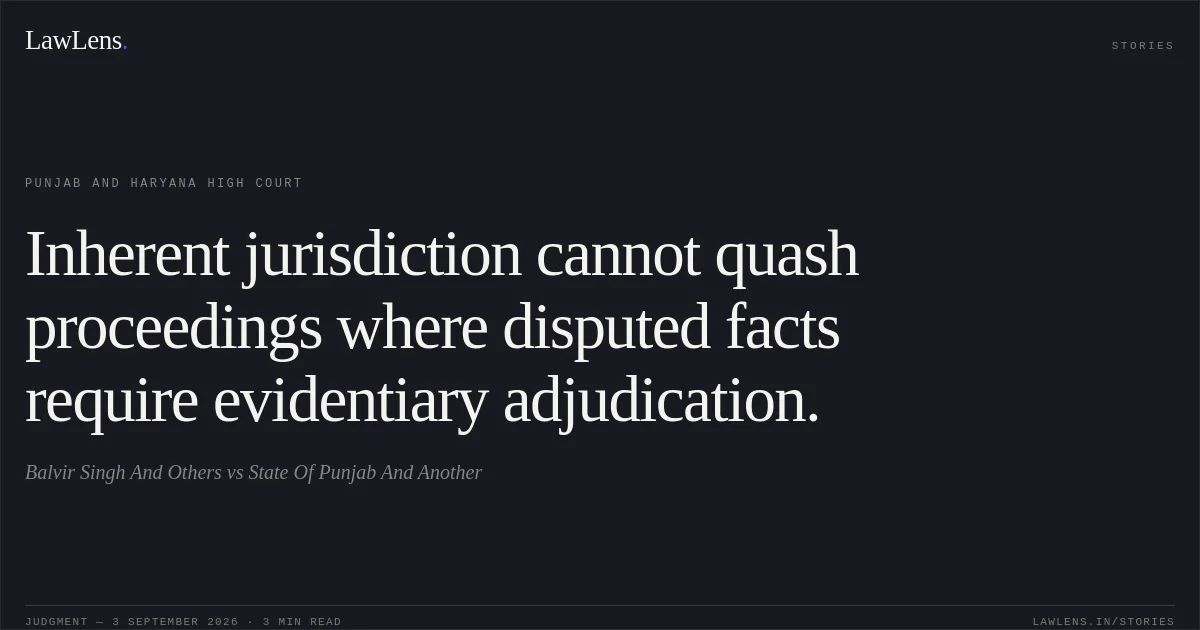
Source reference: para. 6.2The Court also relied on M/s Neeharika Infrastructure Pvt. Ltd. v. State of Maharashtra, (2021) 19 SCC 401, reaffirming that the High Court should not adjudicate disputed questions of fact, assess the reliability or genuineness of evidence, examine the accused’s defence or conduct a mini-trial while exercising inherent jurisdiction.
Source reference: paras. 7–7.1The relevant principles were further traced to R.P. Kapur v. State of Punjab, AIR 1960 SC 866.
Source reference: para. 7.1Reasoning
The Court held that the FIR and the investigative material could not, at the threshold, be characterised as devoid of allegations constituting cognizable offences.
Source reference: paras. 6.1, 8If accepted at face value, the allegations concerning impersonation, use of allegedly incorrect identity particulars in sale deeds and facilitation of the transactions were not inherently incapable of constituting the offences alleged.
Source reference: paras. 6.1, 8The petitioners’ reliance on documents showing that petitioner No. 1’s father was named “Surta Singh” raised a disputed factual issue rather than conclusively disproving the prosecution case.
Source reference: paras. 9–9.3Determining the actual identity of petitioner No. 1’s father, whether the particulars in the sale deeds were deliberately furnished, the identity of the persons involved and the existence of a culpable intention would require appreciation of oral and documentary evidence.
Source reference: paras. 9–9.3Since the allegations were not patently absurd, inherently improbable, frivolous or manifestly mala fide, the Court declined to undertake a comparative examination of the documents or a mini-trial under Section 528 BNSS.
Source reference: paras. 8, 9.1–9.4Holding
The Court answered the issues against the petitioners.
It held that the case did not fall within any of the recognised categories warranting exercise of inherent jurisdiction under Section 528 BNSS and found no illegality, perversity or jurisdictional infirmity in the order framing charges dated 21 April 2026.
Source reference: paras. 8, 9.5The petition seeking quashing of the FIR, the charge-framing order and consequential proceedings was accordingly dismissed.
Source reference: no citationThe Court clarified that its observations were prima facie and would not affect the independent consideration of the matter by the Investigating Agency or the Trial Court.
Source reference: para. 10All pending miscellaneous and connected applications were disposed of.
Source reference: para. 11Acts & Sections Cited
15 provisions across 4 statutes referred to in this judgment. Each provision opens on LawLens.
Bharatiya Nagarik Suraksha Sanhita, 20231
Code of Criminal Procedure, 19733
Indian Penal Code, 18605
Bharatiya Nyaya Sanhita, 20236
Original Court PDF
Balvir Singh And OthersvsState Of Punjab And Another
Click to open original judgment
Original judgment, available to read, download and summarize on LawLens.in