Facts
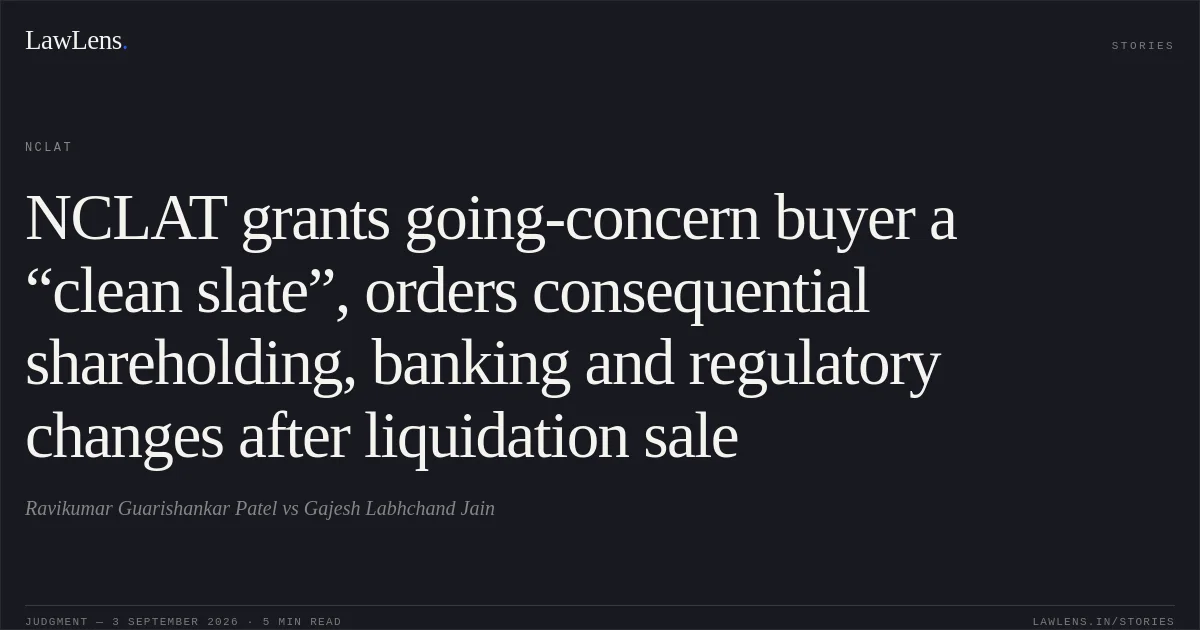
Talwalkars Better Value Fitness Limited (“Corporate Debtor”) was admitted to CIRP on 11 January 2021 and ordered into liquidation on 28 April 2022, with the Respondent appointed as Liquidator.
Source reference: para. 2The Liquidator issued an e-auction notice and Process Memorandum for sale of the Corporate Debtor as a going concern under Regulations 32(e) and 32A of the IBBI (Liquidation Process) Regulations, 2016.
Source reference: para. 2The Appellant emerged as the successful bidder at ₹15 crore, paid the entire consideration, and received a Sale Certificate dated 23 January 2025.
Source reference: para. 2The Appellant applied under Section 60(5) of the Insolvency and Bankruptcy Code, 2016 (“IBC”) for reliefs and concessions required to operationalise the going-concern sale, including restructuring of shareholding, recognition of the new management, directions to financial creditors, immunity from prior liabilities, continuation of licences and consents, and change of the Corporate Debtor’s MCA status from “liquidation” to “active”.
Source reference: paras. 3–4, 14, 30, 41, 59, 67By order dated 26 February 2026, the NCLT rejected or partly allowed several prayers and directed the Appellant to approach SEBI, stock exchanges, financial institutions and other authorities.
Source reference: para. 2The Appellant challenged that order under Section 61 of the IBC.
Source reference: no citationIssues
Whether the Adjudicating Authority had jurisdiction under Sections 35(1)(n) and 60(5)(c) of the IBC to grant consequential and ancillary reliefs necessary to implement the sale of the Corporate Debtor as a going concern.
Source reference: paras. 8–11, 23–29Whether the Adjudicating Authority could direct or permit consequential changes in the Corporate Debtor’s shareholding and listing status, subject to compliance with applicable securities laws and procedures.
Source reference: paras. 13–29Whether financial creditors could be directed to undertake ministerial acts, including updating credit records, releasing pre-existing charges and unfreezing bank accounts, following completion of the going-concern sale.
Source reference: paras. 30–37Whether the Appellant was entitled to a clean-slate protection against prior liabilities, offences, defaults and regulatory proceedings under Section 32A of the IBC, as extended to a going-concern sale in liquidation.
Source reference: paras. 41–53Whether existing consents, licences, approvals, rights and privileges of the Corporate Debtor continued after its sale as a going concern, subject to statutory compliance by the purchaser.
Source reference: paras. 59–64Whether the Corporate Debtor’s status could be changed in the ROC/MCA records from “liquidation” to “active”.
Source reference: paras. 67–70Whether the Appellant was entitled to waiver of stamp duty, taxes, fees and other acquisition-related statutory charges contrary to the terms of the auction documents and Sale Certificate.
Source reference: paras. 54–58Law Applied
Section 35(1)(n) of the IBC authorises the Liquidator to seek orders or directions necessary for liquidation, including directions facilitating a going-concern sale.
Source reference: para. 10Section 60(5)(c) confers broad residuary jurisdiction on the NCLT to determine questions of law or fact arising out of or in relation to insolvency resolution or liquidation proceedings, including consequential directions necessary to give effect to the process.
Source reference: para. 11The “clean slate” principle in Committee of Creditors of Essar Steel India Ltd. v. Satish Kumar Gupta and Ghanashyam Mishra & Sons (P) Ltd. v. Edelweiss Asset Reconstruction Co. Ltd. protects a successful acquirer from historical liabilities that frustrate revival.
Source reference: para. 25Section 32A grants immunity from prior offences and protection against action against the Corporate Debtor’s property upon a change in control, subject to statutory conditions; the Tribunal held that the principle applies, by analogy, to a going-concern sale in liquidation.
Source reference: paras. 44–47Arun Kumar Jagatramka v. Jindal Steel & Power Ltd. recognises liquidation sale as a mode of revival comparable to resolution-plan implementation.
Source reference: para. 26Relying on Nikhil Jain v. Anil Goel, Liquidator of Birla Cotsyn (India) Ltd., Equator Financial Services Ltd. v. BSE Ltd., and M/s Shiv Shakti Inter Globe Exports Pvt. Ltd. v. KTC Foods Pvt. Ltd., the Tribunal applied a purposive interpretation favouring commercially effective revival, while preserving the independent statutory powers of regulators and authorities.
Source reference: paras. 19–22, 48–52However, the purchaser remains bound by the contractual terms of the e-auction notice, Letter of Intent and Sale Certificate and cannot obtain extra-contractual waiver of stamp duty, taxes or acquisition expenses.
Source reference: paras. 55–58, 71Reasoning
The Tribunal held that the reliefs sought had a direct nexus with the liquidation and the Sale Certificate and therefore fell within Section 60(5)(c).
Source reference: paras. 24, 27–29Since the Process Memorandum expressly contemplated the purchaser approaching the NCLT for directions, waivers and consequential reliefs, the Adjudicating Authority erred in treating the requested shareholding and listing directions as matters wholly outside its jurisdiction.
Source reference: para. 18The proposed 95:5 promoter-public shareholding was viewed not as an impermissible exemption but as a structure intended to comply with Rule 19A of the Securities Contracts (Regulation) Rules, 1957; the directions were therefore allowed subject to statutory filings, procedures and fees.
Source reference: para. 22Similarly, requiring the purchaser to approach each financial creditor separately would undermine the commercial efficacy and finality of the going-concern sale.
Source reference: paras. 33–37The financial creditors could accordingly be directed to perform ministerial acts recognising the consequences of the sale, without restricting their independent statutory powers.
Source reference: paras. 33–37In relation to prior liabilities and offences, the Tribunal relied on the clean-slate doctrine, Section 32A and the fact that liquidation proceeds had already been distributed under Section 53, holding that historical claims could not be imposed on the purchaser or the Corporate Debtor under new management.
Source reference: paras. 46–49, 53Existing licences, approvals and contractual benefits were held to continue with the Corporate Debtor, but the purchaser remained responsible for fresh compliance and renewal fees arising from the change in ownership.
Source reference: para. 64The MCA status change was a necessary procedural consequence expressly contemplated by the Sale Certificate and was therefore directed.
Source reference: paras. 67–70In contrast, waiver of stamp duty, taxes and acquisition-related charges was refused because the purchaser had expressly accepted responsibility for them under the auction terms, LoI and Sale Certificate.
Source reference: paras. 55–58Holding
The appeal was partly allowed.
The Tribunal allowed the shareholding and SEBI/stock-exchange-related prayers at items B, C, E, H, I and J, subject to applicable procedures, filings and prescribed fees.
Source reference: para. 72(a)Financial creditors were directed to undertake necessary ministerial and consequential acts relating to the going-concern sale, while preserving their statutory powers; any balance in the relevant bank accounts as of the sale date was to remain part of the liquidation estate and be distributed under Section 53.
Source reference: para. 72(b)Statutory authorities, governmental departments, regulators, financial institutions and other concerned persons were directed to recognise the legal consequences of the sale, subject to their independent statutory powers.
Source reference: para. 72(c)Existing consents, licences, approvals, rights and privileges were directed to remain vested in the Corporate Debtor, subject to compliance and renewal obligations of the Appellant.
Source reference: para. 72(d)The Liquidator, in consultation with the ROC, was directed to change the Corporate Debtor’s status from “liquidation” to “active” in the ROC records in accordance with procedure.
Source reference: para. 72(e)The refusal of relief concerning preservation of receivables and extension of limitation, waiver of taxes and stamp duty, and other non-contractual concessions was affirmed.
Source reference: paras. 40, 58, 71–72(f)No order as to costs was made.
Source reference: no citationActs & Sections Cited
8 provisions across 2 statutes referred to in this judgment. Each provision opens on LawLens.
Insolvency and Bankruptcy Code, 2016.7
Companies Act, 20131
Original Court PDF
Ravikumar Guarishankar PatelvsGajesh Labhchand Jain
Click to open original judgment
Original judgment, available to read, download and summarize on LawLens.in