Facts
The prosecution alleged that the respondent drove a lorry into a motorcycle at a junction, causing the pillion rider’s death, and charged him under Sections 279 and 304A IPC.
Source reference: para. 3The judgment contains inconsistent dates for the alleged accident: paragraph 3 states 25 November 2018, while the Sessions Court’s reasoning reproduced in the judgment refers to dates in 2008.
Source reference: paras. 3, 10The JMFC convicted the respondent; the Sessions Court allowed his appeal and acquitted him on 2 March 2015.
Source reference: paras. 4–5The State challenged that acquittal under Section 378 CrPC.
Source reference: paras. 4–5Issues
1. Whether the State had established grounds to interfere with the Sessions Court’s order acquitting the respondent
Source reference: para. 72. What order should follow from the Court’s determination of the appeal
Source reference: para. 7Law Applied
Sections 279 and 304A IPC concern, respectively, rash driving on a public way and causing death by a rash or negligent act.
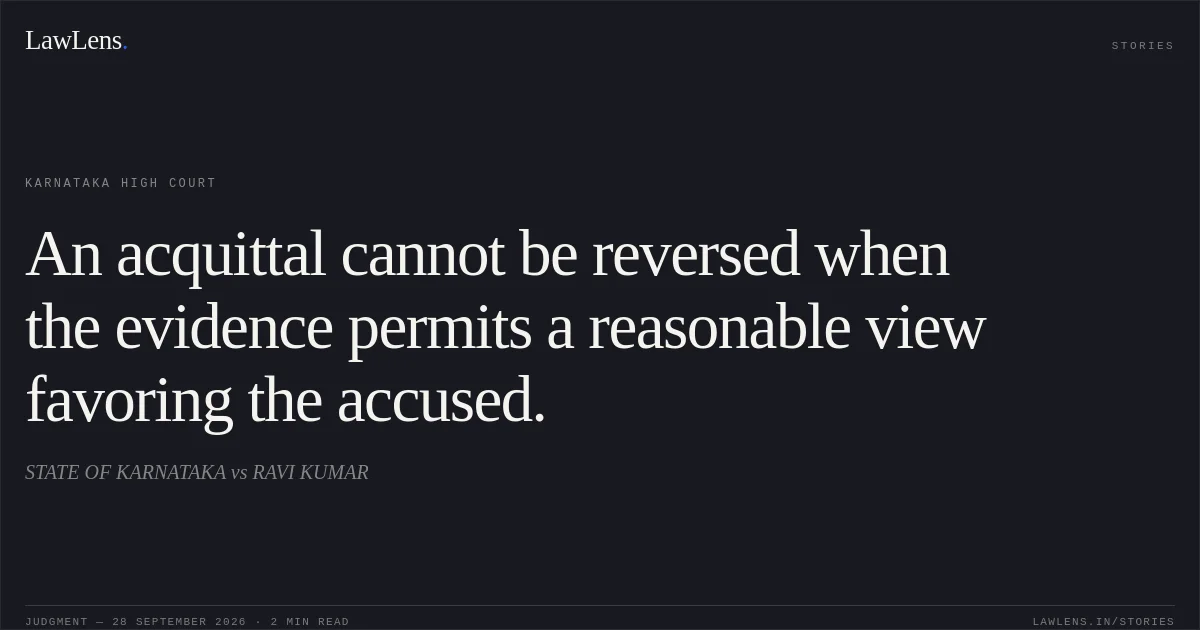
Source reference: para. 3In an appeal against acquittal under Section 378 CrPC, the appellate court may reappreciate the evidence, but the acquittal strengthens the presumption of innocence. If the acquittal represents a possible view of the evidence, it cannot be reversed merely because another view is also possible; interference is warranted where the acquittal is perverse, rests on a misreading or omission of material evidence, or where guilt is the only conclusion reasonably available.
Source reference: para. 9Constable 907 Surendra Singh v. State of Uttarakhand, (2025) 5 SCC 433; Babu Sahebgouda Rudragoudar v. State of Karnataka, (2024) 8 SCC 149; Chandrappa v. State of Karnataka, (2007) 4 SCC 415; and H.D. Sundara v. State of Karnataka, (2023) 9 SCC 581.
Source reference: para. 9Reasoning
The Sessions Court treated the evidence as insufficient to establish rashness or negligence: the lorry was travelling on the main road, the motorcycle entered from a cross-road, and the evidence included 60 feet of lorry brake marks but no recorded motorcycle brake marks.
Source reference: para. 10It also held that evidence of high speed alone did not establish rash or negligent driving.
Source reference: para. 10After independently reappreciating the evidence, the High Court found no legal or factual error in that assessment and no basis to conclude that the acquittal was perverse or that conviction was the only possible view.
Source reference: para. 11Holding
The Court answered the question whether grounds existed to allow the State’s appeal in the negative and dismissed the appeal.
The Sessions Court’s acquittal therefore remained undisturbed.
Source reference: paras. 8, 11Acts & Sections Cited
2 provisions across 2 statutes referred to in this judgment. Each provision opens on LawLens.
Code of Criminal Procedure, 19731
Indian Penal Code, 18601
Original Court PDF
STATE OF KARNATAKAvsRAVI KUMAR
Click to open original judgment
Original judgment, available to read, download and summarize on LawLens.in