Facts
The complainant alleged that she had advanced ₹3,30,000 to respondent Mulema Singh pursuant to an agreement and that, when repayment was demanded, the respondents entered her house on 6 January 2017, abused her using caste-related and obscene words, and threatened her and her daughter.
Source reference: para. 2Her complaint to the Superintendent of Police dated 4 March 2017 led to registration of an FIR for offences under the IPC and the Scheduled Castes and the Scheduled Tribes (Prevention of Atrocities) Act, 1989 (“SC/ST Act”).
Source reference: para. 3The prosecution examined seven witnesses and relied upon the complaint, spot maps, the complainant’s caste-status certificate, bank passbook, and loan agreement.
Source reference: para. 4The Special Court framed charges under Sections 452, 294 and 506 Part II of the IPC and Sections 3(1)(r) and 3(1)(s) of the SC/ST Act, but acquitted the respondents.
Source reference: para. 4The State preferred the present appeal under Section 14-A(1) of the SC/ST Act.
Source reference: para. 1Issues
Whether the prosecution proved beyond reasonable doubt that the respondents committed offences under Sections 452, 294 and 506 Part II of the IPC and Sections 3(1)(r) and 3(1)(s) of the SC/ST Act?
Source reference: paras. 8–16Whether the trial court’s acquittal was so perverse or legally untenable as to warrant interference in an appeal against acquittal?
Source reference: paras. 17–19Law Applied
The Court considered the charged offences under Sections 452, 294 and 506 Part II of the IPC and Sections 3(1)(r) and 3(1)(s) of the SC/ST Act.
Source reference: paras. 1, 3For the offences under Sections 3(1)(r) and 3(1)(s), the prosecution was required to establish the relevant intentional caste-based insult or abuse and that the conduct occurred in a place within public view; the Court accepted the trial court’s finding that the alleged incident inside the complainant’s house did not satisfy this requirement.
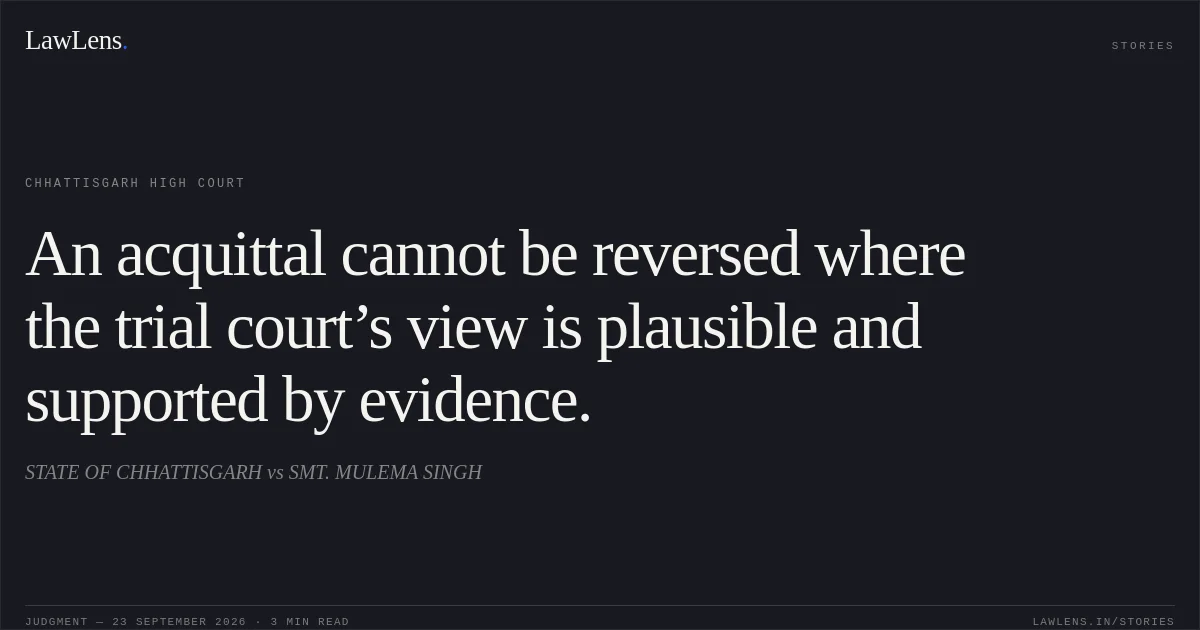
Source reference: para. 8In an appeal against acquittal, the appellate court may interfere only where the trial court’s view is impossible or perverse; if two plausible views are available, the acquittal should not be reversed merely because another view is possible.
Source reference: para. 17The Court relied on State of Rajasthan v. Kistoora Ram, 2022 SCC OnLine SC 984.
Source reference: para. 17Jafarudheen v. State of Kerala, (2022) 8 SCC 440, recognise the strengthened presumption of innocence following acquittal and require thorough scrutiny before interference.
Source reference: para. 18Reasoning
The High Court found that the prosecution evidence did not establish the essential ingredients of the alleged offences beyond reasonable doubt.
Source reference: no citationThe complainant alleged obscene and caste-related abuse, but PW-2 did not hear or describe any obscene words and stated that Mulema Singh had not abused the complainant.
Source reference: para. 12PW-3 merely stated that the respondents abused the complainant without identifying the words used, and also indicated that the quarrel occurred inside the house.
Source reference: para. 13Although PW-4 alleged the use of filthy language, her evidence did not cure the deficiencies concerning the exact words, the place of occurrence, or public view.
Source reference: paras. 14–15The Court further noted the delay in lodging the complaint: the alleged incident occurred on 6 January 2017, whereas the written complaint to the Superintendent of Police was made on 4 March 2017, without a satisfactory explanation.
Source reference: para. 11The parties also had a prior monetary dispute, including a dismissed cheque-bounce complaint by the complainant and a criminal case pending against her on the respondents’ complaint, providing a basis for the trial court to assess the evidence cautiously.
Source reference: paras. 8, 10 and 16Applying the restricted standard governing appeals against acquittal, the High Court held that the trial court’s assessment was a possible and plausible view of the evidence and was neither perverse nor illegal.
Source reference: paras. 16–19Holding
The Court answered both issues against the State.
It held that the prosecution failed to prove the charged offences beyond reasonable doubt and that the trial court’s acquittal was based on a plausible appreciation of the evidence.
Source reference: paras. 19–20Consequently, the acquittal appeal under Section 14-A(1) of the SC/ST Act was dismissed, and the acquittal of Smt. Mulema Singh and Ramesh Singh was affirmed.
Source reference: paras. 19–20Acts & Sections Cited
11 provisions across 3 statutes referred to in this judgment. Each provision opens on LawLens.
Scheduled Castes and the Scheduled Tribes (Prevention of Atrocities) Act, 19891
Indian Penal Code, 18607
Code of Criminal Procedure, 19733
Original Court PDF
STATE OF CHHATTISGARHvsSMT. MULEMA SINGH
Click to open original judgment
Original judgment, available to read, download and summarize on LawLens.in