Facts
The prosecution alleged that the deceased was last seen going towards a canal with two accused and was later found dead in the canal with head injuries.
Source reference: pp. 2–5, 7–9The post-mortem doctor opined that death resulted from the head injuries, which were sufficient in the ordinary course to cause death.
Source reference: pp. 2–5, 7–9The complainant lodged a murder complaint four days after the incident; the initial accidental-death information had not mentioned the alleged last-seen circumstance.
Source reference: pp. 2–5, 7–9The Sessions Court acquitted the accused of offences under Sections 302, 201, 34 and 120(B) of the Indian Penal Code.
Source reference: pp. 2–5, 7–9The State appealed against the acquittal.
Source reference: pp. 2–5, 7–9Issues
Whether the deceased’s death was homicidal.
Source reference: pp. 7–8Whether the prosecution proved beyond reasonable doubt, through a complete chain of circumstantial evidence, that the accused caused the deceased’s death, warranting interference with the acquittal.
Source reference: pp. 9, 14–15Law Applied
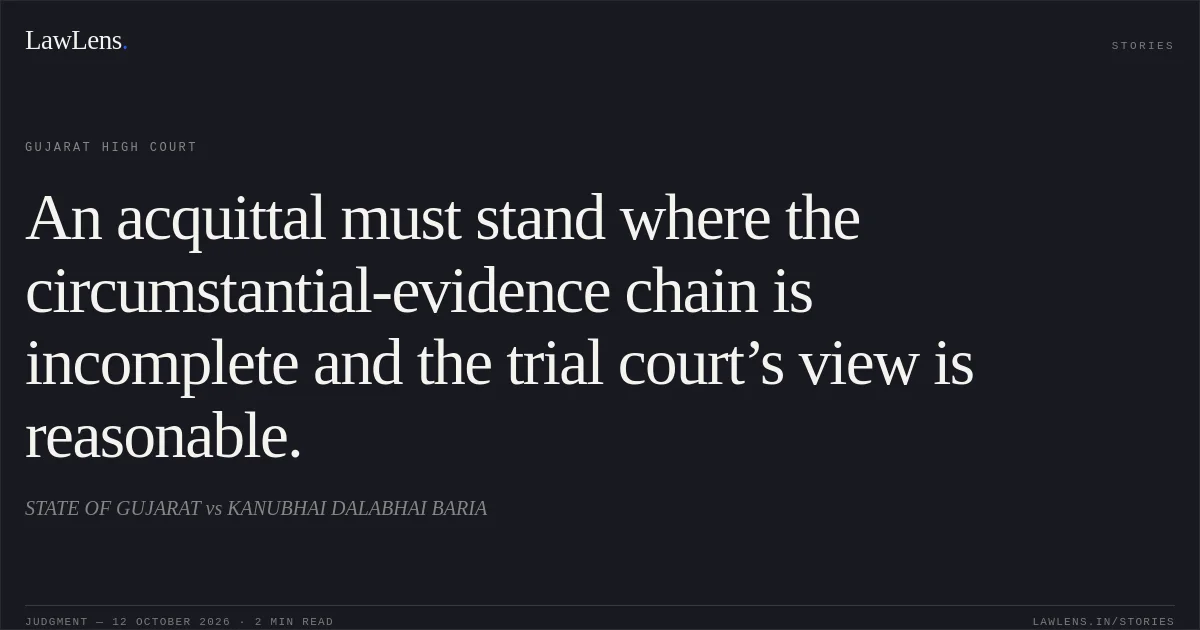
The prosecution must prove every circumstance relied upon in a circumstantial case beyond reasonable doubt; the circumstances must be conclusive, consistent only with guilt, and cumulatively form a complete chain excluding every reasonable hypothesis other than the accused’s guilt.
Source reference: pp. 12–14An appeal against acquittal permits interference where the acquittal is perverse or unreasonable, but not merely because another view is possible; the acquittal reinforces the presumption of innocence.
Source reference: pp. 9, 14–15The Court considered the appeal under Section 419 of the Bharatiya Nagarik Suraksha Sanhita, 2023, corresponding to Section 378 of the Code of Criminal Procedure.
Source reference: pp. 2, 9Reasoning
The medical evidence established that the death was homicidal: the doctor identified multiple head injuries and opined that they caused death, while the possibility raised in cross-examination of an accidental fall did not displace that opinion.
Source reference: pp. 7–8But proof of homicidal death did not identify the assailant.
Source reference: pp. 9–10The alleged last-seen circumstance rested on one witness, who did not see an assault; the initial accidental-death report omitted the alleged last-seen account, and the complaint naming the accused was lodged four days later.
Source reference: pp. 9–10No weapon was recovered or linked to the injuries, the FSL evidence did not connect the accused to the crime, and the alleged land-related motive was unsupported.
Source reference: pp. 10–12These deficiencies left the circumstantial chain incomplete.
Source reference: pp. 12–15The Sessions Court’s view was therefore reasonable and not perverse, so the appellate standard for disturbing an acquittal was not met.
Source reference: pp. 12–15Holding
The Court affirmed the finding that the death was homicidal but held that the prosecution had not proved the accused’s involvement beyond reasonable doubt.
Finding no basis to interfere with the acquittal, it dismissed the State’s appeal and confirmed the Sessions Court’s judgment and order.
Source reference: pp. 8, 15Acts & Sections Cited
7 provisions across 3 statutes referred to in this judgment. Each provision opens on LawLens.
Indian Penal Code, 18603
Bharatiya Nagarik Suraksha Sanhita, 20231
Code of Criminal Procedure, 19733
Original Court PDF
STATE OF GUJARATvsKANUBHAI DALABHAI BARIA
Click to open original judgment
Original judgment, available to read, download and summarize on LawLens.in