Facts
The prosecution alleged that Prathibha died from stab injuries after going to respondent No. 2’s house, where respondent No. 1 was present.
Source reference: para. 4–6Respondent No. 1 admitted being with Prathibha but stated in his Section 313 Cr.P.C. examination that she first stabbed him and then stabbed herself.
Source reference: para. 4–6No eyewitness testified, and no fingerprints were found on the knives recovered from the scene.
Source reference: para. 4–6The Sessions Court acquitted both respondents, finding the circumstantial-evidence chain incomplete.
Source reference: para. 1, 7The State appealed under Section 378(1) and (3) Cr.P.C.
Source reference: para. 1, 7Issues
1. Whether the evidence established beyond reasonable doubt that respondent No. 1 inflicted the fatal injuries on Prathibha, rather than the injuries being self-inflicted.
Source reference: para. 14–162. Whether the Sessions Court’s acquittal should be disturbed in a State appeal where the evidence permitted a reasonable view in favour of the accused.
Source reference: para. 12, 16–17Law Applied
The prosecution bears the burden of proving guilt beyond reasonable doubt, including in a case based on circumstantial evidence; the circumstances must form a complete chain pointing to the accused’s guilt.
Source reference: para. 7, 16An accused need not establish a defence beyond reasonable doubt and may discharge the relevant burden on a preponderance of probabilities (M. Abbas v. State of Kerala, (2001) 10 SCC 103).
Source reference: para. 6A court must carefully consider an accused’s alternative account under Section 313 Cr.P.C. (Premchand v. State of Maharashtra, (2023) 5 SCC 522).
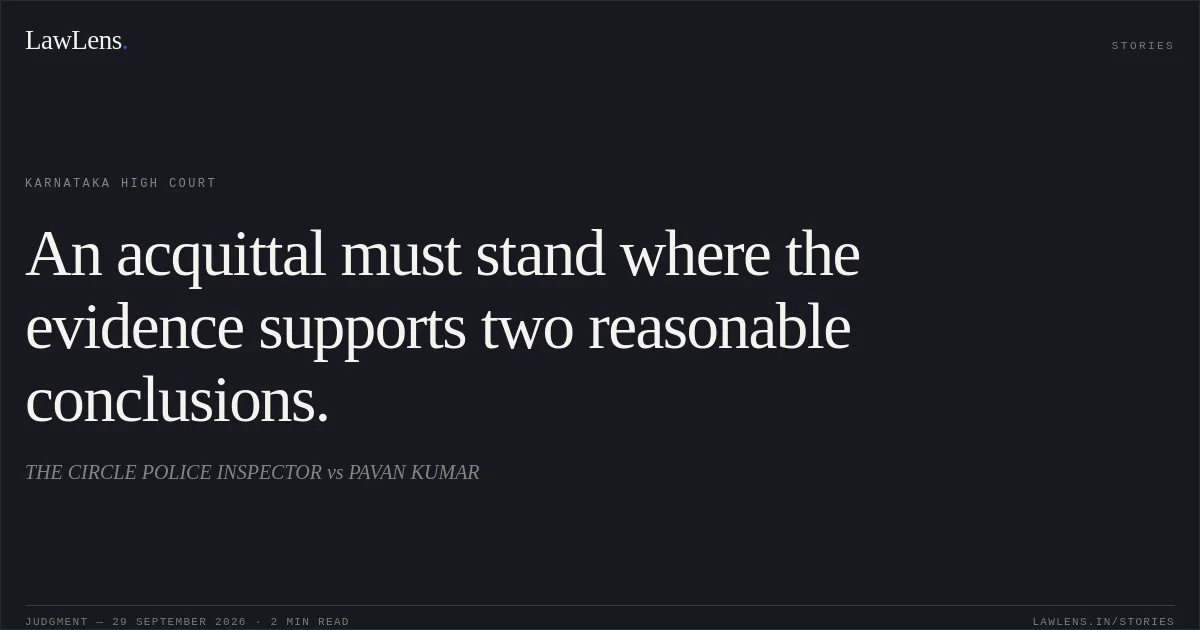
Source reference: para. 10–12On appeal against acquittal, the accused has a double presumption of innocence, and where two reasonable conclusions are available on the evidence, the appellate court should not displace the acquittal (Chandrappa v. State of Karnataka, (2007) 4 SCC 415).
Source reference: para. 12, 16Reasoning
The Court accepted that respondent No. 1 was present with Prathibha and noted the doctor’s opinion that her injuries were unlikely to have been self-inflicted.
Source reference: para. 14–16However, there was no eyewitness, the knives bore no fingerprints, and the medical opinion did not conclusively determine who inflicted the injuries.
Source reference: para. 14–16The Court considered respondent No. 1’s account that Prathibha stabbed him and then herself as a possible explanation, and held that the prosecution had not excluded that reasonable alternative or completed the circumstantial chain.
Source reference: para. 14–16Given the applicable restraint on appellate interference with acquittals, the Sessions Court’s view could not be displaced.
Source reference: para. 14–16Holding
The High Court dismissed the State’s appeal and upheld the acquittal, finding no basis to interfere with the Sessions Court’s judgment.
It directed that the respondents, who were before the Court, be released and set free, and directed the Registry to return the trial court records.
Source reference: para. 18–19Acts & Sections Cited
6 provisions across 2 statutes referred to in this judgment. Each provision opens on LawLens.
Code of Criminal Procedure, 19732
Indian Penal Code, 18604
Original Court PDF
THE CIRCLE POLICE INSPECTORvsPAVAN KUMAR
Click to open original judgment
Original judgment, available to read, download and summarize on LawLens.in