Facts
The prosecution alleged that, after their marriage on 10 July 2016, Devidas demanded additional dowry from Nikita’s parents and harassed her.
Source reference: pp. 4–11It further alleged that on 29 November 2016 he attempted to kill her by throwing boiling oil at her, causing burns to her back.
Source reference: pp. 4–11The Sessions Court acquitted him of offences under Sections 498A and 307 of the Indian Penal Code (IPC) and Section 4 of the Dowry Prohibition Act.
Source reference: pp. 4–11The State and Nikita appealed against the acquittal; Nikita also sought to produce additional documents under Section 391 of the Code of Criminal Procedure (CrPC)
Source reference: pp. 4–11, 29–30Issues
1. Whether the acquittal was arbitrary, perverse, or unsupported by the evidence, warranting appellate interference
Source reference: p. 152. Whether the additional documents sought to be produced by Nikita under Section 391 CrPC were relevant to determination of the appeals
Source reference: pp. 29–30Law Applied
The appeals were considered under Sections 378(1) and (3) and 372 CrPC, governing appeals against acquittal by the State and victim; Section 391 CrPC permits additional evidence at the appellate stage.
Source reference: pp. 2–4, 28–29The prosecution was required to prove the charged offences under Sections 498A and 307 IPC and Section 4 of the Dowry Prohibition Act beyond reasonable doubt.
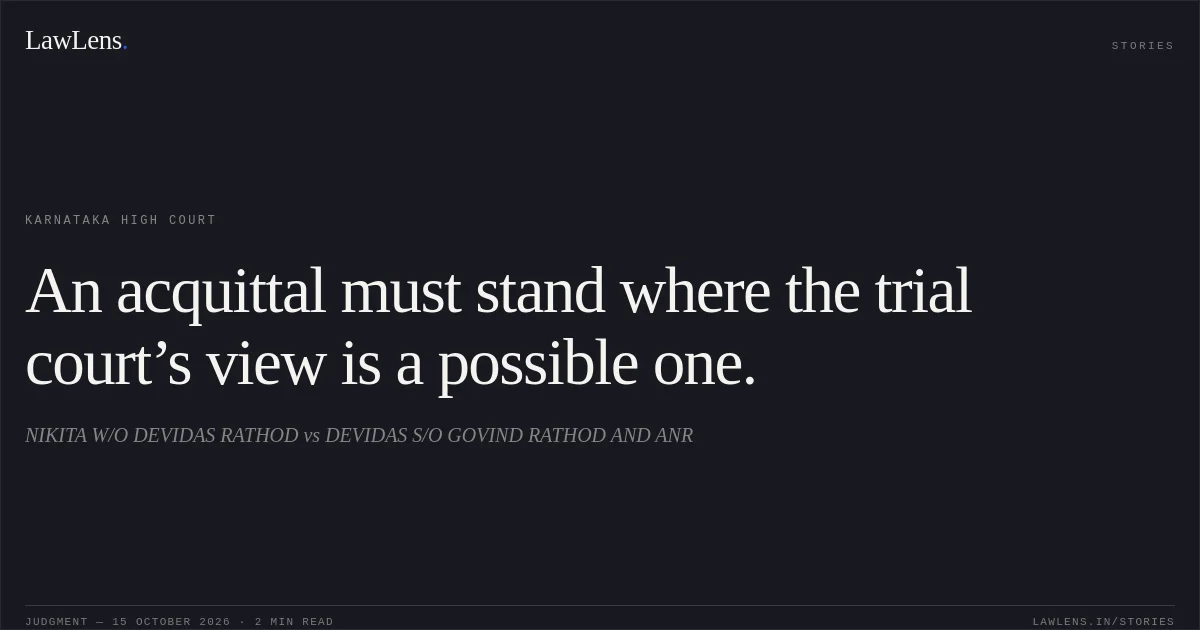
Source reference: pp. 2–4, 28–29Relying on *Jafarudheen v. State of Kerala*, (2022) 8 SCC 440, para 25, the Court stated that an acquittal reinforces the presumption of innocence and should be reversed only after thorough scrutiny; where the trial court’s view is a possible one on the evidence, the appellate court should be slow to interfere
Source reference: pp. 2–4, 28–29Reasoning
The Court found material weaknesses and inconsistencies in the prosecution case.
Source reference: pp. 22–28Nikita admitted that Devidas took her to hospital, while the medical evidence recorded a history of accidental burns and the prosecution did not examine the attendant who supplied that history.
Source reference: pp. 22–28The evidence about dowry was inconsistent: Nikita described the marriage gifts as voluntary, while other witnesses called them dowry; the witnesses also did not specify when the alleged later demands occurred.
Source reference: pp. 22–28The evidence differed as to whether the incident took place in the kitchen or hall.
Source reference: pp. 22–28Considering these circumstances, the Sessions Court’s view that the charges were not proved beyond reasonable doubt was a possible one and did not justify appellate interference
Source reference: pp. 22–28The Court also found the additional documents proposed under Section 391 CrPC irrelevant to deciding the appeals.
Source reference: pp. 29–30Holding
The Court answered the appellate issue in the negative, holding that the acquittal was not shown to be arbitrary, perverse, or otherwise erroneous.
It dismissed both appeals and dismissed Nikita’s application to produce additional documents; any pending applications were also disposed of
Source reference: pp. 30–31Acts & Sections Cited
12 provisions across 4 statutes referred to in this judgment. Each provision opens on LawLens.
Code of Criminal Procedure, 19735
Indian Penal Code, 18604
Hindu Marriage Act, 19551
Original Court PDF
NIKITA W/O DEVIDAS RATHODvsDEVIDAS S/O GOVIND RATHOD AND ANR
Click to open original judgment
Original judgment, available to read, download and summarize on LawLens.in