Facts
On 10 December 2017, Sahil left his home and was allegedly last seen in the company of Respondent No. 2, a juvenile, and another person.
Source reference: pp. 1–3His dead body was subsequently found in a canal at Aurangpura Sim in the early hours of 12 December 2017.
Source reference: pp. 1–3The complainant lodged an FIR at Thasra Police Station, initially against unknown persons, expressing suspicion against Respondent No. 2.
Source reference: pp. 1–3The post-mortem indicated death caused by neck compression and injuries.
Source reference: pp. 1–3After investigation, a charge-sheet was filed against the juvenile under Sections 302 and 201 of the Indian Penal Code.
Source reference: pp. 1–3The Juvenile Justice Board, Nadiad, acquitted him in Juvenile Criminal Case No. 36 of 2018 by judgment dated 28 February 2025.
Source reference: pp. 1–3The victim-appellant challenged the acquittal under Section 413 of the Bharatiya Nagarik Suraksha Sanhita, 2023, read with Section 101 of the Juvenile Justice (Care and Protection of Children) Act, 2015.
Source reference: pp. 1–3Issues
Whether the prosecution proved beyond reasonable doubt, through circumstantial evidence, that Respondent No. 2 committed Sahil’s murder and caused disappearance of evidence under Sections 302 and 201 IPC?
Source reference: pp. 7–14Whether the evidence regarding the deceased being last seen with Respondent No. 2, together with the medical, recovery, and documentary evidence, completed the chain of circumstances sufficient to sustain conviction?
Source reference: pp. 8–14Whether the Juvenile Justice Board’s order of acquittal was perverse, based on a misreading or omission of material evidence, or otherwise warranted appellate interference?
Source reference: pp. 15–19Law Applied
The Court applied Sections 302 and 201 of the Indian Penal Code concerning murder and causing disappearance of evidence, along with Section 413 of the Bharatiya Nagarik Suraksha Sanhita, 2023 and Section 101 of the Juvenile Justice Act, 2015 governing the appeal against acquittal.
Source reference: p. 1In a case based on circumstantial evidence, the prosecution must establish every circumstance conclusively, form a complete chain pointing only to the accused’s guilt, and exclude every reasonable alternative hypothesis; the Court referred to Sharad Birdhichand Sarda v. State of Maharashtra, Shailendra Rajdev Pasvan v. State of Gujarat, and Laxman Prasad alias Laxman v. State of Madhya Pradesh.
Source reference: pp. 13–14In an appeal against acquittal, although the appellate court may reappreciate the evidence, the acquittal carries a reinforced presumption of innocence and cannot be reversed merely because another view is possible.
Source reference: pp. 15–19Interference is justified only where the judgment is perverse, rests on a misreading or omission of material evidence, or where the guilt of the accused is the only reasonable conclusion.
Source reference: pp. 15–19Reasoning
The Court held that PW-1’s evidence primarily established that Sahil was missing, that his body was later found, and that suspicion had been raised against Respondent No. 2; it did not establish direct involvement in the murder.
Source reference: pp. 8–9PW-9 proved, at most, that Respondent No. 2 went out with Sahil, but did not testify that he witnessed the murder or any incriminating act.
Source reference: p. 9The evidence of PW-10, PW-11, and PW-12 was treated as hearsay or otherwise unreliable because those witnesses lacked personal knowledge of the incident and, in some instances, had merely repeated information received from others.
Source reference: pp. 10–11The alleged last-seen circumstance was also weakened because another person was reportedly with Sahil and there was a substantial time gap between the alleged last sighting and discovery of the body.
Source reference: pp. 11–12Further, no motive or prior animosity was established, and the prosecution failed to connect the medical or recovery evidence specifically to Respondent No. 2.
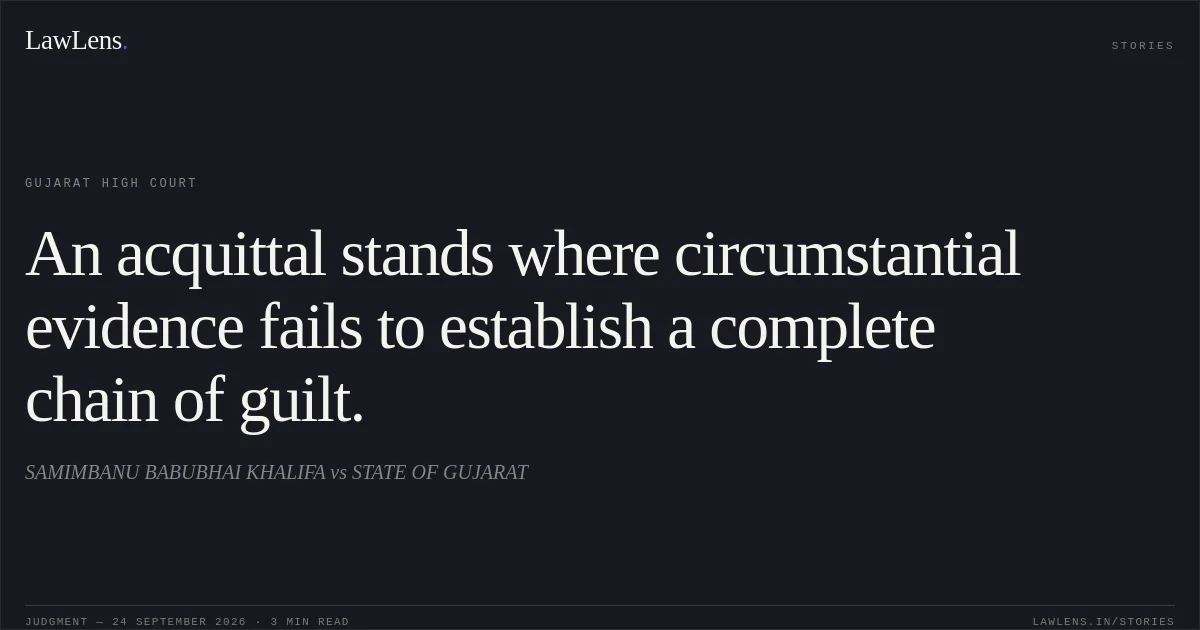
Source reference: pp. 11–14Applying the rule that suspicion cannot substitute proof and that every link in a circumstantial chain must be conclusively established, the Court found that the prosecution had not excluded reasonable alternative hypotheses.
Source reference: pp. 14–19The Board’s view was therefore a possible and reasonable view on the evidence and did not suffer from perversity or misappreciation warranting appellate intervention.
Source reference: pp. 14–19Holding
The High Court answered the issues against the appellant.
It held that the prosecution failed to prove beyond reasonable doubt that Respondent No. 2 committed the murder or caused disappearance of evidence, and that the alleged last-seen evidence and other circumstances did not form a complete chain of proof.
Source reference: pp. 11–14Finding no perversity, material omission, or other compelling reason to interfere with the acquittal, the Court dismissed the criminal appeal and confirmed the Juvenile Justice Board’s judgment and order dated 28 February 2025 acquitting Respondent No. 2.
Source reference: p. 19Acts & Sections Cited
6 provisions across 4 statutes referred to in this judgment. Each provision opens on LawLens.
Indian Penal Code, 18602
Bharatiya Nagarik Suraksha Sanhita, 20231
Juvenile Justice (Care and Protection of Children) Act, 2015.1
Code of Criminal Procedure, 19732
Original Court PDF
SAMIMBANU BABUBHAI KHALIFAvsSTATE OF GUJARAT
Click to open original judgment
Original judgment, available to read, download and summarize on LawLens.in