Facts
The prosecution alleged that on 8 October 2011, at Azad Chowk, Chhattiyarda, the accused abused the complainant by caste, assaulted him with kicks and fist blows, and threatened to kill him.
Source reference: paras. 1–2The accused was charged under Sections 323, 504 and 506(2) of the Indian Penal Code and Section 3(1)(x) of the Scheduled Castes and Scheduled Tribes (Prevention of Atrocities) Act, 1989. The trial court acquitted him on 26 September 2012; the State appealed under Section 378(1)(3) of the Code of Criminal Procedure, 1973.
Source reference: paras. 5–6Issues
Whether the prosecution evidence proved beyond reasonable doubt that the accused committed the charged assault, abuse and criminal intimidation
Source reference: paras. 10–14, 19Whether the trial court’s acquittal disclosed an error warranting appellate interference
Source reference: paras. 15–20Law Applied
The appeal was brought under Section 378(1)(3) of the Code of Criminal Procedure, 1973; the charged offences were under Sections 323, 504 and 506(2) of the Indian Penal Code and Section 3(1)(x) of the Scheduled Castes and Scheduled Tribes (Prevention of Atrocities) Act, 1989.
Source reference: para. 1Under Chandrappa v. State of Karnataka, as reaffirmed in Rajesh Prasad v. State of Bihar, Babu Sahebagouda Rudragoudar v. State of Karnataka and Ramesh v. State of Karnataka, an appellate court may review and reappreciate the evidence in an appeal against acquittal, but must account for the reinforced presumption of innocence; where two reasonable views are possible, the acquittal should not be disturbed.
Source reference: paras. 15–18Reasoning
The complainant’s relatives, who were said to have intervened, acknowledged that they were at home and were not present at the scene.
Source reference: paras. 11–12Although the alleged incident occurred in a busy market, no independent eyewitness was examined, and the investigating officer had not recorded statements from nearby persons.
Source reference: paras. 11–12The evidence did not establish that caste-based derogatory words were used in public view.
Source reference: para. 13The medical evidence described a simple injury that could also have resulted from a fall on a hard surface, and did not independently substantiate the alleged assault.
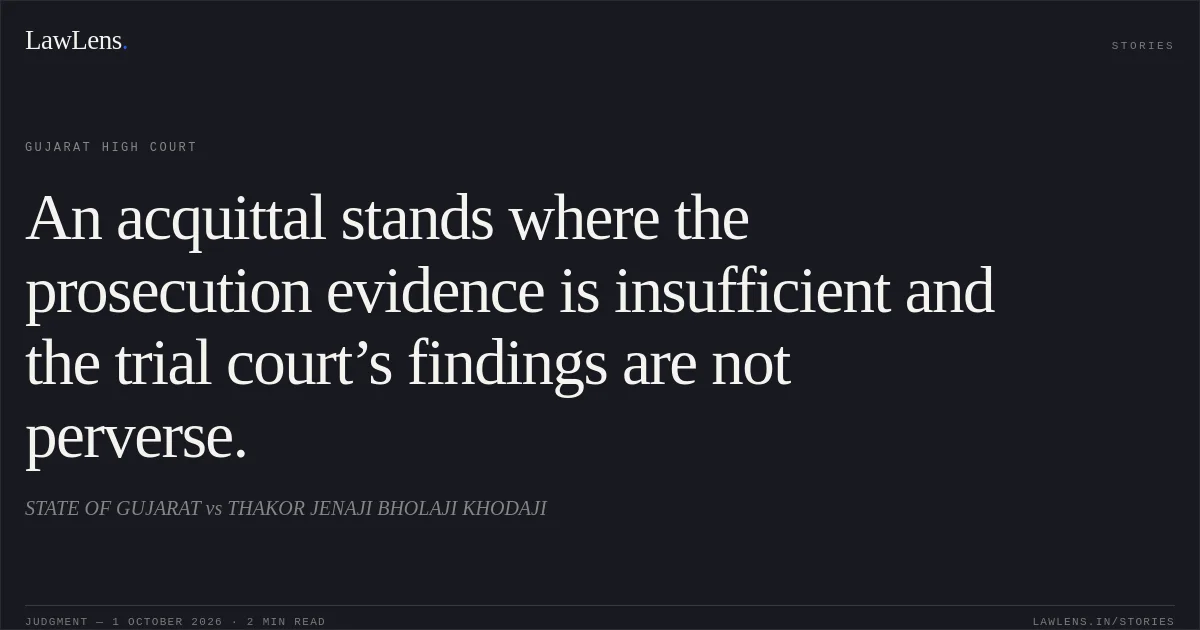
Source reference: para. 14In light of these evidentiary deficiencies, the acquittal was a reasonable view of the record and did not warrant appellate interference.
Source reference: paras. 19–20Holding
The High Court held that the prosecution had failed to prove the charges beyond reasonable doubt and that the trial court had committed no error of fact or law in acquitting the accused.
The State’s appeal was dismissed, the acquittal was confirmed, and the bail bond was cancelled; the record and proceedings were ordered to be returned to the trial court.
Source reference: para. 21Acts & Sections Cited
6 provisions across 3 statutes referred to in this judgment. Each provision opens on LawLens.
Code of Criminal Procedure, 19732
Indian Penal Code, 18603
Scheduled Castes and the Scheduled Tribes (Prevention of Atrocities) Act, 19891
Original Court PDF
STATE OF GUJARATvsTHAKOR JENAJI BHOLAJI KHODAJI
Click to open original judgment
Original judgment, available to read, download and summarize on LawLens.in