Facts
The appellant, a 31-year-old woman, alleged that on 28 May 2021 the accused forced her to travel with him from Village Sadra to Barvada, threatened to kill her and her minor son, and kept her at a farm for about 12 days, where he repeatedly raped and confined her.
Source reference: pp. 1–3, 5After returning, the parties’ community leader attempted to resolve the matter; the appellant subsequently lodged an FIR.
Source reference: pp. 1–3, 5The accused was charged under Sections 363, 344, 376(N) and 506(2) of the IPC.
Source reference: pp. 1–3, 5The Sessions Court acquitted him, finding the appellant’s evidence unreliable in light of her conduct, the nature of the relationship and the delay in reporting.
Source reference: pp. 1–3, 5The appellant, as victim and complainant, appealed under Section 413 of the Bharatiya Nagarik Suraksha Sanhita, 2023.
Source reference: pp. 1–3, 5Issues
Whether the Sessions Court was justified in acquitting the accused, or whether its findings warranted appellate interference?
Source reference: para. 12, p. 5Whether the appellant’s testimony, considered with the surrounding circumstances, was sufficiently reliable to establish kidnapping, rape and wrongful confinement beyond reasonable doubt?
Source reference: paras. 15–18, pp. 5–9Law Applied
Section 413 of the Bharatiya Nagarik Suraksha Sanhita, 2023 (corresponding to Section 372 of the Code of Criminal Procedure) provides for a victim’s appeal against acquittal.
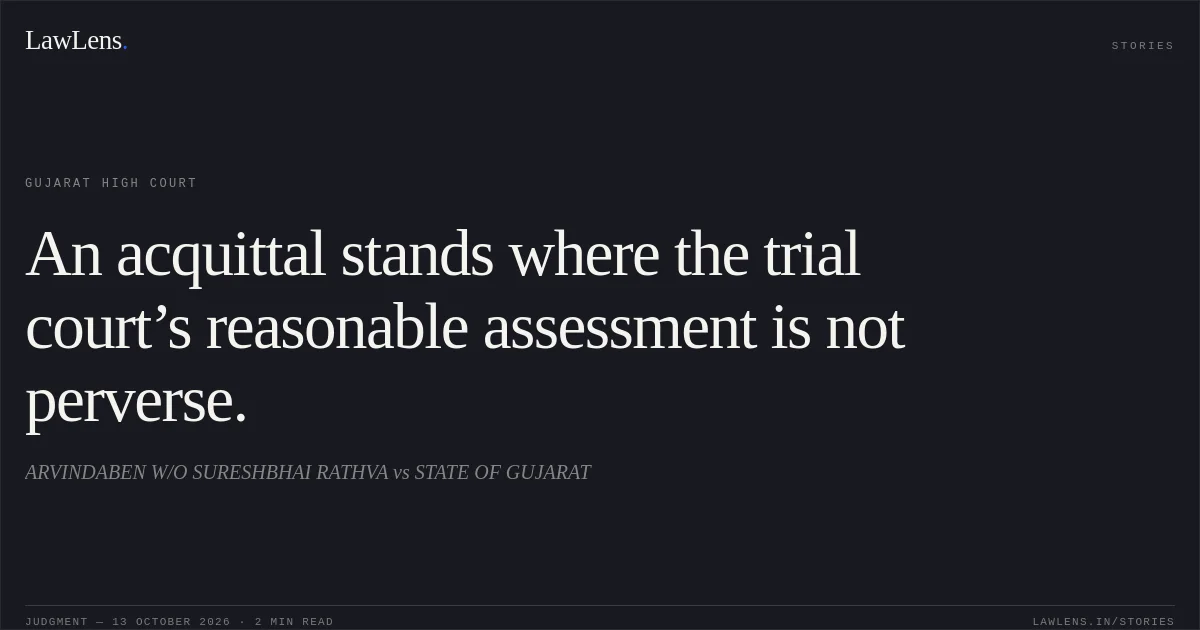
Source reference: para. 1, p. 1An appellate court may interfere with an acquittal where compelling circumstances show that the judgment is perverse; it must also account for the presumption of innocence, strengthened by acquittal, and avoid interference where the trial court’s view is reasonable.
Source reference: para. 14, p. 5A victim’s sole testimony may support conviction if reliable and trustworthy; the “sterling witness” standard requires a consistent and unassailable account.
Source reference: para. 15, pp. 6–7Where the testimony contains material deficiencies and does not inspire confidence, corroboration may be necessary.
Source reference: para. 16, pp. 8–9The charges in this case were under Sections 363, 344, 376(N) and 506(2) of the IPC.
Source reference: para. 2, p. 1Reasoning
The High Court considered that the appellant was an adult, travelled with the accused over a substantial distance, stayed with him at the farm for about 12 days, had a mobile phone, and did not report the alleged kidnapping during that period; it also noted the delay in lodging the FIR and the parties’ relationship.
Source reference: paras. 15–18, pp. 5–9On those circumstances, the Court found that her evidence did not inspire confidence on the allegations of kidnapping, rape and illegal confinement.
Source reference: paras. 15–18, pp. 5–9It held that the trial court had given sufficient reasons for its assessment and that its acquittal was a reasonable view, not a perverse one warranting appellate intervention.
Source reference: paras. 15–18, pp. 5–9Holding
The High Court held that the prosecution had failed to prove the charges beyond reasonable doubt and that the trial court was justified in acquitting the accused.
Finding no basis to interfere, it dismissed the appeal at the admission stage.
Source reference: para. 20, p. 10Acts & Sections Cited
10 provisions across 3 statutes referred to in this judgment. Each provision opens on LawLens.
Bharatiya Nagarik Suraksha Sanhita, 20231
Code of Criminal Procedure, 19734
Indian Penal Code, 18605
Original Court PDF
ARVINDABEN W/O SURESHBHAI RATHVAvsSTATE OF GUJARAT
Click to open original judgment
Original judgment, available to read, download and summarize on LawLens.in