Facts
The prosecution alleged that Rupesh Singh was shot and killed by unidentified assailants while returning home.
Source reference: p. 2, para. 2After investigation, the respondents were tried for offences under Sections 302 and 120(B) of the Indian Penal Code and Section 27 of the Arms Act; the trial court acquitted them.
Source reference: pp. 2–3, paras. 4–5The State appealed, contending that the circumstantial evidence established the respondents’ involvement.
Source reference: p. 6, paras. 8–10Issues
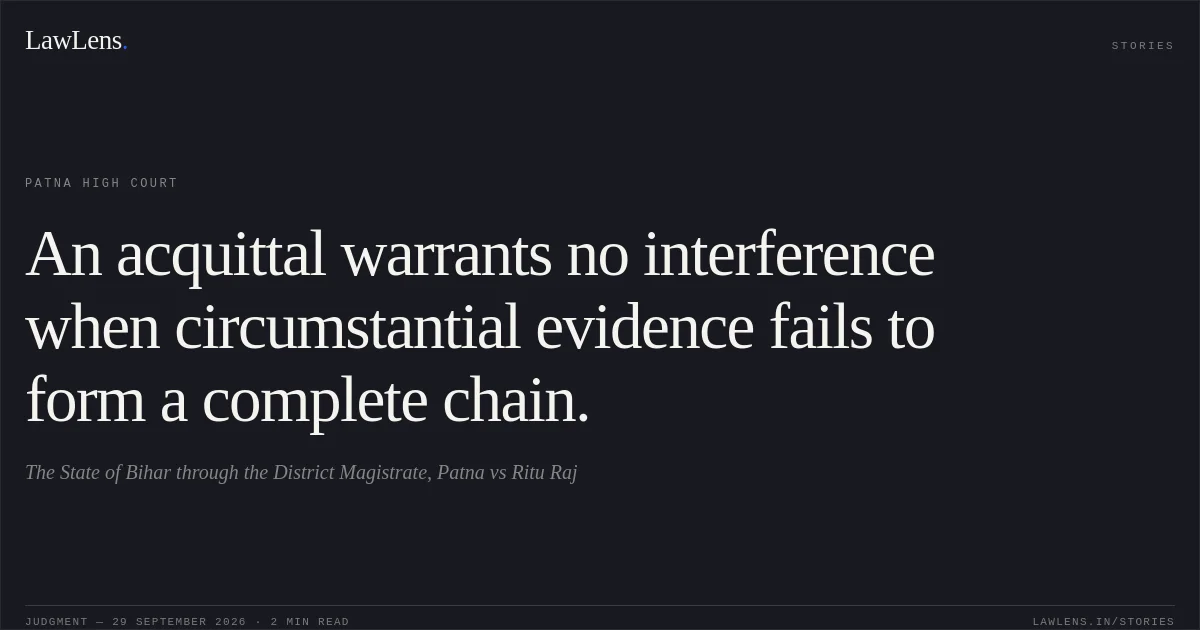
Whether the circumstances relied upon by the prosecution formed a complete and unbroken chain pointing to the respondents’ guilt, such that the acquittal warranted appellate interference.
Source reference: p. 7, para. 10Law Applied
In an appeal against acquittal, the appellate court may reassess the evidence, but should not interfere where the trial court’s view is reasonable; the presumption of innocence is strengthened by acquittal, and a merely possible alternative view is insufficient to reverse it (*Ghurey Lal v. State of Uttar Pradesh*, (2008) 10 SCC 450; *Muralidhar @ Gidda v. State of Karnataka*, (2014) 5 SCC 730).
Source reference: pp. 7–9, paras. 11–12For a case based on circumstantial evidence, the circumstances must be fully established, consistent only with guilt, conclusive, exclude reasonable hypotheses of innocence, and form a complete chain (*Sharad Birdhichand Sarda v. State of Maharashtra*, (1984) 4 SCC 116; *Hanumant v. State of M.P.*, (1952) 2 SCC 71).
Source reference: pp. 9–11, paras. 13–14Motive has particular significance in a circumstantial-evidence case as an important link in the chain (*Indrajit Das v. State of Tripura*, (2023) 18 SCC 506).
Source reference: p. 11, para. 15The charges in this case were under Sections 302 and 120(B) IPC and Section 27 of the Arms Act.
Source reference: p. 2, para. 2Reasoning
Applying the circumstantial-evidence test, the Court found no clear or cogent motive and noted that the prosecution’s suggested motives had not been established.
Source reference: p. 11, para. 15The alleged weapon recoveries and forensic evidence were doubtful: the descriptions of weapons differed between the seizure list and FSL report, the articles were received together despite directions to seal them separately, and the bullet evidence raised discrepancies, including a reported “extra” bullet and a mismatch between bullets and the alleged weapons.
Source reference: pp. 12–13, paras. 16–17The CCTV footage neither captured the assailants nor reliably connected the respondents to the occurrence; its custodians were not examined and no hash value was produced to establish its integrity.
Source reference: p. 13, para. 18These deficiencies left gaps in the chain, and the trial court’s conclusion was a reasonable view of the evidence.
Source reference: pp. 13–14, para. 19Holding
The Court answered the issue in the negative, holding that the prosecution had not established a complete chain of circumstances proving guilt beyond reasonable doubt and that the trial court’s findings did not warrant interference.
The State’s appeal was dismissed at the admission stage; any pending applications were also disposed of.
Source reference: p. 14, paras. 20–21Acts & Sections Cited
4 provisions across 3 statutes referred to in this judgment. Each provision opens on LawLens.
Indian Penal Code, 18601
Arms Act, 19591
Code of Criminal Procedure, 19732
Original Court PDF
The State of Bihar through the District Magistrate, PatnavsRitu Raj
Click to open original judgment
Original judgment, available to read, download and summarize on LawLens.in