Facts
A complaint alleged that Nagannagouda, a government teacher, participated in an election victory rally and that his wife improperly received ₹74,500 under a government housing scheme. Following a report under Section 12(3) of the Karnataka Lokayukta Act, 1984, the competent authority entrusted an inquiry to the Lokayukta under Rule 14A of the Karnataka Civil Services (Classification, Control and Appeal) Rules, 1957. The inquiry officer found the charges proved and recommended withholding two annual increments with cumulative effect and recovery of ₹74,500; the competent authority imposed the recommended penalty
Source reference: pp. 3, 7Nagannagouda challenged the disciplinary action before the Karnataka State Administrative Tribunal, which allowed his application. The Lokayukta challenged the Tribunal’s order in this writ petition
Source reference: pp. 3, 7Issues
1. Whether the Tribunal’s order was liable to be quashed because it did not apply its mind to the issues before it
Source reference: p. 8, para. 82. Whether the High Court should determine the merits of the underlying disciplinary challenge at this stage
Source reference: p. 9, para. 9(v)–(vi)Law Applied
Section 12(3) of the Karnataka Lokayukta Act, 1984, and Rule 14A of the Karnataka Civil Services (Classification, Control and Appeal) Rules, 1957, formed part of the procedural background to the complaint report and entrustment of the inquiry
Source reference: p. 7, para. 7The petitioner cited State of Karnataka v. N. Gangaraj, (2020) 3 SCC 423, and Deputy General Manager (Appellate Authority) v. Ajai Kumar Srivastava, (2021) 2 SCC 612
Source reference: p. 5The High Court did not apply those authorities to decide the disciplinary merits; it held that the Tribunal’s order could not stand because the Tribunal had extracted decisions without applying its mind to the matter
Source reference: p. 8, para. 8Reasoning
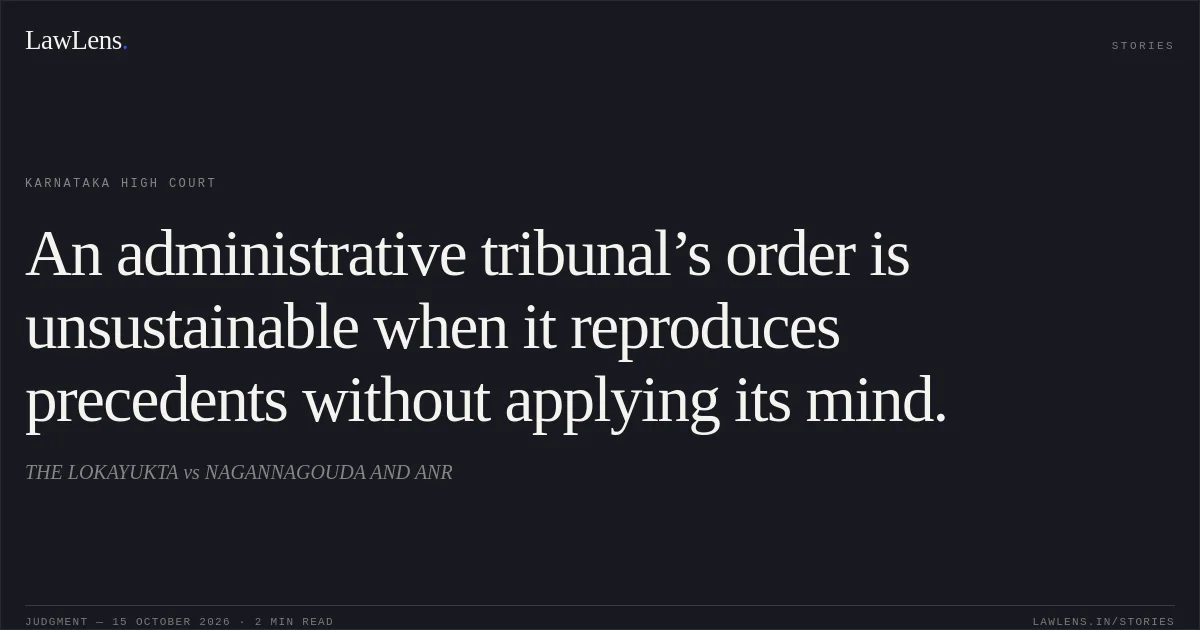
The High Court found that the Tribunal had referred to decisions relied on by the parties but had not applied its mind to the dispute, rendering its order unsustainable
Source reference: p. 8, para. 8It therefore set aside the Tribunal’s order and restored the application for fresh consideration, without deciding whether the inquiry or penalty was legally justified
Source reference: p. 9, para. 9(iii)–(vi)Holding
The writ petition was allowed and the Tribunal’s order dated 31 January 2024 was quashed. The application was restored to the Tribunal, which was directed to reconsider it and issue a detailed order in accordance with law.
The High Court made no determination on the merits, kept all parties’ contentions open, and directed the parties to appear before the Tribunal on 30 October 2026
Source reference: p. 9, para. 9(i)–(vii)Original Court PDF
THE LOKAYUKTAvsNAGANNAGOUDA AND ANR
Click to open original judgment
Original judgment, available to read, download and summarize on LawLens.in