Facts
The applicant/complainant filed a complaint under Section 138 of the Negotiable Instruments Act, 1881, against the non-applicant, registered as Complaint Case No. 380/2019 before the Judicial Magistrate First Class, Ambikapur.
Source reference: para. 3The complaint was dismissed for want of prosecution on 28 November 2025 because neither the complainant nor his counsel appeared when the matter was called.
Source reference: para. 3The complainant asserted that he was in Lucknow for his grandson’s medical treatment and, on returning the same day, learned from his counsel that the complaint had been dismissed.
Source reference: para. 3The applicant thereafter preferred Criminal Appeal No. 118/2025 before the 6th Additional Sessions Judge, Ambikapur.
Source reference: para. 3.1The appeal was dismissed on 20 February 2026 solely because it had been filed under an incorrect provision—Section 478 of the CrPC, corresponding to Section 524 of the BNSS—instead of Section 413 of the BNSS.
Source reference: paras. 3.1, 6The applicant challenged that dismissal in the present criminal revision under Sections 438 and 442 of the BNSS.
Source reference: para. 2Issues
Whether dismissal of a complaint for want of prosecution under Section 279 of the BNSS amounts to an acquittal, thereby giving the complainant a right to appeal under Section 413 of the BNSS?
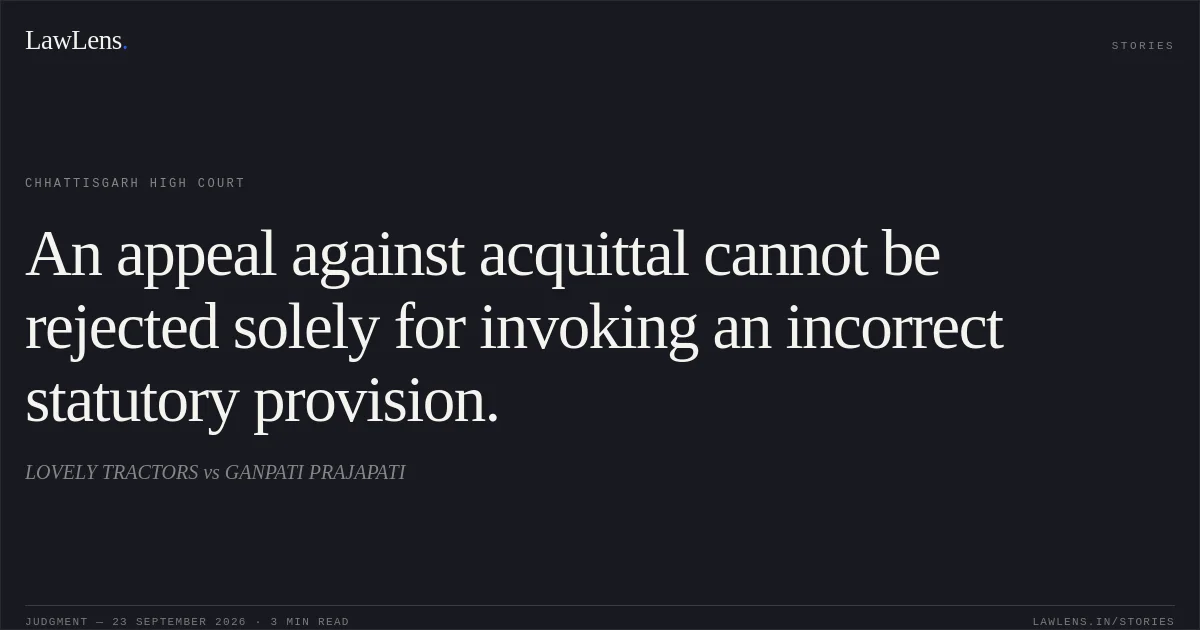
Source reference: para. 7Whether an appeal could be rejected solely because it referred to an incorrect statutory provision, when the appellate remedy was otherwise properly invoked?
Source reference: paras. 6, 8–9Law Applied
The Court applied Section 279 of the BNSS, under which dismissal of a complaint for non-appearance or want of prosecution entails acquittal of the accused, and Section 413 of the BNSS, which provides the remedy of an appeal against an order of acquittal.
Source reference: para. 7It further applied the principle that mere mention of an incorrect statutory provision does not invalidate proceedings where the court possesses jurisdiction and the substantive remedy has been properly invoked.
Source reference: para. 8Relying on P.K. Palanisamy v. N. Arumugham & Anr., (2009) 9 SCC 173, the Court held that an application or proceeding is not rendered non-maintainable merely because a wrong or no statutory provision has been cited.
Source reference: para. 8Reasoning
The trial Court’s dismissal of the Section 138 complaint for want of prosecution operated as an acquittal under Section 279 of the BNSS.
Source reference: para. 7Consequently, the applicant had pursued the correct substantive remedy by filing an appeal against acquittal, even though the appeal cited the wrong statutory provision.
Source reference: para. 7The Sessions Court therefore erred in treating the incorrect provision as fatal rather than examining the appeal according to its substance.
Source reference: para. 8Applying the principle in P.K. Palanisamy, the High Court held that the wrong citation did not deprive the appellate court of jurisdiction or invalidate the proceeding.
Source reference: para. 8Since the appeal had been rejected on a purely technical ground and the applicant had been denied adjudication on merits, the impugned order was held to be illegal.
Source reference: para. 9Holding
The High Court allowed the criminal revision and set aside the order dated 20 February 2026 passed by the 6th Additional Sessions Judge, Ambikapur, in Criminal Appeal No. 118/2025.
It directed that, if the applicant files a fresh memo of appeal under Section 413 of the BNSS within 30 days from the date of the order, the concerned Additional Sessions Judge shall restore Criminal Appeal No. 118/2025 and decide it in accordance with law.
Source reference: para. 10Acts & Sections Cited
7 provisions across 3 statutes referred to in this judgment. Each provision opens on LawLens.
Bharatiya Nagarik Suraksha Sanhita, 20235
Negotiable Instruments Act, 18811
Code of Criminal Procedure, 19731
Original Court PDF
LOVELY TRACTORSvsGANPATI PRAJAPATI
Click to open original judgment
Original judgment, available to read, download and summarize on LawLens.in