Facts
On 12 January 2017, the prosecutrix alleged that Omprakash Verma entered her house, consumed liquor, followed her into her room, sexually assaulted her while she was asleep, threatened to kill her, and caused injuries by assaulting and strangulating her.
Source reference: para. 2She reported the incident the following day after her husband and children arrived, following which investigation was conducted and the respondent was charged under Sections 450, 376, 323 and 506-B of the IPC.
Source reference: para. 2The prosecution examined 12 witnesses and produced 18 documents, while the respondent denied the allegations and produced four defence documents.
Source reference: para. 3The Additional Sessions Judge, Khairagarh, acquitted the respondent in Sessions Trial No. 03/2017 by judgment dated 25 August 2018.
Source reference: para. 4The State challenged the acquittal under Section 378(1) of the CrPC.
Source reference: paras. 1, 4Issues
Whether the testimony of the prosecutrix, considered with the oral, medical and documentary evidence, established the offences under Sections 450, 376, 323 and 506-B of the IPC beyond reasonable doubt?
Source reference: paras. 9–13Whether the trial court’s judgment of acquittal was illegal, perverse, or contrary to the evidence so as to warrant interference in an appeal against acquittal under Section 378(1) of the CrPC?
Source reference: paras. 8, 14Law Applied
The Court considered the offences charged under Sections 450, 376, 323 and 506-B of the IPC and the State’s appellate remedy under Section 378(1) of the CrPC.
Source reference: paras. 1, 4It relied on Mallappa v. State of Karnataka, (2024) 3 SCC 544, for the principles governing appeals against acquittal: the evidence must be assessed as a whole; where two reasonable views are possible, the view favourable to the accused must be adopted; and interference is justified only where the acquittal is illegal, perverse, or affected by a material error of law or fact.
Source reference: para. 8Under Ganesan v. State, (2020) 10 SCC 573, conviction may rest solely on the prosecutrix’s testimony where it is trustworthy, unblemished, credible and of sterling quality.
Source reference: para. 10Relying on Santosh Prasad @ Santosh Kumar v. State of Bihar, (2020) 3 SCC 443, the Court reiterated that a sole prosecutrix’s testimony cannot be accepted mechanically when it contains material contradictions, is improbable, and lacks supporting medical or forensic evidence.
Source reference: para. 11Reasoning
The Court found that the prosecutrix’s testimony did not possess the reliability and sterling quality required for sustaining a conviction solely on her evidence.
Source reference: para. 9The medical examination disclosed head and forehead injuries but gave no definite opinion supporting rape, and no signs suggestive of rape were found; the chemical examination also detected neither semen nor human sperm on the slides or clothing.
Source reference: para. 9The prosecution witnesses other than the prosecutrix had no direct knowledge of the occurrence and largely repeated her account.
Source reference: para. 12In contrast, defence-related evidence indicated that the injury could have resulted from the prosecutrix striking her head against a doorframe.
Source reference: para. 12Material admissions by the prosecutrix—including that she became unconscious, did not know whether the respondent had assaulted her, did not raise an alarm, and that money was demanded for treatment before the report was lodged—created reasonable doubt regarding the prosecution narrative.
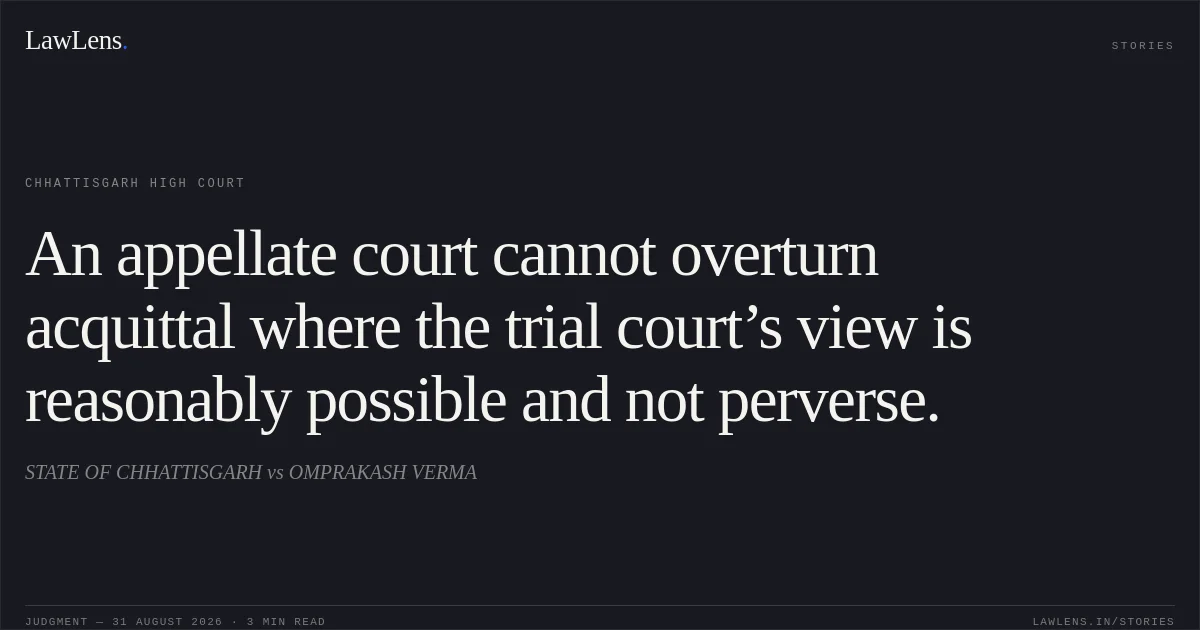
Source reference: para. 12Applying the rule governing appeals against acquittal, the Court held that the trial court’s view was a reasonably possible view based on the evidence and was neither perverse nor illegal.
Source reference: paras. 13–14Holding
The Court answered the issues against the State.
It held that the prosecution failed to establish the charged offences beyond reasonable doubt and that the trial court’s acquittal did not warrant appellate interference.
Source reference: para. 15The appeal was accordingly dismissed, and the judgment of acquittal dated 25 August 2018 was affirmed.
Source reference: para. 15A certified copy of the judgment, along with the original record, was directed to be transmitted to the concerned trial court.
Source reference: para. 16Acts & Sections Cited
6 provisions across 2 statutes referred to in this judgment. Each provision opens on LawLens.
Code of Criminal Procedure, 19732
Indian Penal Code, 18604
Original Court PDF
STATE OF CHHATTISGARHvsOMPRAKASH VERMA
Click to open original judgment
Original judgment, available to read, download and summarize on LawLens.in