Facts
The petitioner, respondent No. 8 in Regular Civil Appeal No. 20 of 2019, challenged the appellate court’s order dated 20 November 2021.
Source reference: para. 4; p. 2During that appeal, some appellants and respondents entered into a compromise, which the appellate court recorded and used to pass a consent decree disposing of the appeal.
Source reference: para. 7; pp. 4–5The petitioner was not a party to the compromise and contended that the decree prejudiced her rights.
Source reference: paras. 4, 7; pp. 2, 4–5The respondent’s counsel did not dispute that the decree could affect the petitioner’s interests, while submitting that she had failed to establish her case before the trial court.
Source reference: paras. 5–5.1; pp. 3–4Issues
Whether the appellate court could record a compromise and pass a consent decree without giving the petitioner, a party to the appeal whose rights could be affected, an opportunity to object.
Source reference: paras. 7–7.1; pp. 4–6Whether the impugned consent decree and order disposing of the appeal should be set aside and the appeal restored for decision on its merits.
Source reference: paras. 8–9; pp. 6–7Law Applied
The Court exercised its supervisory jurisdiction under Article 227 of the Constitution of India.
Source reference: para. 3; p. 2It held that where a compromise between some parties to an appeal may prejudice the rights of another party, the appellate court must examine that potential effect and provide the affected party an opportunity to state any objection before recording the compromise and passing an order.
Source reference: paras. 7.1–9; pp. 5–7Reasoning
The petitioner was a party to the appeal but had not joined the compromise.
Source reference: paras. 7–8; pp. 4–6The appellate court accepted the settlement and disposed of the appeal without first determining whether it affected her rights or hearing her position.
Source reference: paras. 7–8; pp. 4–6The parties’ submissions before the High Court left undisputed that her interests were prejudiced by the consent decree.
Source reference: paras. 7–8; pp. 4–6In those circumstances, the failure to give her an opportunity to be heard amounted to a gross irregularity and jurisdictional error warranting supervisory intervention.
Source reference: paras. 7–8; pp. 4–6Holding
The High Court partly allowed the petition, set aside the appellate court’s order dated 20 November 2021, and restored Regular Civil Appeal No. 20 of 2019 to its original file.
It directed the appellate court to decide the appeal on its merits in accordance with law, while considering the compromise and allowing affected parties to state their position regarding it.
Source reference: paras. 9–10; p. 7Rule was made absolute to that extent; no order as to costs.
Source reference: paras. 9–10; p. 7Original Court PDF
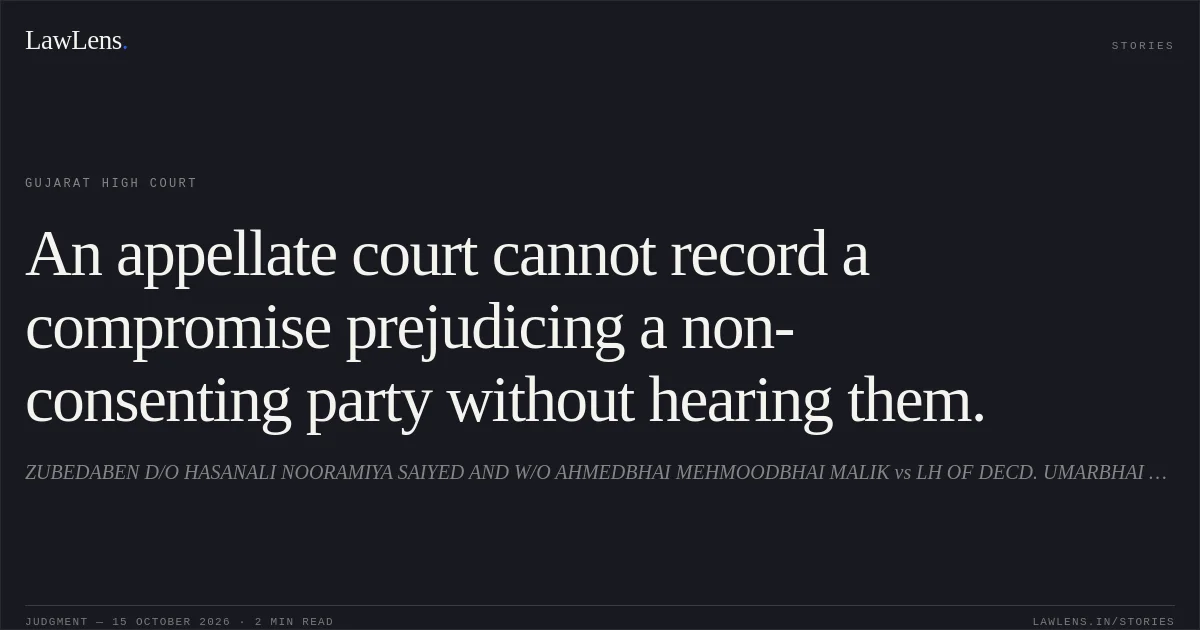
ZUBEDABEN D/O HASANALI NOORAMIYA SAIYED AND W/O AHMEDBHAI MEHMOODBHAI MALIKvsLH OF DECD. UMARBHAI BADARBHAI MALEK
Click to open original judgment
Original judgment, available to read, download and summarize on LawLens.in