Facts
The plaintiffs brought a suit for specific performance and other reliefs, including cancellation of sale deeds concerning the suit land.
Source reference: no citationTheir initial application for injunction at Exh. 5 was rejected on 13 June 2023, and they did not appeal.
Source reference: no citationAfter a public notice inviting objections to a proposed title-clearance certificate was published on 13 June 2025, the plaintiffs filed Exh. 80 seeking an injunction; the subsequent transferee was joined as defendant no. 4.
Source reference: para. 4, p. 3The trial court rejected Exh. 80. On 29 August 2026, the first appellate court reversed that decision, relying principally on the risk of further alienation and multiplicity of proceedings.
Source reference: paras. 3, 5–6, pp. 1–4The defendants challenged that appellate order in this petition.
Source reference: no citationIssues
1. Whether the first appellate court was justified in reversing the trial court’s refusal of an injunction without adequately addressing the requirements for interim relief under Order XXXIX Rules 1 and 2 of the CPC.
Source reference: paras. 5–7, pp. 4–52. Whether the appellate court’s interference with the trial court’s discretionary order was consistent with the limits on appellate interference stated in Wander Ltd. v. Antox India Private Ltd.
Source reference: paras. 8–9, p. 5Law Applied
Order XXXIX Rules 1 and 2 of the Code of Civil Procedure govern temporary injunctions; an applicant must establish a prima facie case, balance of convenience, and irreparable injury.
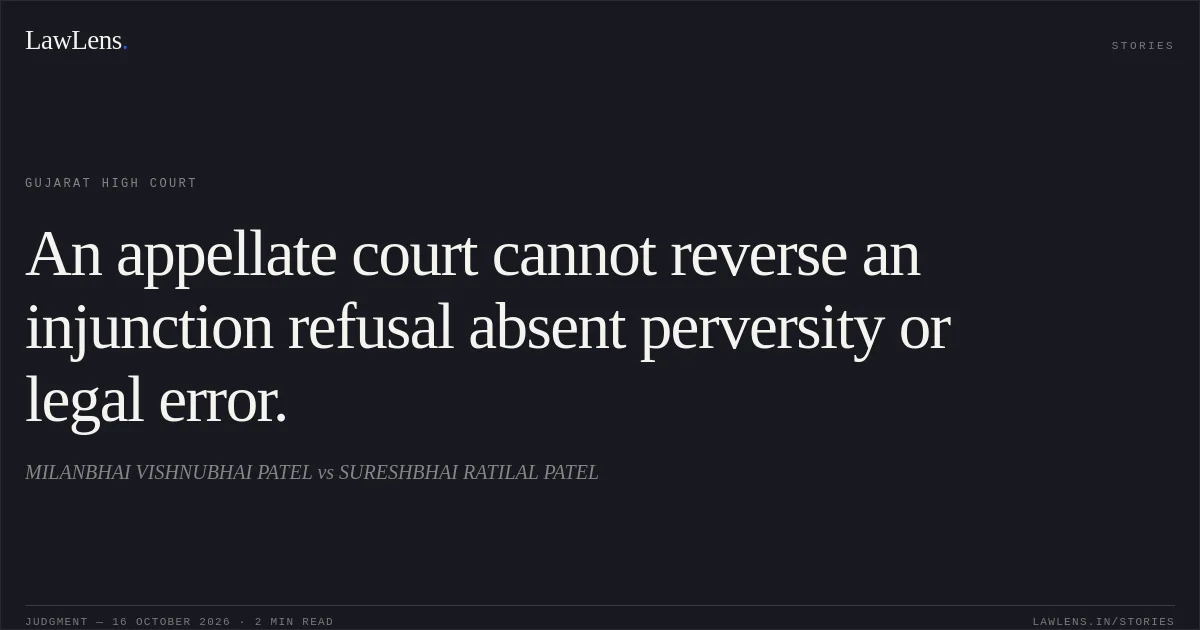
Source reference: para. 5, p. 4Under Wander Ltd. v. Antox India Private Ltd., 1990 Supp (1) SCC 27, an appellate court should not substitute its discretion for that of the court of first instance unless the latter’s exercise of discretion is arbitrary, capricious, perverse, or contrary to settled principles governing interlocutory injunctions.
Source reference: para. 8, p. 5Section 52 of the Transfer of Property Act, 1882, was mentioned in the appellate court’s discussion, but the High Court did not rely on it to decide the petition.
Source reference: para. 5, p. 4Reasoning
The High Court found that the appellate court had based its reversal chiefly on the possibility of further alienation and multiplicity of proceedings, without explaining how the plaintiffs had established the three requirements for an injunction.
Source reference: paras. 5–7, pp. 4–5The appellate court had also set aside the trial court’s order while expressly declining to express an opinion on the merits of the rival claims.
Source reference: paras. 6–7, p. 5Applying Wander, the High Court held that the appellate decision did not demonstrate a permissible basis for interfering with the trial court’s discretionary determination.
Source reference: paras. 8–9, p. 5Holding
The High Court held that the first appellate court’s order was inadequately reasoned and contrary to the principles governing appellate interference with discretionary injunction orders.
It set aside the judgment and order dated 29 August 2026 and allowed the petition.
Source reference: paras. 9–10, pp. 5–6Acts & Sections Cited
1 provisions across 1 statute referred to in this judgment. Each provision opens on LawLens.
Transfer of Property Act, 18821
Original Court PDF
MILANBHAI VISHNUBHAI PATELvsSURESHBHAI RATILAL PATEL
Click to open original judgment
Original judgment, available to read, download and summarize on LawLens.in