Facts
The appeal challenged a decree in a partition suit concerning property at E-79, Anand Niketan, New Delhi.
Source reference: p. 2The Single Judge had allowed the plaintiff’s application under Order XII Rule 6 CPC, declared the plaintiff and defendant No. 3 entitled to 1/4 shares each, and determined the remaining shares by intestate succession.
Source reference: pp. 2–7The dispute arose from rival Wills attributed to the parties’ father.
Source reference: pp. 2–7During the appeal, the parties reached a family settlement, recorded in a Memorandum of Family Settlement (MOFS) dated 10 September 2026 and accompanied by an Agreement to Sell and Construction Agreements.
Source reference: pp. 2–7They jointly applied to have the compromise recorded and a decree passed in its terms.
Source reference: pp. 2–7The parties’ statements were verified and recorded on oath before the Joint Registrar.
Source reference: p. 7Issues
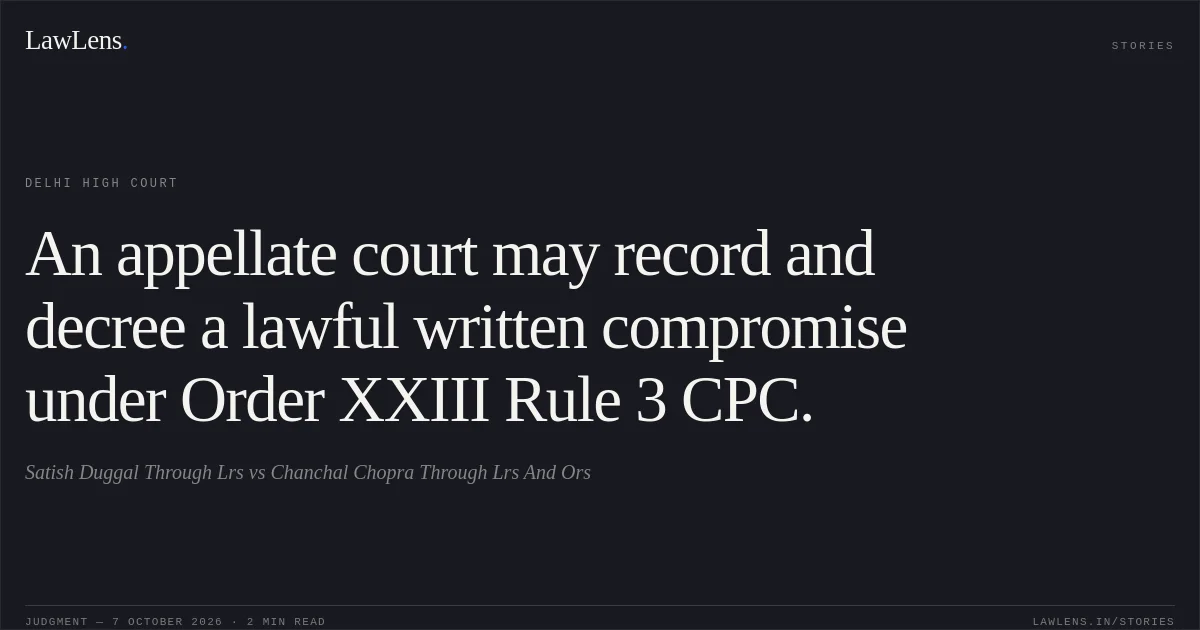
Whether the appellate court could record the parties’ compromise and pass a decree in its terms under Order XXIII Rule 3 CPC.
Source reference: p. 8Whether the MOFS and accompanying agreements constituted a lawful, voluntary compromise that could be recorded and made the basis of a decree.
Source reference: pp. 8–9Law Applied
Section 107(2) CPC confers on an appellate court the same powers as a court of original jurisdiction, including the power to record a compromise under Order XXIII Rule 3 CPC.
Source reference: p. 8A compromise may be recorded where it is in writing, signed by the parties, and lawful; the court must be satisfied that it is genuine and not unlawful.
Source reference: p. 8The application also invoked Section 151 CPC, but the judgment identified Section 107(2) and Order XXIII Rule 3 as the basis for recording the compromise.
Source reference: pp. 1, 8Reasoning
The Court examined the MOFS, its annexures, the joint application and supporting affidavits, together with the parties’ sworn statements.
Source reference: pp. 7–8The statements confirmed that the settlement had been entered into voluntarily, without coercion, undue influence, fraud, misrepresentation, threat or pressure, and that the parties undertook to perform its terms.
Source reference: pp. 7–8Finding the compromise written, signed, lawful and voluntary, and identifying no basis to regard it as unlawful or contrary to public policy, the Court accepted it.
Source reference: pp. 8–9It also clarified that the decree would operate only between the parties to the appeal; the rights and obligations involving the buyer and developer would be governed by their respective agreements.
Source reference: pp. 8–9Holding
The Court allowed the joint application, took the MOFS, Agreement to Sell and Construction Agreements on record, and modified the decree dated 20 March 2020 by passing a decree in terms of the MOFS and its annexures.
It directed that the parties remain bound by the settlement and their recorded statements, clarified the limited operation of the decree as between the appeal parties, and directed the Registry to draw up the decree sheet.
Source reference: pp. 8–9The appeal and pending applications were disposed of accordingly.
Source reference: p. 9Acts & Sections Cited
2 provisions across 1 statute referred to in this judgment. Each provision opens on LawLens.
Code of Civil Procedure, 19082
Original Court PDF
Satish Duggal Through LrsvsChanchal Chopra Through Lrs And Ors
Click to open original judgment
Original judgment, available to read, download and summarize on LawLens.in