Facts
The petitioners, convicted under Section 138 of the Negotiable Instruments Act, 1881 (NI Act), were sentenced to pay a fine of ₹2.25 crore.
Source reference: pp. 3–5They appealed under Section 374(3)(a) of the Code of Criminal Procedure, 1973 (CrPC), and sought suspension of sentence under Section 389(1) CrPC.
Source reference: pp. 3–5The Sessions Court suspended the sentence subject to deposit of 20% of the fine under Section 148 of the NI Act, without giving reasons for imposing that condition.
Source reference: pp. 3–5, 20–21The petitioners challenged the order under Section 482 CrPC, relying on Jamboo Bhandari v. Madhya Pradesh State Industrial Development Corporation Ltd.
Source reference: pp. 3–5, 20–21Issues
Whether the appellate court had power under Section 148 of the NI Act to direct deposit of 20% of the fine while considering an application to suspend sentence under Section 389 CrPC.
Source reference: p. 6Whether the deposit condition could be imposed without reasons addressing whether the case warranted an exception under Jamboo Bhandari.
Source reference: pp. 20–21Law Applied
Section 389(1) CrPC empowers an appellate court to suspend execution of a sentence for reasons recorded in writing.
Source reference: pp. 6–13Section 148(1) of the NI Act authorises the appellate court, in an appeal against conviction under Section 138, to direct deposit of at least 20% of the fine or compensation; under Surinder Singh Deswal v. Virender Gandhi, such a direction is ordinarily the rule, and dispensing with it requires special reasons.
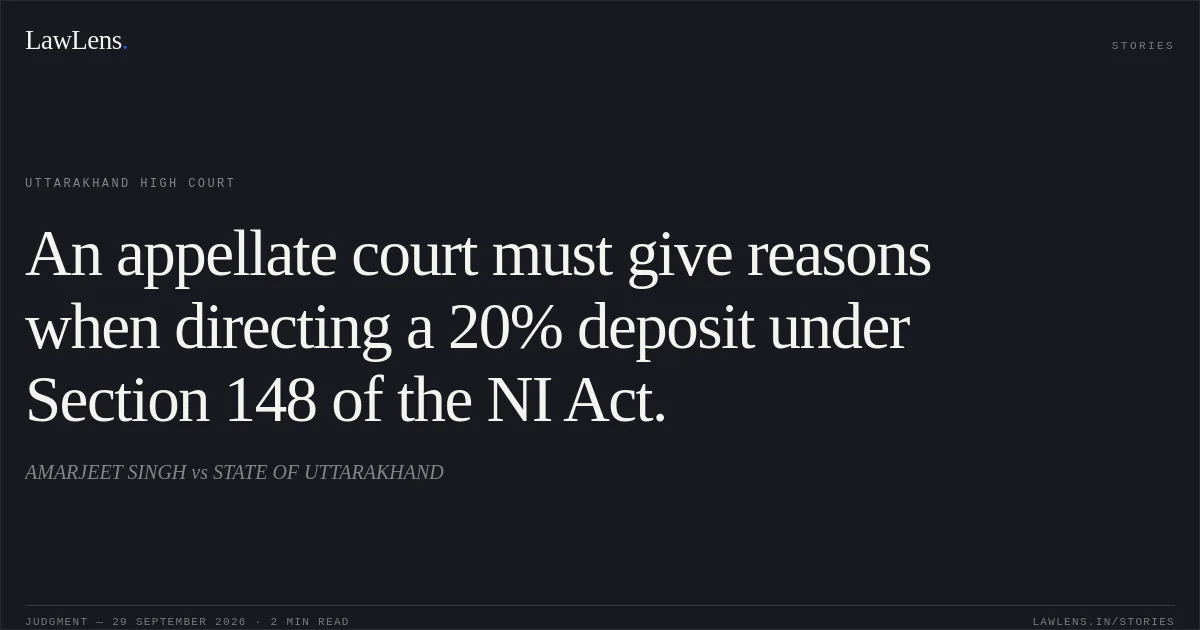
Source reference: pp. 6–13, 16–20Jamboo Bhandari v. Madhya Pradesh State Industrial Development Corporation Ltd. clarifies that the appellate court may make an exception where the deposit condition would be unjust or would effectively deprive the appellant of the right of appeal, but must specifically record its reasons for doing so.
Source reference: pp. 16–20Reasoning
The High Court accepted that Section 148 permits the appellate court to impose the deposit condition while deciding an application under Section 389 CrPC.
Source reference: pp. 20–21However, the appellate court’s order merely found that the appellants had an arguable case on the merits and made suspension conditional on deposit of 20%; it gave no reasons addressing whether the condition was appropriate or whether the case called for an exception under Jamboo Bhandari.
Source reference: pp. 20–21The order was therefore inadequately reasoned and inconsistent with the governing principles.
Source reference: pp. 20–21Holding
The High Court allowed the petition and quashed the Sessions Court’s order dated 25 March 2026.
It remitted the matter for fresh consideration of the application to suspend sentence and directed that the sentence remain suspended until the appellate court passed a fresh order.
Source reference: pp. 21–22Acts & Sections Cited
11 provisions across 3 statutes referred to in this judgment. Each provision opens on LawLens.
Code of Criminal Procedure, 19737
Negotiable Instruments Act, 18813
Indian Penal Code, 18601
Original Court PDF
M/S NANDHINI BUILDERS PVT LTDvsSRI S CHINNA SWAMY
Click to open original judgment
Original judgment, available to read, download and summarize on LawLens.in