Facts
Falguniben was found dead by hanging at her matrimonial home.
Source reference: no citationHer father alleged dowry-related cruelty and a homicidal death, and a complaint was registered under Sections 302, 498A and 120B of the Indian Penal Code (IPC).
Source reference: no citationThe Sessions Court acquitted the accused, finding the prosecution case unproved.
Source reference: no citationIn the State’s appeal, the High Court had already recorded that the appeal abated as to respondents 1 and 5, who had died during its pendency.
Source reference: para. 1–2.4The State challenged the assessment of the family witnesses, the medical evidence and the potential presumption under Section 113A of the Evidence Act.
Source reference: para. 3.1–3.5Issues
Whether the prosecution proved cruelty, conspiracy or intentional killing by the accused beyond reasonable doubt, including whether the evidence established a basis to presume abetment of suicide under Section 113A of the Evidence Act.
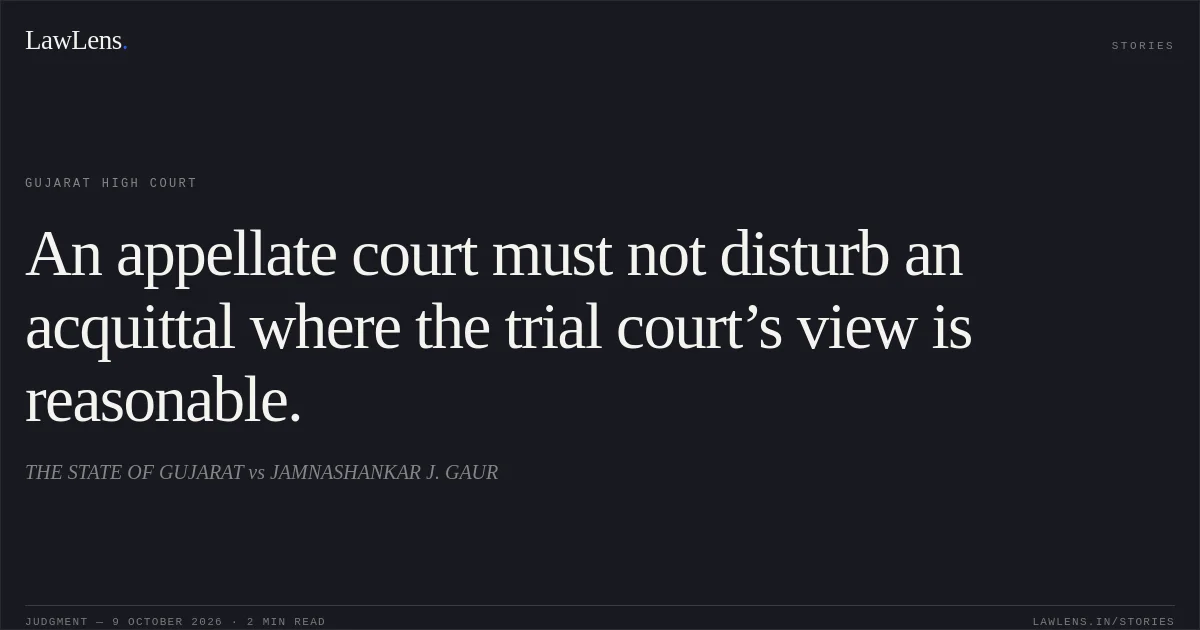
Source reference: para. 3.1, 14, 22–26Whether the Sessions Court’s acquittal was unreasonable or perverse so as to warrant appellate interference.
Source reference: para. 23, 27–28Law Applied
Sections 302, 498A and 120B IPC governed the charged offences.
Source reference: no citationSection 113A of the Evidence Act permits, but does not compel, a presumption of abetment where a married woman dies by suicide within seven years of marriage and it is proved that her husband or relative subjected her to cruelty; the court must consider all the circumstances.
Source reference: para. 4.2; see also para. 3.1In a case based on circumstantial evidence, the relied-on circumstances must be proved, point unerringly to guilt, form a complete chain consistent only with guilt, and exclude other reasonable hypotheses.
Source reference: para. 25–26, citing Sharad Birdhichand Sarda v. State of Maharashtra and Shailendra Rajdev Pasvan v. State of Gujarat, through Laxman Prasad Alias LaxmanAn appellate court should not interfere with an acquittal merely because another view is possible; interference is warranted where the acquittal is perverse or otherwise unreasonable, bearing in mind that acquittal reinforces the presumption of innocence.
Source reference: para. 23, 27, citing Tulasareddi @ Mudakappa & Anr. v. State of Karnataka & Ors., 2026 INSC 67Reasoning
The Court found that the sister’s account of beatings and dowry harassment was materially improved at trial and inconsistent with her admission that she had not discussed the deceased’s married life with her.
Source reference: para. 6–8The relative’s account of harassment was hearsay and lacked particulars of any dowry demand.
Source reference: para. 9–10The doctor’s opinion was that death resulted from hanging and was suicidal; although the post-mortem records contained irregularities and noted injuries, the medical evidence did not establish homicidal strangulation or an assault followed by hanging.
Source reference: para. 11–14The postcard and diary were not properly proved, did not reliably identify their author or implicate the accused, and were accompanied by inconsistencies in the panch witness’s evidence.
Source reference: para. 15–21The Court therefore found no reliable proof of cruelty on which to base a Section 113A presumption, and no complete circumstantial chain establishing the charged offences.
Source reference: para. 14, 22–26The Sessions Court’s view was a reasonable one, not a perverse view warranting appellate intervention.
Source reference: para. 23, 27Holding
The High Court held that the prosecution had not proved the accused’s involvement in cruelty, conspiracy or intentional killing beyond reasonable doubt, and that the acquittal did not call for appellate interference.
The appeal was dismissed; it had previously abated as to respondents 1 and 5.
Source reference: para. 2.4, 23–28Acts & Sections Cited
3 provisions across 2 statutes referred to in this judgment. Each provision opens on LawLens.
Code of Criminal Procedure, 19732
Indian Penal Code, 18601
Original Court PDF
THE STATE OF GUJARATvsJAMNASHANKAR J. GAUR
Click to open original judgment
Original judgment, available to read, download and summarize on LawLens.in