01Facts
The parties’ registered Lease Deed provided, among other things, for termination by the lessee on six months’ written notice under Clause 21.1, and for termination in specified circumstances under Clauses 21.2–21.4.
¶ 3–8, 13–17, 23–26The tenant gave notice on 1 May 2021 to terminate the lease and surrender possession by 31 October 2021, but the landlord disputed the termination and claimed rent and interest for a later period.
¶ 3–8, 13–17, 23–26The arbitrator held the notice invalid because it did not establish grounds under Clauses 21.2–21.4, and awarded the tenant the balance of its security deposit after adjusting rent and interest.
¶ 3–8, 13–17, 23–26On the tenant’s Section 34 application, the Commercial Court held that Clause 21.1 independently permitted termination on notice and set aside the award’s findings on post-termination rent and interest, while leaving intact the security-deposit refund and interest.
¶ 3–8, 13–17, 23–26The landlord appealed under Section 37 of the Arbitration and Conciliation Act, 1996.
¶ 3–8, 13–17, 23–2602Issues
i.1. Whether the Commercial Court was justified in finding patent illegality in the arbitrator’s interpretation of Clause 21 and in holding the termination notice valid, thereby setting aside the consequential rent and interest liability
¶ 29ii.2. Whether the Commercial Court could set aside the rent and interest portions of the award while preserving the determination on refund of the security deposit and interest
¶ 35–3903Law Applied
Under Sections 34 and 37 of the Arbitration and Conciliation Act, 1996, a court does not sit in appeal over an arbitral award or substitute its view merely because another interpretation is possible.
¶ 30However, a domestic award may be set aside for patent illegality where the tribunal’s contractual construction is perverse, irrational, or not one that a fair or reasonable person could adopt (*DMRC Ltd. v. Delhi Airport Metro Express (P) Ltd.*, (2024) 6 SCC 357).
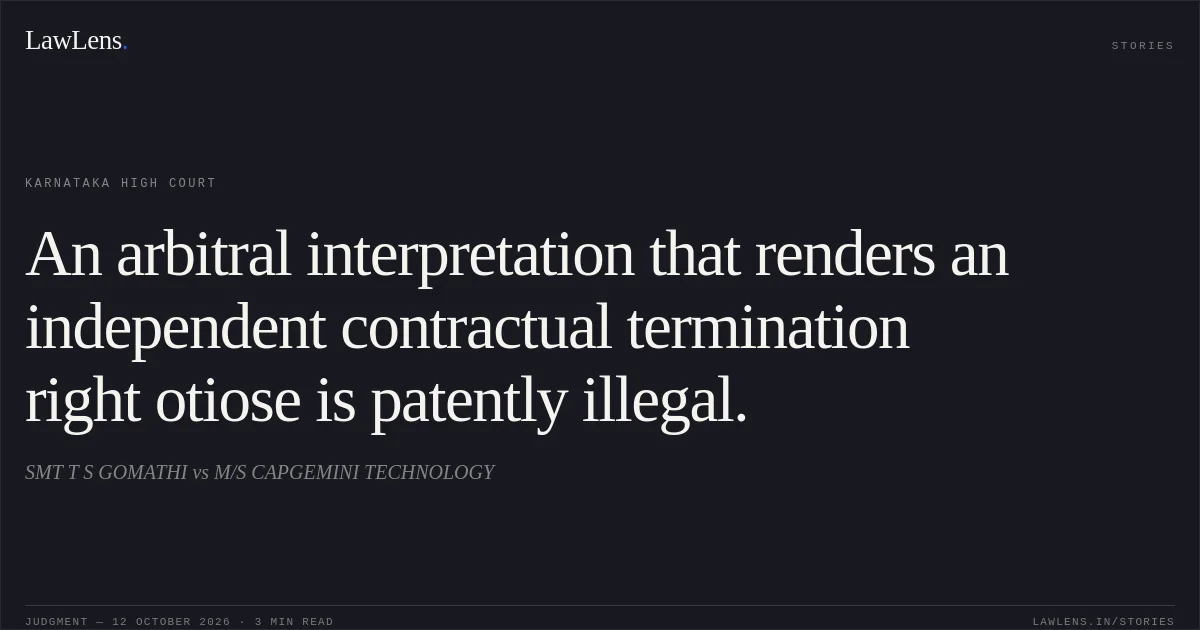
¶ 30Contractual provisions should, so far as possible, be construed harmoniously to give effect to each provision; an interpretation that renders an express right otiose is impermissible.
¶ 32–34Under *Gayatri Balasamy v. ISG Novasoft Technologies Ltd.*, (2025) 7 SCC 1, an award may be set aside in part where the valid and invalid portions are legally and practically separable.
¶ 36, 39Provisions in the judgment · 4 · Linked ones open on LawLens
Commercial Courts Act, 2015 Section 13
Arbitration and Conciliation Act, 1996 Section 37Section 34Section 28
04Reasoning
Clause 21.1 expressly granted the lessee a right to terminate by six months’ written notice, while Clauses 21.2–21.4 addressed termination in specified circumstances.
¶ 32–39The arbitrator’s view that a Clause 21.1 notice had to establish one of those specified circumstances made the independent notice-based right substantially otiose and was not a reasonable construction of the Lease Deed.
¶ 32–39The Commercial Court therefore properly found patent illegality in the arbitrator’s invalidation of the notice.
¶ 32–39Because the rent and related interest liability flowed from that invalidation, those findings fell with it.
¶ 32–39The security-deposit refund and interest, however, were independently determined and could stand without the rent findings; their preservation was consistent with the separability principle.
¶ 32–3905Holding
The High Court answered the principal issue in the affirmative and upheld the Commercial Court’s intervention under Section 34, including its partial setting aside of the arbitral award.
¶ 39–40It dismissed the appeal, directed that the appellant’s deposited sum of Rs.54,67,179.97 be credited towards the amount payable under the award as modified by the Commercial Court, and made no order as to costs.
¶ 39–40Original Court PDF
SMT T S GOMATHIvsM/S CAPGEMINI TECHNOLOGY
Click to open original judgment
Original judgment, available to read, download and summarize on LawLens.in