Facts
The dispute arose from a construction and development contract for the project “Sikka Kamya Greens, Sector-10, Greater Noida,” awarded to the respondent for Rs. 53,73,50,000, with completion stipulated within 34 months, by 8 February 2019.
Source reference: p.1During execution, disputes arose concerning delay, non-release of payments, supply of materials, site hindrances and responsibility for prolongation. The parties executed an MOU dated 27 September 2018, whose effect was disputed.
Source reference: p.2The respondent invoked arbitration on 13 July 2020, and a sole arbitrator was appointed by consent of the parties.
Source reference: p.2A Local Commissioner/independent engineer inspected the site and submitted reports concerning the work executed and materials, machinery and equipment allegedly lying at the site.
Source reference: p.2The respondent raised twelve claims totalling Rs. 15,07,05,796, while the petitioner raised thirteen counterclaims totalling Rs. 4,02,71,750.
Source reference: p.3The tribunal held the petitioner responsible for the contractual breaches and delay, partly allowed claims relating to work executed, WCT, idling of machinery, additional overheads, material at site and loss of profit, and rejected the petitioner’s counterclaims.
Source reference: p.3The tribunal subsequently passed an additional award correcting a computational error in claim no. 6, increasing the amount from Rs. 2,04,53,218 to Rs. 2,84,53,218.
Source reference: p.4The petitioner challenged both awards under Section 34 of the Arbitration and Conciliation Act, 1996, contending, inter alia, that the tribunal’s mandate had expired, that material recorded during unsuccessful conciliation had been improperly relied upon, and that the awards under claims nos. 1, 4, 6, 8 and 9 lacked evidentiary and legal foundation.
Source reference: pp.4–5Issues
Whether the arbitral tribunal’s mandate had expired under Section 29A(1) of the Arbitration and Conciliation Act, 1996 before the award was pronounced?
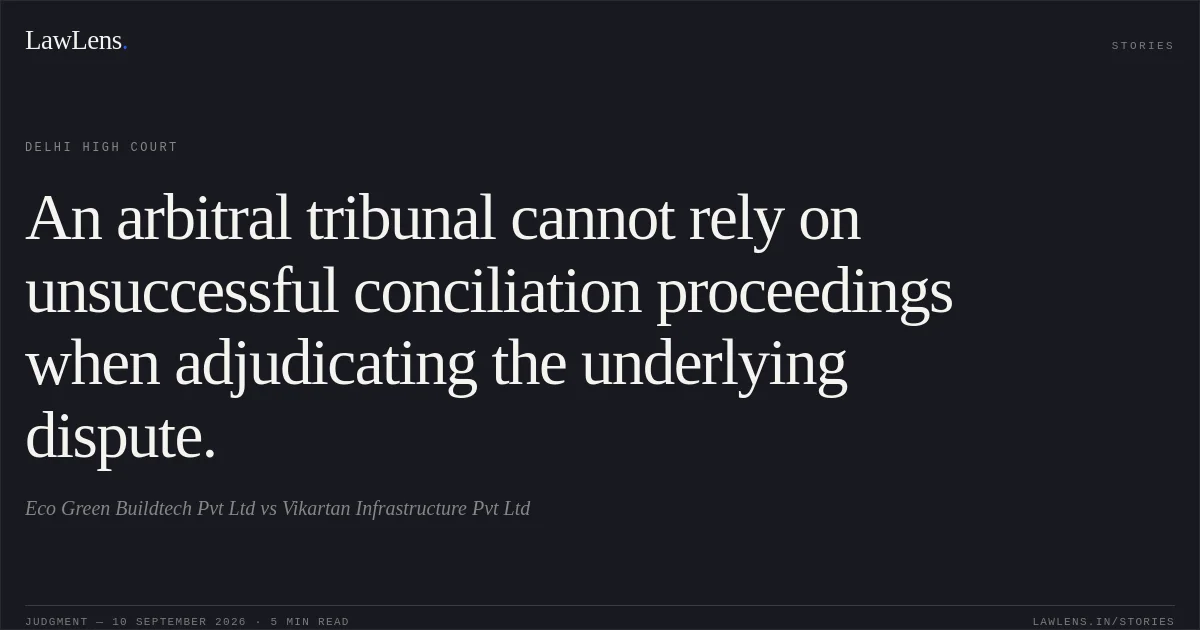
Source reference: pp.4, 7Whether statements, concessions or discussions recorded during unsuccessful conciliation proceedings could be relied upon in the subsequent adjudication of the arbitration?
Source reference: pp.7–11Whether the tribunal’s award under claim no. 1, concerning the value of work executed, was sustainable in the absence of reconciliation of payments, proper consideration of the MOU and an opportunity to object to the Local Commissioner’s report?
Source reference: pp.4, 9–12Whether the awards under claims nos. 4 and 6, relating to idling of resources and additional overheads, were legally sustainable without proof of actual loss or expenditure?
Source reference: pp.12–15Whether the award under claim no. 8, concerning material allegedly lying at the site, was sustainable without proof of ownership, existence and valuation of the material?
Source reference: pp.15–16Whether the award under claim no. 9 for loss of profit or profitability could be sustained merely on the basis of the Hudson formula, personal experience and unproved trade usage, without credible evidence of actual loss?
Source reference: pp.16–18Law Applied
The Court applied Section 29A(1) of the Arbitration and Conciliation Act, 1996, under which an arbitral tribunal in a domestic arbitration must make the award within twelve months from completion of pleadings.
Source reference: p.7It applied the principles of confidentiality governing mediation and conciliation, relying on Moti Ram v. Ashok Kumar, (2011) 1 SCC 466, and Perry Kansagra v. Smriti Madan Kansagra, (2019) 20 SCC 753, which hold that unsuccessful settlement discussions, offers and concessions cannot be used in subsequent adjudication.
Source reference: pp.10–11Sections 18 and 24(3) of the Arbitration Act require equal treatment, a fair opportunity to present one’s case, and disclosure of material relied upon by the tribunal.
Source reference: pp.15, 14For damages, the Court applied Sections 55 and 73 of the Indian Contract Act, 1872, holding, with reference to Fateh Chand v. Balkishan Dass and Kailash Nath Associates v. DDA, (2015) 4 SCC 136, that breach alone is insufficient and consequential actual loss or damage must be established.
Source reference: p.13For loss of profit, the Court relied on Unibros v. All India Radio, 2023 SCC OnLine SC 1366, which requires proof of delay, absence of responsibility for the delay on the claimant’s part, the claimant’s status as an established contractor, and credible evidence of loss; the Hudson formula is only an estimating tool and cannot itself prove loss.
Source reference: pp.16–17Reasoning
The Court rejected the limitation challenge because the rejoinder, though dated 25 February 2022, was actually filed on 10 May 2022; the award dated 28 February 2023 was therefore within twelve months of completion of pleadings.
Source reference: p.7However, it held that the tribunal had improperly relied on matters recorded during the attempted conciliation, including the petitioner’s alleged acceptance of the Local Commissioner’s report. Such settlement discussions were confidential and could not substitute for a procedurally fair adjudication.
Source reference: pp.8–11Claim no. 1 was unsustainable because the tribunal failed to reconcile the MOU figure of Rs. 11,82,55,494 with the amount of Rs. 10,72,84,936 allegedly received, relied on a self-serving document, and did not provide an effective opportunity to object to the Local Commissioner’s report.
Source reference: p.12Although the petitioner did not dispute deduction and non-deposit of WCT, claims nos. 4 and 6 failed because the respondent produced no proof of actual rent, expenditure or additional overheads; the tribunal’s personal experience, trade practice and CPWD circulars could not replace evidence, particularly when the circulars had not been confronted to the petitioner in breach of Section 24(3).
Source reference: pp.12–15Claim no. 8 also failed because the respondent did not prove ownership, existence or value of the material at site, and the tribunal’s site inspection and reliance on the conciliation record did not cure the evidentiary and procedural defects.
Source reference: p.16Finally, claim no. 9 was improperly quantified at 7.5% of the balance contract value based on personal experience and unproved trade usage; reliance on the Hudson formula did not establish actual loss or satisfy the requirements stated in Unibros.
Source reference: pp.16–18Holding
The Court held that the tribunal’s mandate had not expired, but found the awards legally unsustainable on account of reliance on confidential conciliation proceedings, denial of a fair opportunity to challenge material evidence, failure to reconcile relevant payment figures, and awards of damages unsupported by proof of actual loss or rational quantification.
Although no interference was warranted with claim no. 3 concerning WCT, the Court concluded that the defects affecting the impugned adjudication warranted setting aside the award dated 28 February 2023 and the additional award dated 27 March 2023 in their entirety.
Source reference: p.19The petition under Section 34 was accordingly allowed, and the pending application was disposed of.
Source reference: p.19Acts & Sections Cited
8 provisions across 2 statutes referred to in this judgment. Each provision opens on LawLens.
Arbitration and Conciliation Act, 19966
Indian Contract Act, 18722
Original Court PDF
Eco Green Buildtech Pvt LtdvsVikartan Infrastructure Pvt Ltd
Click to open original judgment
Original judgment, available to read, download and summarize on LawLens.in