01Facts
IRCON, the petitioner, engaged Kanchanjunga Construction Co. Pvt. Ltd. (KCCPL), the respondent, as a subcontractor for part of a highway project in Nepal.
pp. 1–6The works were delayed amid material-supply issues and political unrest, including bandhs.
pp. 1–6After the subcontract was closed, KCCPL claimed, among other things, compensation for idling of resources and interest.
pp. 1–6The sole arbitrator allowed idling compensation for 248 days, price adjustment, and compound interest, and rejected IRCON’s counterclaims.
pp. 1–6IRCON challenged the award under Section 34 of the Arbitration and Conciliation Act, 1996, principally contesting the idling award and compound interest.
pp. 1–6The Court assessed the challenge under the pre-2015 amendment framework.
p. 602Issues
i.1. Whether the arbitrator’s award of idling compensation, despite contractual provisions concerning force majeure and bandh-related extensions, was contrary to the contract and the unamended Section 28(3) of the Act.
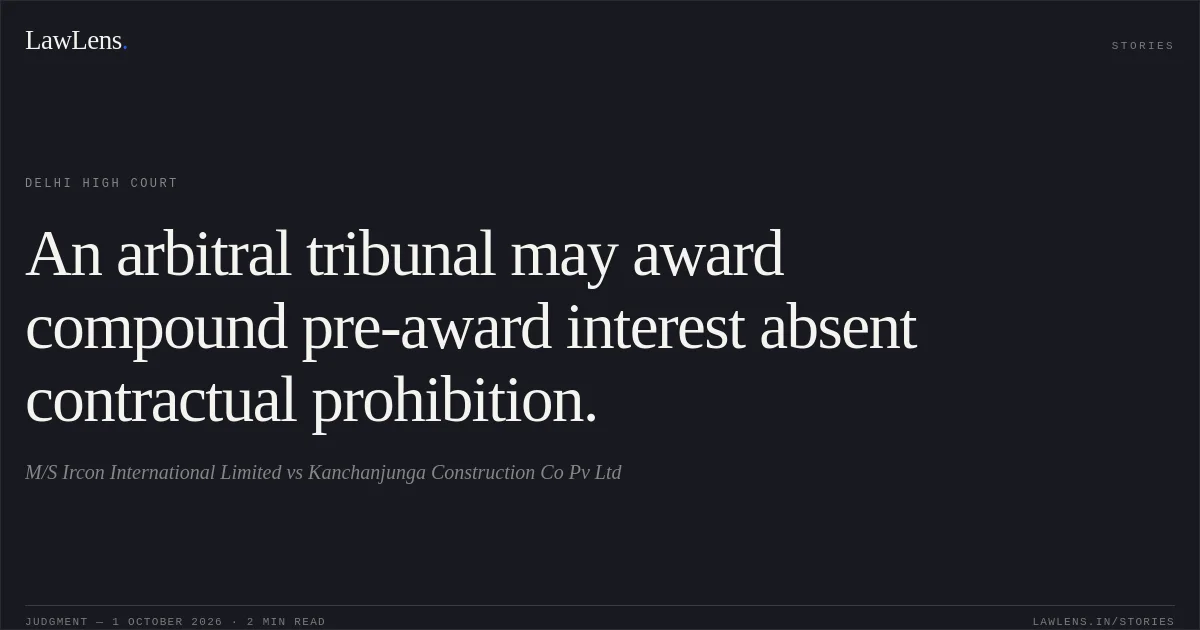
pp. 15–19ii.2. Whether, absent a contractual prohibition, the arbitrator could award compound interest for the pre-award period under Section 31(7)(a) of the Act.
pp. 19–2803Law Applied
Under the pre-amendment Section 28(3) of the Arbitration and Conciliation Act, 1996, an arbitral tribunal was required to decide in accordance with the contract; an award departing from contractual terms could be set aside if the departure amounted to patent illegality going to the root of the matter.
pp. 6–12ONGC Ltd. v. Saw Pipes Ltd., Associate Builders v. DDA and related authorities set out the limits on interference under Section 34, including that a reasonable contractual interpretation is not open to review.
pp. 6–12Section 31(7)(a) empowers an arbitral tribunal, unless the parties have agreed otherwise, to award interest at a rate it considers reasonable for all or part of the period from the cause of action to the award; contractual silence is not, by itself, an exclusion of that power.
pp. 20–24In Hyder Consulting (UK) Ltd. v. State of Orissa, the Supreme Court held that the Act permits compound interest where the tribunal awards it in exercising its statutory discretion.
pp. 24–28Provisions in the judgment · 17 · Linked ones open on LawLens
Arbitration and Conciliation Act, 1996 13 provisions
Section 34Section 13Section 16Section 28Section 31Section 17Section 21Section 23Section 24Section 25Section 26Section 29Section 85Indian Contract Act, 1872 Section 73Section 74
04Reasoning
On idling costs, the Court noted that the arbitrator had found the claim unsustainable under the contract when considered in isolation.
pp. 17–19However, the arbitrator also relied on IRCON’s undisputed representation that it would accept KCCPL’s claim on the same basis as IRCON’s own idling-cost recovery from the Government of Nepal, subject to supporting documentation.
pp. 17–19IRCON had itself relied on KCCPL’s records to pursue that recovery.
pp. 17–19The Court treated the representation and conduct as an admission and waiver, and held that IRCON could not rely on the contractual bar to resile from its undertaking.
pp. 17–19On interest, the Court held that the contract contained no prohibition on interest and that silence did not displace the discretion under Section 31(7)(a).
pp. 21–28Applying Hyder Consulting, it found that compound interest was within the arbitrator’s power and that no basis for interference had been shown.
pp. 21–2805Holding
The Court rejected both challenges.
pp. 18–19, 27–28It held that the award of idling compensation for 248 days was sustainable in light of IRCON’s admission and waiver, and that the award of compound interest was permissible under Section 31(7)(a).
pp. 18–19, 27–28The Section 34 petition was dismissed, along with any pending applications.
p. 28Original Court PDF
M/S Ircon International LimitedvsKanchanjunga Construction Co Pv Ltd
Click to open original judgment
Original judgment, available to read, download and summarize on LawLens.in