Facts
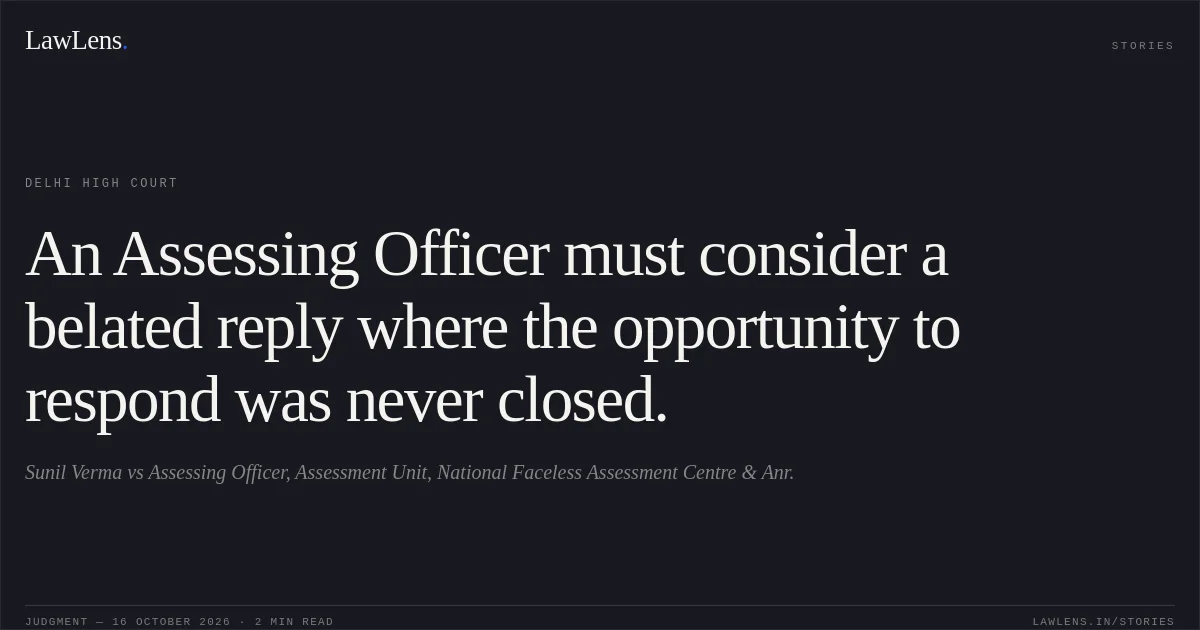
The petitioner challenged an assessment order dated 6 March 2026, passed under Sections 144 and 144B of the Income Tax Act, 1961, alleging denial of natural justice.
Source reference: p.1, para. 1After responding to a notice under Section 142(1) on 20 August 2025, he received a show-cause notice with a lengthy questionnaire on 4 February 2026, requiring a response by 8 February 2026.
Source reference: p.2, paras. 3–4He sought an adjournment on 9 February, then submitted a reply on 3 March, which the Assessing Officer viewed on 4 March. The assessment order was uploaded on 9 March, without addressing that reply or providing the requested video-conference hearing.
Source reference: pp.2–3, paras. 5–9The respondents argued that the adjournment request was made after the response deadline.
Source reference: pp.3–4, paras. 10–11Issues
1. Whether the assessment order should be set aside where the Assessing Officer did not consider the petitioner’s reply, submitted after the stated deadline but viewed before the order was issued.
Source reference: pp.4–5, paras. 13–152. Whether the petitioner should be afforded a video-conference hearing before a fresh assessment order is passed.
Source reference: p.5, para. 15Law Applied
The assessment was made under Sections 144 and 144B of the Income Tax Act, 1961.
Source reference: p.1, para. 1The Court applied the principles of natural justice and fair, objective consideration of material available on the record, observing that an Assessing Officer, as a quasi-judicial authority, must deal with that material dispassionately.
Source reference: p.4, para. 14No precedent was cited.
Source reference: no citationReasoning
The Court accepted that the petitioner should have sought an adjournment by the stipulated deadline and held that the Assessing Officer could not be faulted merely for proceeding after the late request.
Source reference: p.4, paras. 13–14However, the Assessing Officer had neither closed the petitioner’s right to reply nor informed him that it was closed; moreover, only four days had been allowed to respond to a lengthy questionnaire after a six-month interval. Since the reply was ultimately submitted and viewed before the assessment order was issued, fairness required that it be considered.
Source reference: pp.4–5, paras. 14–15The Court also directed that the petitioner be given a video-conference hearing.
Source reference: pp.4–5, paras. 14–15Holding
The Court quashed and set aside the assessment order dated 6 March 2026.
It directed the Assessing Officer/NFAC to fix a hearing, provide the petitioner a video-conference link, consider his reply dated 3 March 2026 and any oral submissions, and pass a fresh order in accordance with law.
Source reference: p.5, paras. 15–16The Court made no findings on the merits of the petitioner’s contentions.
Source reference: p.5, para. 16The writ petition and pending applications were disposed of.
Source reference: p.5, para. 17Acts & Sections Cited
3 provisions across 1 statute referred to in this judgment. Linked provisions open on LawLens.
Income Tax Act, 19613
Original Court PDF
Sunil VermavsAssessing Officer, Assessment Unit, National Faceless Assessment Centre & Anr.
Click to open original judgment
Original judgment, available to read, download and summarize on LawLens.in