Facts
The petitioner, a Nepalese citizen, and his brother, Ramesh Kumar Agrawal, jointly invested in three SBI term deposits/STDRs bearing Nos. 926482, 926483 and 926484, issued on 21.11.1993 and operated under the mandate “Either or Survivor”.
Source reference: paras. 2–3; pp. 2–3The deposits matured on 21.11.2003. On the maturity date, the petitioner presented the original deposit certificates to SBI’s Jogbani Branch, but the Bank did not release the proceeds, stating that duplicate STDRs had allegedly been issued at the request of the petitioner’s brother on the ground that the originals had been lost.
Source reference: paras. 3–4; pp. 3–4The petitioner’s brother died issueless on 03.02.2021, after which the petitioner claimed to be the sole surviving claimant.
Source reference: para. 5; p. 4The Bank contended that payment had been withheld because of the duplicate STDRs and the objection raised by the other joint holder, and also challenged the writ petition on the grounds of disputed facts, money claim, and delay of approximately 20 years.
Source reference: paras. 11–17; pp. 9–12Issues
1. Whether the petitioner, as one of the joint holders under an “Either or Survivor” mandate, was entitled to receive the maturity proceeds of the three STDRs without the presence, consent, or signature of the other joint holder.
Source reference: paras. 25–31; pp. 15–192. Whether the Bank could withhold payment on the basis of allegedly issued duplicate STDRs and a subsequent objection by the other joint holder, in the absence of any order of a competent court restraining payment.
Source reference: paras. 27–32; pp. 16–193. Whether the writ petition was maintainable despite involving a monetary claim, disputed factual matters, and an alleged delay of about 20 years.
Source reference: paras. 11, 17, 33; pp. 9–12, 19–204. Whether the petitioner was entitled to interest on the maturity proceeds from the date on which the deposits became payable.
Source reference: paras. 34–37; pp. 20–21Law Applied
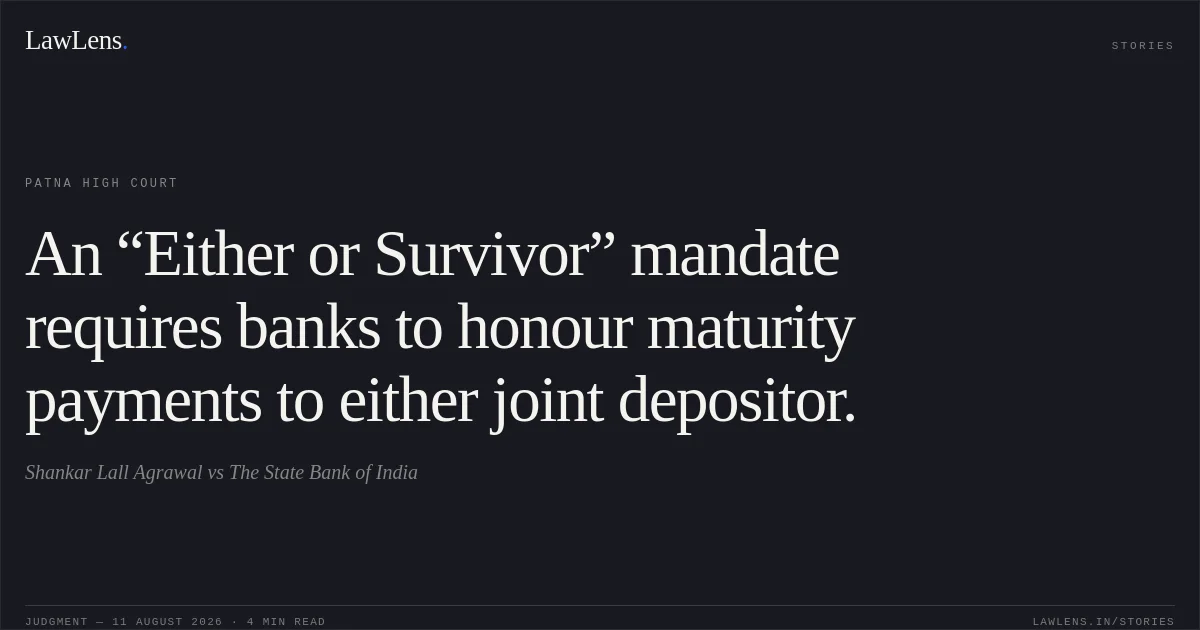
The Court applied the contractual principle governing joint deposits operated under an “Either or Survivor” instruction, namely, that either account holder may receive the maturity proceeds and that payment to either holder constitutes a valid discharge by the bank.
Source reference: para. 10; pp. 6–9Relying on the Supreme Court precedent reported in (2004) 8 SCC 498, the Court held that the operating mandate forms part of the tripartite contractual arrangement between the bank and the joint depositors and cannot be unilaterally varied by one depositor; issuance of a duplicate fixed-deposit receipt or alteration of the account instructions requires the consent of all joint holders.
Source reference: paras. 10, 31; pp. 6–9, 18–19The Court also relied on the Reserve Bank of India circular dated 04.11.2011, which clarifies that both depositors’ signatures or presence are not required for payment of a term deposit on maturity where the account is operated under an “Either or Survivor” mandate.
Source reference: paras. 7, 28, 35; pp. 5–6, 16–18It further applied the principle that writ jurisdiction may be exercised where the material facts are substantially undisputed and the dispute concerns enforcement of a contractual/public duty by a bank.
Source reference: para. 33; pp. 19–20Reasoning
The Court found that the joint holding, the “Either or Survivor” mandate, maturity of the deposits, and presentation of the original STDR certificates by the petitioner were not seriously disputed.
Source reference: paras. 25, 33; pp. 15–16, 19–20Under the governing contractual mandate and RBI clarification, the petitioner was entitled to seek payment independently on maturity.
Source reference: no citationThe Bank’s reliance on duplicate STDRs allegedly obtained at the unilateral request of the other joint holder could not defeat the petitioner’s rights, particularly since the original instruments had been produced and the Bank failed to establish any valid application, legal impediment, or court order restraining payment.
Source reference: paras. 29–31; pp. 17–19The subsequent objection by the other joint holder could not, by itself, withdraw or override the agreed operating mandate.
Source reference: no citationThe Court also noted that the Bank had adopted shifting grounds—duplicate STDRs, absence of the joint holder, and an alleged family dispute—which did not justify withholding the money indefinitely.
Source reference: para. 32; p. 19Since the core facts were undisputed and the issue primarily concerned the Bank’s obligation to honour the deposit mandate, the objections concerning maintainability, disputed facts, and delay were rejected.
Source reference: para. 33; pp. 19–20As the petitioner had been deprived of the use of his money due to the Bank’s actions, he was held entitled to interest in accordance with law.
Source reference: para. 34; p. 20Holding
The Court held that the Bank’s refusal to release the maturity proceeds was unjustified and contrary to the “Either or Survivor” mandate and the applicable RBI guidelines.
The writ petition was allowed, and SBI was directed to release the maturity proceeds of all three STDRs in favour of the petitioner, together with interest applicable in accordance with law from the date the amounts became payable until actual payment.
Source reference: para. 37; p. 21The Bank was directed to complete the exercise within three months from the date of receipt or production of a copy of the judgment.
Source reference: para. 37; p. 21Original Court PDF
Shankar Lall AgrawalvsThe State Bank of India
Click to open original judgment
Original judgment, available to read, download and summarize on LawLens.in