Facts
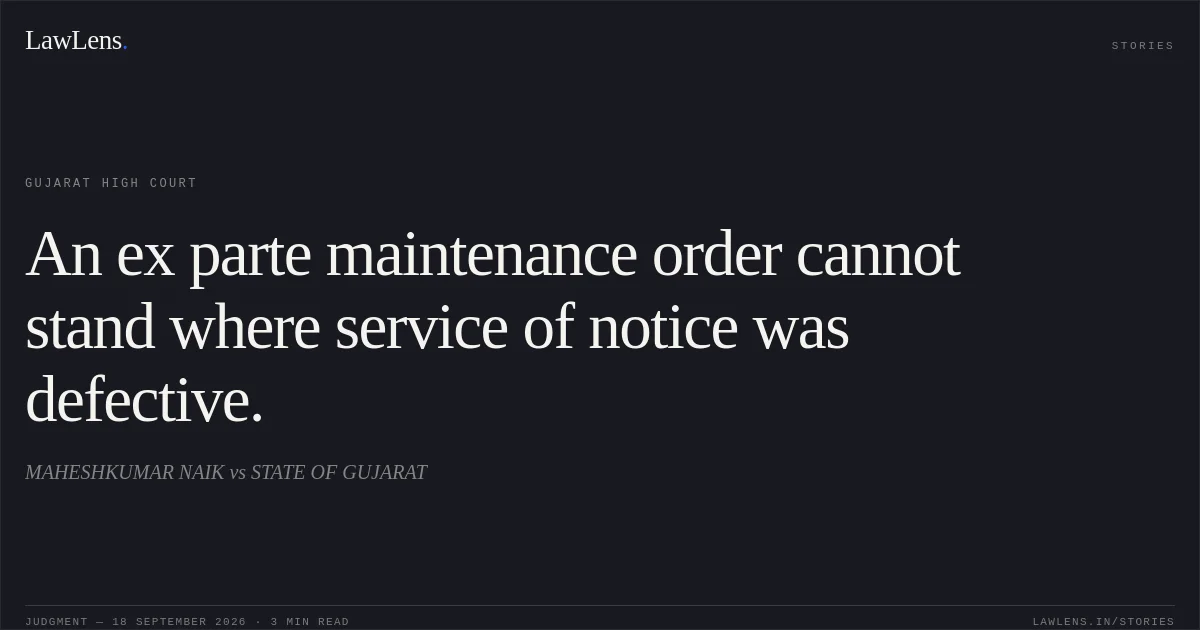
The applicant challenged, under Sections 397 and 401 of the Code of Criminal Procedure, 1973, the ex parte order dated 9 December 2014 passed by the Principal Judge, Family Court, Rajkot, in Criminal Misc. Application No. 373 of 2014.
Source reference: para. 1; p. 1By that order, the Family Court had partly allowed the respondents’ application under Section 125 CrPC and awarded monthly maintenance, residential expenses, and costs.
Source reference: para. 1; p. 1The applicant contended that he had not been duly served and that the postal endorsement, written in Marathi, did not indicate refusal of service.
Source reference: paras. 3–5; pp. 2–3According to his affidavit dated 20 August 2026, the endorsement meant that the address could not be found and the notice had been returned unserved on 7 May 2014.
Source reference: paras. 3–5; pp. 2–3He also submitted that respondent no. 2 was gainfully employed and earning an income, but that issue had not been considered by the Family Court.
Source reference: para. 3; p. 2Respondent nos. 2 to 4 were served in the revision proceedings but did not appear.
Source reference: para. 2; p. 2Issues
Whether the Family Court was justified in treating the applicant as duly served and proceeding ex parte when the notice was allegedly returned because the address could not be located
Source reference: paras. 3, 5–7; pp. 2–5Whether the ex parte maintenance order could be sustained when the applicant was not afforded a fair opportunity to contest the Section 125 CrPC proceedings
Source reference: paras. 5–8; pp. 3–5Whether the matter should be remanded for fresh adjudication, including consideration of the applicant’s contention regarding respondent no. 2’s employment and income
Source reference: paras. 7–10; pp. 5–6Law Applied
The Court exercised revisional jurisdiction under Sections 397 and 401 CrPC and considered the legality of the ex parte order passed in proceedings under Section 125 CrPC.
Source reference: para. 1; p. 1It applied the principles of natural justice, holding that proper service of notice is foundational to a fair hearing and that an order imposing monetary liability cannot ordinarily stand if based on defective or non-existent service.
Source reference: para. 5; p. 3The Court relied on C.C. Alavi Haji v. Palapetty Muhammed & Anr., (2007) 6 SCC 555, for the principle that the presumptions of due service under Section 27 of the General Clauses Act, 1897, and Section 114 of the Indian Evidence Act, 1872, including where a postal article bears endorsements such as “refused” or “not available,” are rebuttable.
Source reference: para. 6; p. 4Once non-service is credibly shown, the affected party is entitled to an opportunity to contest the proceedings.
Source reference: paras. 6–7; pp. 4–5Reasoning
The High Court found that the Family Court’s decision to proceed ex parte rested on the assumption that the applicant had been duly served.
Source reference: paras. 3, 5–6; pp. 2–4However, the applicant’s affidavit and the material placed on record indicated that the notice had been returned because the address was not traceable, rather than because the applicant had refused service.
Source reference: paras. 3, 5–6; pp. 2–4Applying the rebuttable-service principle in C.C. Alavi Haji, the Court held that the presumption of due service had been rebutted.
Source reference: para. 6; p. 4Since the applicant had therefore been condemned unheard and denied an opportunity to file a reply, lead evidence, and contest the maintenance claim, the ex parte order was inconsistent with natural justice and could not be sustained.
Source reference: para. 7; p. 5The Court accordingly considered a fresh hearing necessary, including examination of the applicant’s contention concerning respondent no. 2’s employment and income.
Source reference: paras. 8–9; pp. 5–6Holding
The revision application was allowed.
The ex parte order dated 9 December 2014 passed below Exhibit 19 in Criminal Misc. Application No. 373 of 2014 was quashed and set aside, and the matter was remanded to the Family Court, Rajkot, for fresh hearing and adjudication.
Source reference: para. 8; p. 5The Trial Court was directed to ensure proper service, permit the applicant to file a reply, allow both parties to lead evidence—including on respondent no. 2’s income and employment—and decide the matter expeditiously without unnecessary adjournments.
Source reference: paras. 9–10; p. 6The High Court clarified that it had expressed no opinion on the merits, entitlement to maintenance, or quantum, all of which were left open for determination by the Trial Court.
Source reference: para. 11; p. 6Rule was made absolute to that extent.
Source reference: para. 12; p. 7Acts & Sections Cited
4 provisions across 2 statutes referred to in this judgment. Each provision opens on LawLens.
Code of Criminal Procedure, 19733
General Clauses Act, 18971
Original Court PDF
MAHESHKUMAR NAIKvsSTATE OF GUJARAT
Click to open original judgment
Original judgment, available to read, download and summarize on LawLens.in