Facts
The petitioners, original plaintiffs, obtained a decree entitling them to recover ₹30 lakh with 6% interest from respondent No. 1, the original first defendant. The decree separately provided that the plaintiffs and respondent No. 1 could, if they so chose, jointly execute it to recover the amount from defendants Nos. 2 to 4.
Source reference: paras. 8–9, pp. 5–6The petitioners filed Special Execution Petition No. 14 of 2020 seeking recovery from respondent No. 1; although they joined respondents Nos. 2 to 4, no relief was sought against them. The Executing Court allowed respondent No. 1 to be transposed as a co-applicant. The petitioners challenged that order under Article 227 of the Constitution, stating they did not intend to pursue execution against respondents Nos. 2 to 4 at that stage.
Source reference: paras. 5–6, 10–11, pp. 2–4, 6Issues
Whether the Executing Court could transpose respondent No. 1, a judgment-debtor in the execution petition, as a co-applicant when the petitioners sought execution only against him
Source reference: paras. 11–14, pp. 6–7Whether allowing the transposition was an irregularity warranting correction under Article 227 of the Constitution
Source reference: para. 14, p. 7Law Applied
Article 227 of the Constitution empowers the High Court to correct a jurisdictional error or gross irregularity by a subordinate court. An executing court must act within the terms of the decree and cannot go beyond it.
Source reference: paras. 12–14, pp. 6–7Where a decree gives a decree-holder an independent right to recover from a judgment-debtor, the execution of that right is distinct from any separate provision permitting joint execution against other parties.
Source reference: paras. 12–14, pp. 6–7Reasoning
The decree entitled the petitioners to recover the decretal amount from respondent No. 1, while permitting the petitioners and respondent No. 1 to jointly execute against respondents Nos. 2 to 4 if they chose to do so.
Source reference: paras. 9, 12, pp. 5–6The pending execution petition sought relief only against respondent No. 1. By transposing him as a co-applicant, the Executing Court disregarded his status as the judgment-debtor in that proceeding and the limited relief sought, thereby acting beyond the decree and committing a gross irregularity. The petitioners’ stated intention not to proceed against respondents Nos. 2 to 4 supported directing their deletion from the execution petition.
Source reference: paras. 10–15, pp. 6–8Holding
The High Court answered the first issue in the negative and held that the transposition was an irregularity correctable under Article 227.
It allowed the petition, quashed and set aside the Executing Court’s order dated 2 July 2021, and directed the petitioners to seek deletion of respondents Nos. 2 to 4 from the execution petition. The Executing Court was directed to decide the execution petition as early as possible, preferably within three months of receiving the order.
Source reference: paras. 14–17, pp. 7–8Original Court PDF
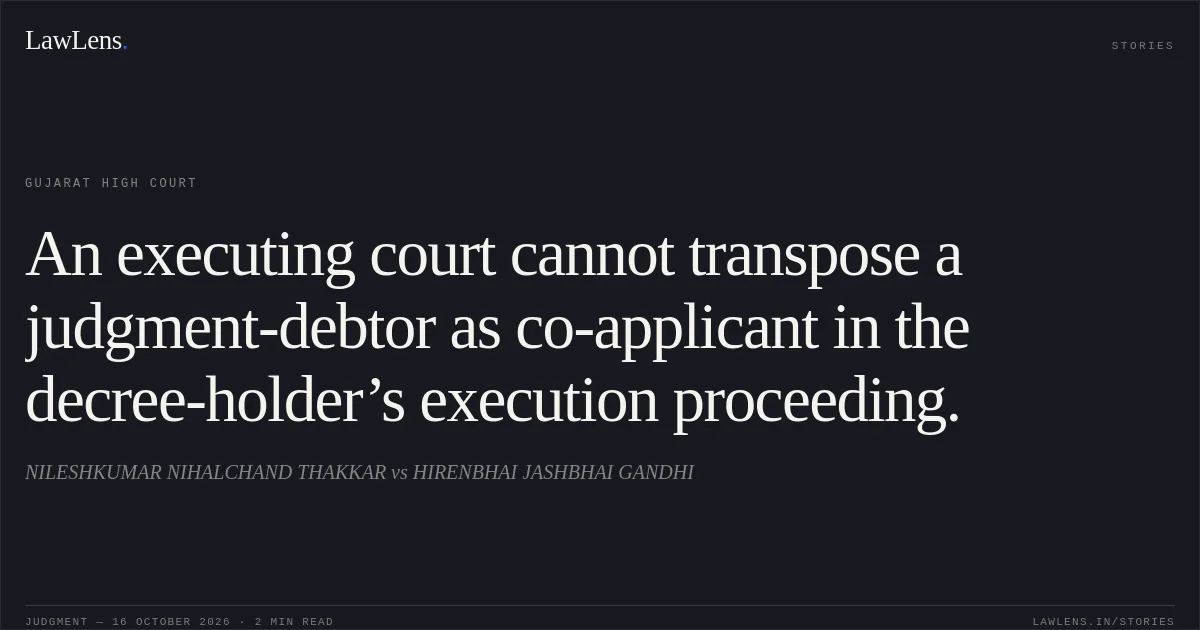
NILESHKUMAR NIHALCHAND THAKKARvsHIRENBHAI JASHBHAI GANDHI
Click to open original judgment
Original judgment, available to read, download and summarize on LawLens.in