Facts
The petitioner, a Taiwanese national, initially held an Employment Visa to work with Maxxis Rubber India Pvt. Ltd. The visa was extended until 12 November 2025. During his employment, he pursued online academic courses, including programmes conducted by IIM Shillong and the National Law School of India University.
Source reference: pp. 2–4, para. 3(i)–(iii)He subsequently secured admission to the three-year LL.B. course at Government Law College, Mumbai, resigned from employment with effect from 1 July 2025, and returned to Taiwan on 17 July 2025.
Source reference: p. 4, para. 3(iv)–(vii)On 14 August 2025, the Indian Embassy in Taiwan granted him a Student Visa valid until 13 August 2028, subject inter alia to registration within fourteen days of arrival and a prohibition on work or business. He re-entered India on 20 August 2025 and submitted an online application for a Registration Certificate on 1 September 2025, within the prescribed fourteen-day period.
Source reference: pp. 4–5, para. 3(viii)–(ix)The Foreigners Regional Registration Office (“FRRO”) nevertheless closed the application, demanded a penalty of Rs. 50,000, and ultimately issued an Exit Permit dated 21 February 2026 directing him to leave India, without assigning adequate reasons or considering his representations. The petitioner challenged the Exit Permit and sought directions for processing and granting his Registration Certificate.
Source reference: pp. 5–6, para. 3(x)–(xii); p. 2, para. 2Issues
Whether the petitioner’s pursuit of online academic courses while holding an Employment Visa constituted a breach of the visa conditions justifying refusal of registration and issuance of an Exit Permit.
Source reference: pp. 8–10, paras. 6–8Whether the FRRO was justified in imposing a penalty of Rs. 50,000 and closing the petitioner’s registration application when the application had been submitted within fourteen days of his arrival in India.
Source reference: p. 10, para. 8Whether the Exit Permit directing the petitioner to leave India was arbitrary and liable to be quashed, particularly when he held a valid Student Visa and had not violated its conditions.
Source reference: pp. 9–12, paras. 7–11Law Applied
The Court applied Section 6 of the Immigration and Foreigners Act, 2025, concerning registration of foreigners upon arrival in India, and Section 7(2)(f), which requires foreign nationals to comply with the conditions of their visas.
Source reference: pp. 9–10, para. 7It also applied the fourteen-day registration requirement under the Registration of Foreigners Rules, 1992, which governed the petitioner’s registration obligation at the relevant time.
Source reference: p. 10, para. 8The governing principle was that executive action affecting a foreign national’s lawful stay must be based on an established breach of the applicable visa conditions and must not be arbitrary or unsupported by reasons.
Source reference: no citationThe Court distinguished Kasha Elizabeth Vande v. Ministry of Home Affairs & Ors., 2018 SCC OnLine Del 9920, where the foreign national had engaged in activities contrary to her visa, made incorrect statements, and overstayed; that decision was therefore held inapplicable to the present facts.
Source reference: pp. 11–12, para. 9Reasoning
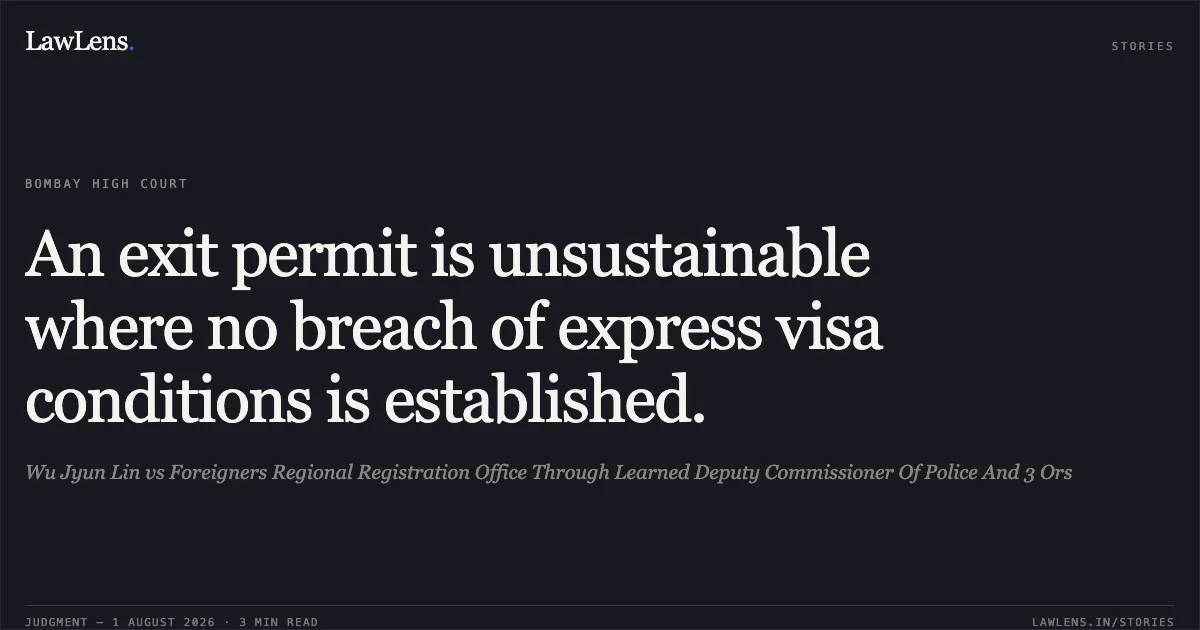
The Court held that the respondents had not established any breach of the express conditions of the petitioner’s Employment Visa. Although the petitioner had undertaken online academic programmes while employed, the Court found no prohibition in the relevant visa conditions against such study.
Source reference: pp. 8–9, para. 6In any event, after resigning, the petitioner left India, applied afresh for a Student Visa through the prescribed process, and obtained a Student Visa valid until 2028 after verification by the Indian Embassy.
Source reference: pp. 9–10, paras. 6–7The petitioner had thereafter entered India for study and there was no allegation that he had undertaken employment, business, or any other activity prohibited by the Student Visa.
Source reference: p. 10, para. 7Further, his registration application was submitted on 1 September 2025, within fourteen days of his arrival on 20 August 2025; consequently, there was no delay warranting the Rs. 50,000 penalty.
Source reference: p. 10, para. 8The unexplained closure of the application, failure to respond meaningfully to his representations, and issuance of the Exit Permit without considering his explanation rendered the respondents’ action arbitrary.
Source reference: p. 10, para. 8Since directing the petitioner to leave India would disrupt his ongoing legal education and no violation of the Student Visa had been shown, the Exit Permit could not be sustained.
Source reference: pp. 10–12, paras. 7–9Holding
The Bombay High Court allowed the petition and quashed the Exit Permit dated 21 February 2026.
It directed Respondent No. 1 to process the petitioner’s application dated 1 September 2025 and pass appropriate orders in accordance with law within six weeks after examining the relevant documents.
Source reference: p. 12, paras. 10–11Pending that consideration, the petitioner was permitted to remain in India and continue his studies under the Student Visa, subject to strict compliance with all visa conditions and a prohibition on undertaking employment, business, or any other unauthorised activity.
Source reference: pp. 12–13, para. 11The rule was made absolute, with no order as to costs, and the pending Interim Application was disposed of.
Source reference: pp. 12–13, paras. 10 and 12Original Court PDF
Wu Jyun LinvsForeigners Regional Registration Office Through Learned Deputy Commissioner Of Police And 3 Ors
Click to open original judgment
Original judgment, available to read, download and summarize on LawLens.in