Facts
The appeals arose from the conviction of A1–A6 for offences including conspiracy and murder following the death of Adhilakshmi, mother of P.W.1.
Source reference: p. 3–4, 11–13; paras. 16–17The prosecution relied principally on an alleged oral dying declaration identifying A1 and four others, a matrimonial dispute said to provide motive, and arrests and recoveries. The trial court convicted the appellants, although it acquitted A2 and A4–A6 of the charge under Section 148 IPC. The appellants challenged their convictions under Section 374(2) CrPC.
Source reference: p. 3–4, 11–13; paras. 16–17Issues
Whether the prosecution proved beyond reasonable doubt the circumstances on which it relied—motive, the alleged oral dying declaration, and arrest and recovery—to establish the appellants’ guilt.
Source reference: p. 14, para. 21; pp. 15–21, paras. 23–36Whether the trial court’s convictions and sentences could stand in light of the evidence and the applicable standard for a case based on circumstantial evidence.
Source reference: pp. 15, 21; paras. 23, 36Law Applied
In a case based on circumstantial evidence, each circumstance relied on by the prosecution must be firmly established by cogent and reliable evidence; cumulatively, the circumstances must form a complete and unbroken chain pointing only to the accused’s guilt, be consistent with guilt, and be inconsistent with any reasonable hypothesis of innocence. If the circumstances permit more than one reasonable inference, the accused must receive the benefit of the doubt.
Source reference: p. 15, para. 23The charges and convictions concerned, among other provisions, Sections 120-B, 147, 148, 302, 302 read with Sections 149 or 109, and Section 71 IPC; the judgment applied no cited precedent.
Source reference: pp. 3–4, 11, 13Reasoning
The Court found that the alleged matrimonial dispute did not establish a nexus between the accused and the murder, and the prosecution had not established the accused’s presence near the scene.
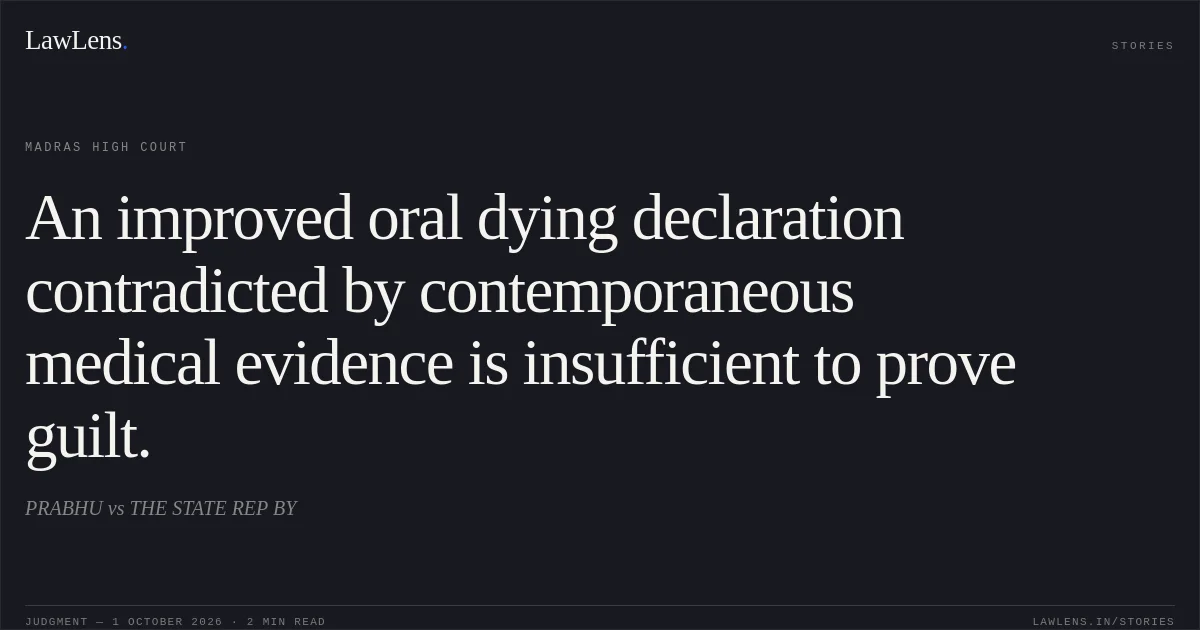
Source reference: pp. 15–17, paras. 25–28The alleged dying declaration was undermined by the Accident Register’s record that the deceased named an unknown assailant, the witnesses’ failure to mention the declaration in their Section 161 CrPC statements, and its omission from the complaint and FIR; the Court treated the later testimony as an improvement.
Source reference: pp. 17–20, paras. 29–34The claimed CCTV identification was also unsupported by the investigating officer’s evidence, while the recoveries had no established nexus to the crime.
Source reference: pp. 19–20, paras. 33, 35Accordingly, the circumstances did not form a reliable chain establishing guilt beyond reasonable doubt.
Source reference: p. 21, para. 36Holding
The Court allowed both appeals, set aside the convictions and sentences of A1–A6, and acquitted them of all charges, holding that the prosecution had not proved its case beyond reasonable doubt.
The trial court’s acquittal of A2 and A4–A6 under Section 148 IPC remained intact; bail bonds were discharged and any fines paid were ordered refunded.
Source reference: p. 21, para. 37Acts & Sections Cited
10 provisions across 2 statutes referred to in this judgment. Each provision opens on LawLens.
Code of Criminal Procedure, 19735
Indian Penal Code, 18605
Original Court PDF
PRABHUvsTHE STATE REP BY
Click to open original judgment
Original judgment, available to read, download and summarize on LawLens.in