Facts
The respondents in Writ Appeal Nos. 616/2024, 1317/2024 and 1449/2024 were employees of the appellant Electricity Distribution Companies against whom charge-sheets were issued proposing departmental enquiries.
Source reference: paras. 2–3The charge-sheets were issued by officers holding the current charge of higher posts, including Chief Engineer, Additional Chief Engineer and other disciplinary authorities, pursuant to the Companies’ Delegation of Powers.
Source reference: paras. 2–3The employees challenged the charge-sheets on the ground that the issuing officers were not substantively appointed to the higher posts and therefore lacked disciplinary jurisdiction.
Source reference: paras. 2–3The learned Single Judge accepted this objection, principally relying on Girija Shankar Shukla v. SDO, Harda, AIR 1973 MP 104, and quashed the charge-sheets.
Source reference: paras. 2–3The Companies preferred appeals.
Source reference: paras. 2–3Writ Appeal No. 1724/2024 was filed by an employee raising the same issue concerning the competence of an officer holding current charge.
Source reference: paras. 10–12Issues
1. Whether an officer entrusted with the current charge of a higher post under the Company’s Delegation of Powers is competent to initiate disciplinary proceedings and issue a charge-sheet against employees falling within the disciplinary jurisdiction of that higher post.
Source reference: para. 102. Whether an officer holding current charge, but not substantively appointed to the higher post, is legally incompetent to exercise disciplinary powers merely because of the absence of substantive appointment.
Source reference: paras. 10, 223. Whether the charge-sheets ought to have been quashed at the threshold on the technical ground that they were issued by officers holding current charge.
Source reference: para. 23Law Applied
The appeals were maintainable under Section 2(1) of the Madhya Pradesh Uchcha Nyayalaya (Khand Nyaypeeth Ko Appeal) Adhiniyam, 2005.
Source reference: para. 2The employees’ service conditions were governed by the applicable service regulations and the Madhya Pradesh Civil Services (Classification, Control and Appeal) Rules, 1966, as adopted by the Electricity Companies, together with the Company’s Delegation of Powers.
Source reference: para. 7Under Part-A, Section IV of the Delegation of Powers, an Additional Chief Engineer/Superintending Engineer in charge of a Circle was vested with full disciplinary powers over Class III and Class IV employees under his administrative control.
Source reference: para. 11In Gopalji Khanna v. Allahabad Bank, (1996) 3 SCC 538, the Supreme Court held that an officer placed in charge of a higher office may discharge the functions attached to that office, even though such entrustment does not amount to substantive promotion.
Source reference: paras. 16–17A. Savariar v. Secretary, Tamil Nadu Public Service Commission, 2008 (4) CTC 753, established that, unless a contrary intention appears from statutory provisions or executive instructions, an officer holding a post in charge may discharge its statutory functions.
Source reference: para. 18Girija Shankar Shukla was held to operate in its particular statutory and factual context, especially where no authorization to exercise the higher powers existed.
Source reference: para. 10The Court also relied on P.S. Dhanwal and Mahendra Pratap Singh for the principle that competence must be assessed under the governing statutory and administrative framework, not merely by reference to the label “current charge”.
Source reference: paras. 5, 20A charge-sheet only initiates disciplinary proceedings and does not itself impose a penalty.
Source reference: para. 23Reasoning
The Court examined the Company’s Delegation of Powers and found that it did not merely assign ministerial or administrative duties to officers holding current charge; it expressly authorized such officers to exercise the powers attached to the higher office, including disciplinary powers over the specified employees.
Source reference: paras. 11–13Applying Gopalji Khanna and A. Savariar, the Court held that substantive appointment to the higher post was not indispensable where the competent authority had entrusted the officer with the office and its associated powers.
Source reference: paras. 16–18The Court distinguished Girija Shankar Shukla because that decision involved the absence of any authorization empowering the officer to exercise the higher statutory functions.
Source reference: para. 10It rejected an absolute rule that an officer holding current charge is always incompetent, stating that competence depends on the applicable statute, service rules and Delegation of Powers.
Source reference: paras. 19–22Since the charge-sheets merely commenced disciplinary proceedings and the employees would have full opportunity to contest the allegations in a regular enquiry, interference at the threshold was also considered inappropriate.
Source reference: para. 23Holding
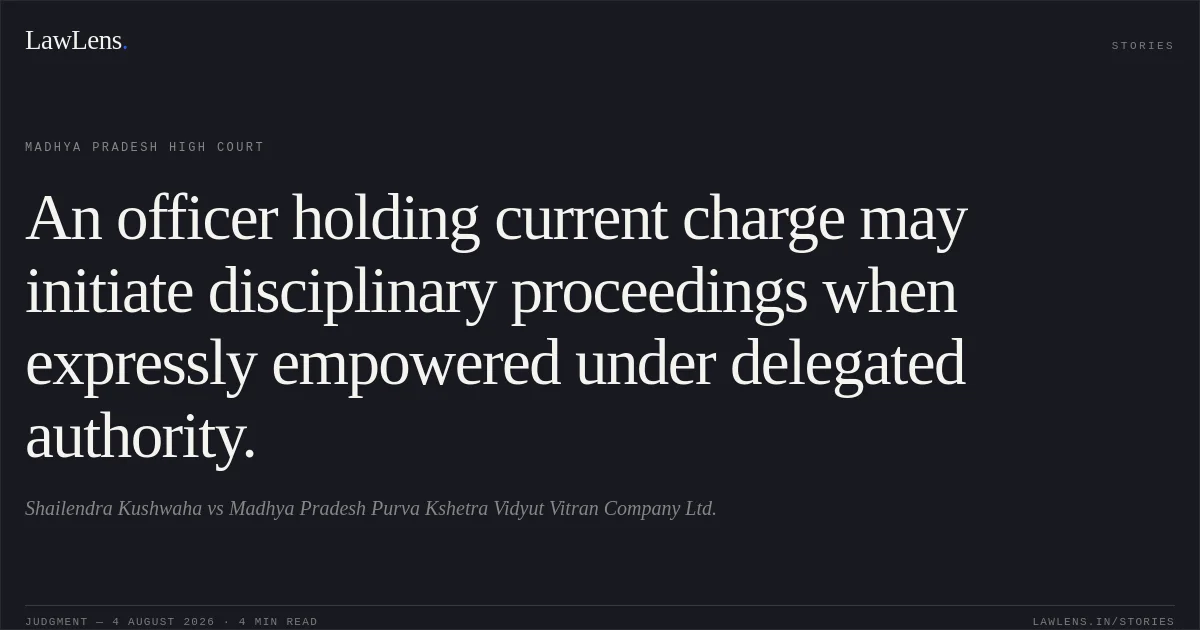
The Court held that an officer holding the current charge of a higher post is competent to issue charge-sheets and initiate disciplinary proceedings where the governing Delegation of Powers authorizes the officer to exercise the powers of that post.
Writ Appeal Nos. 616/2024, 1317/2024 and 1449/2024 filed by the Electricity Distribution Companies were allowed, and the orders of the learned Single Judge quashing the charge-sheets were set aside.
Source reference: para. 24Writ Appeal No. 1724/2024 filed by the employee was dismissed.
Source reference: para. 24No order was made as to costs.
Source reference: para. 24Acts & Sections Cited
3 provisions across 3 statutes referred to in this judgment. Linked provisions open on LawLens.
M.P. Uchcha Nyayalaya (Khand Nyayapeeth Ko Appeal) Adhiniyam, 20051
the Act (alias, unresolved)1
Code of Criminal Procedure, 18981
Original Court PDF
Shailendra KushwahavsMadhya Pradesh Purva Kshetra Vidyut Vitran Company Ltd.
Click to open original judgment
Original judgment, available to read, download and summarize on LawLens.in