01Facts
The defendant/opposite party no. 1 filed a first written statement, which was accepted on 27 January 2015.
¶ 5–7, 11A second written statement was filed on 3 May 2017 and kept with the record, but was neither accepted by the Trial Court nor filed with its leave.
¶ 5–7, 11After the parties’ evidence had concluded, the defendant sought to amend the written statement under Order VI Rule 17 CPC.
¶ 5–7, 11The Trial Court allowed the application, treating it as an application to amend the second written statement.
¶ 5–7, 11The plaintiffs challenged that order in revision.
¶ 5–7, 1102Issues
i.Whether the Trial Court could allow an amendment to the second written statement when that pleading had not been accepted by the Court or filed with its leave.
¶ 8–12ii.Whether the impugned order allowing the amendment should be set aside and the application reheard.
¶ 12–1303Law Applied
The Court considered Order VI Rule 17 of the Code of Civil Procedure, which governs amendment of pleadings.
¶ 5, 8It held that an amendment to a written statement that had not been accepted by the Court could not be allowed; the first written statement remained operative because it had not been withdrawn or abandoned, while the second had not been filed with the Court’s leave or accepted.
¶ 11No precedent was cited.
04Reasoning
The Trial Court treated the amendment application as concerning the second written statement, despite the application not specifying which written statement was to be amended.
¶ 8–10The High Court found that the first written statement remained on record as the accepted pleading, while the second had merely been kept with the record and had not been accepted or filed with leave. Accordingly, the Trial Court could not allow an amendment to the second written statement.
¶ 11–1205Holding
The High Court allowed the revision and set aside the impugned order.
¶ 12–14It directed the Trial Court to rehear the Order VI Rule 17 application, permit the plaintiffs to file an objection, and decide the application promptly, preferably within one month from reopening after the annual (puja) vacation.
¶ 12–14Connected applications were disposed of and any interim order was vacated.
¶ 15–16Original Court PDF
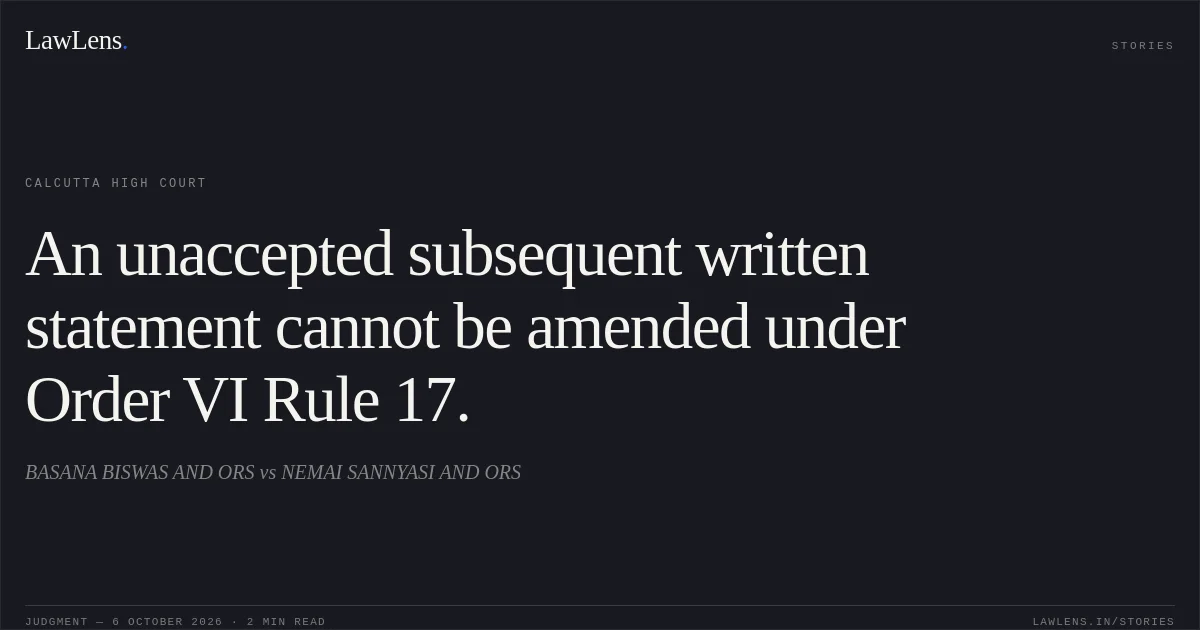
BASANA BISWAS AND ORSvsNEMAI SANNYASI AND ORS
Click to open original judgment
Original judgment, available to read, download and summarize on LawLens.in