Facts
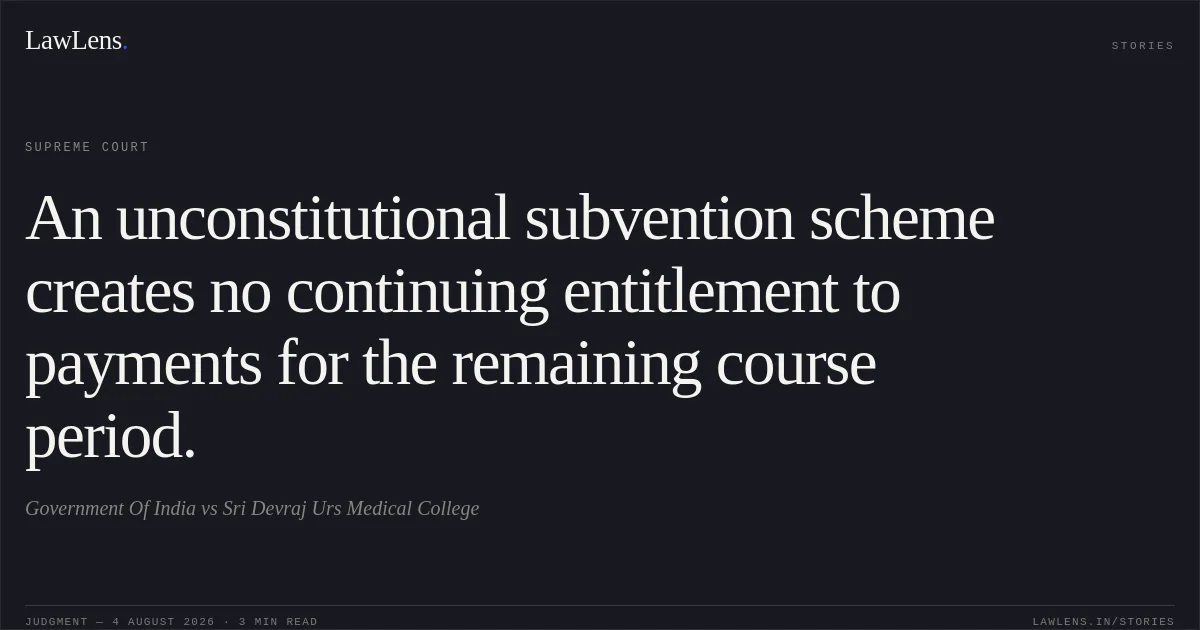
Sri Devraj Urs Medical College claimed payment of a Government subvention of ₹5,000 per student per annum under the scheme arising from the Supreme Court’s interim order dated 11.08.1995 in T.M.A. Pai Foundation v. State of Karnataka.
Source reference: pp. 8–9The scheme contemplated payment for five years or until completion of the course, whichever was earlier, subject to the final decision in T.M.A. Pai Foundation.
Source reference: pp. 8–9After the Constitution Bench delivered its final judgment on 31.10.2002, the Central Government denied subvention payments for the academic year 2002–03 and thereafter through its communication dated 13.05.2005.
Source reference: pp. 1–3The Karnataka High Court’s Single Judge quashed the communication and directed payment for students admitted up to the academic year 2002–03 for five years or until completion of the course, while denying payment for students admitted in 2003–04 and thereafter.
Source reference: pp. 1–3The Division Bench affirmed that order on 03.07.2009. The Government of India and the Government of Karnataka appealed to the Supreme Court.
Source reference: pp. 1–3Issues
1. Whether the final judgment in T.M.A. Pai Foundation dated 31.10.2002 affected the respondent-college’s entitlement to subvention under the interim scheme, and whether the High Court orders required interference?
Source reference: para. 5; pp. 4–52. Whether the appellants were entitled to relief against the direction requiring payment of subvention for the entire five-year course of students admitted in the academic year 2002–03?
Source reference: para. 5; pp. 5, 15–16Law Applied
The Court applied the Constitution Bench’s ruling in T.M.A. Pai Foundation v. State of Karnataka, which overruled the compulsory scheme in Unni Krishnan, J.P. v. State of A.P., while affirming that educational institutions cannot charge capitation fees or engage in profiteering, though reasonable surplus is permissible.
Source reference: pp. 4–5The Court held that, under P.V. George v. State of Kerala, a judgment of the Supreme Court operates retrospectively unless the judgment expressly provides for prospective application.
Source reference: pp. 13–14It also relied on the clarificatory order in State of Karnataka v. T.M.A. Pai Foundation, which required statutory enactments, orders, schemes and regulations to conform to the Constitution Bench judgment.
Source reference: pp. 10–13Further, under Bharat Singh v. State of Haryana, a party relying on factual assertions in writ proceedings must plead and produce supporting material; unsupported factual claims cannot ordinarily be adjudicated.
Source reference: pp. 6–7The subvention scheme imposed an annual payment obligation and was expressly subject to the final outcome in T.M.A. Pai Foundation.
Source reference: pp. 8–9, 15–16Reasoning
The Court rejected the High Court’s view that the 11-Judge Bench decision in T.M.A. Pai Foundation operated prospectively so as to preserve the subvention scheme for the full five-year period of students admitted in 2002–03.
Source reference: pp. 10–14The clarificatory order dated 01.04.2003 did not expressly make the Constitution Bench’s ruling prospective; rather, it required existing schemes and orders to be brought into conformity with that ruling.
Source reference: pp. 10–14Since the subvention scheme was an executive scheme founded on an interim order and was subject to the final decision, it ceased to operate when the scheme underlying Unni Krishnan was declared unconstitutional on 31.10.2002.
Source reference: pp. 14–15Moreover, the scheme required annual payments and did not create an unconditional vested right to receive the entire five-year subvention in advance or notwithstanding the final judgment.
Source reference: pp. 15–16The Court also noted that the college had provided no pleadings or data showing that tuition and other revenues were insufficient to meet its operating expenses, which independently weakened its claim for continued financial support.
Source reference: pp. 5–7Holding
The Supreme Court partly allowed the appeals.
It held that the respondent-college could not claim subvention payments beyond the academic year 2002–03, and set aside the High Court’s direction requiring payment for the entire five-year course of students admitted in 2002–03.
Source reference: paras. 13–14; pp. 16–17The High Court orders were therefore upheld only to the limited extent consistent with payment up to the academic year 2002–03; no subvention was payable for subsequent academic years or for the remaining course period after the scheme had ceased to operate.
Source reference: p. 17The connected appeal arising from SLP (C) No. 9079 of 2011 was disposed of mutatis mutandis.
Source reference: p. 17Original Court PDF
Government Of IndiavsSri Devraj Urs Medical College
Click to open original judgment
Original judgment, available to read, download and summarize on LawLens.in