Facts
The suit concerned partition of four properties in Kanagal Village, claimed to have been inherited from Thaleppa.
Source reference: p. 2–3The plaintiffs sought partition and separate possession, asserting that the properties were ancestral and had not been partitioned.
Source reference: p. 2–3The trial court decreed the suit in part, awarding the plaintiff 3/8 share; on appeal, the first appellate court modified the decree to award Plaintiff No. 2 one-half share, finding that the appellant had not proved she was Balawwa’s daughter.
Source reference: p. 4The appellant brought this second appeal under Section 100 CPC, seeking a greater share and challenging the first appellate court’s decision.
Source reference: p. 1The High Court considered both the appellant’s claimed descent from Balawwa and the first appellate court’s rejection of her entitlement through her deceased husband, Annappa.
Source reference: p. 6–12Issues
Whether the first appellate court was justified in finding that the appellant had not proved she was Balawwa’s daughter, having regard to the evidence and documents on record
Source reference: p. 6–10Whether the first appellate court was justified in denying the appellant a share through her deceased husband, Annappa, despite Defendant No. 1’s admission that she was his brother’s wife
Source reference: p. 12Law Applied
The appeal was brought under Section 100 of the Code of Civil Procedure, which governs second appeals and requires consideration of a substantial question of law.
Source reference: p. 1No other statute or precedent was cited.
Source reference: no citationThe Court considered the evidentiary significance of an unequivocal admission by a party and the sufficiency of the evidence offered to establish a claimed parent-child relationship; it also proceeded on the basis that the appellant was entitled to a share through her deceased husband.
Source reference: p. 7–12Reasoning
The Court held that the appellant had not established that she was Balawwa’s daughter.
Source reference: p. 7–10Her testimony and the other defendant’s admission were unsupported by independent evidence, while the documents relating to the Survivor’s Certificate arose from a revenue enquiry whose procedure and notice to interested parties had not been established.
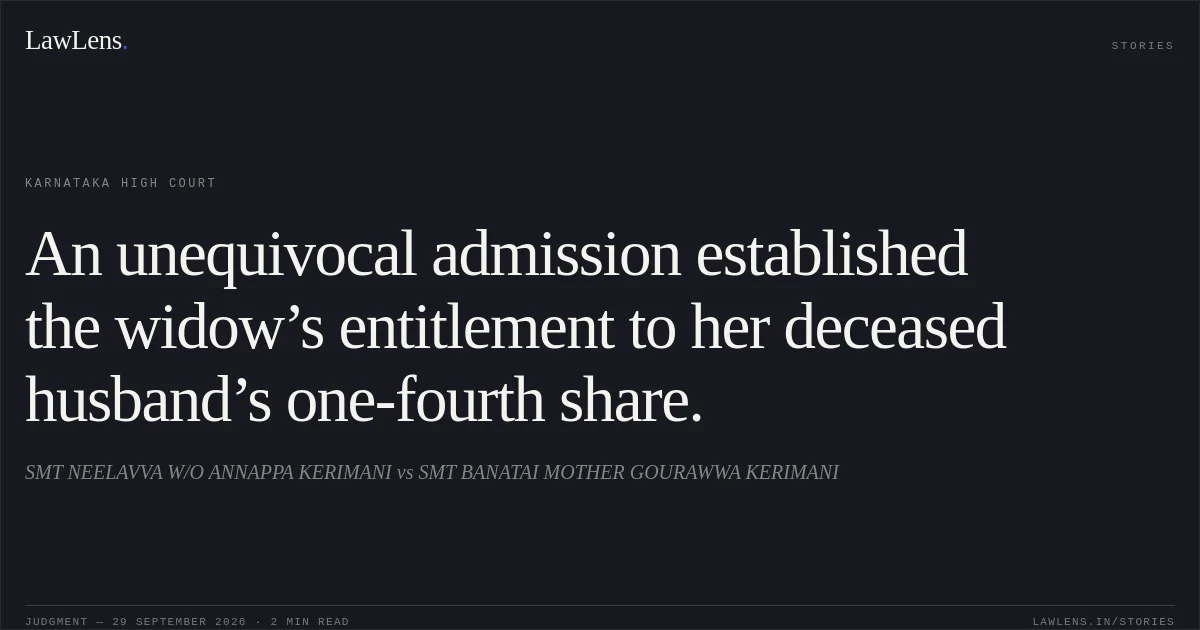
Source reference: p. 7–10The Court nevertheless found error in the first appellate court’s separate conclusion that the appellant was not entitled to a share through Annappa: the parties did not dispute that relationship, and Defendant No. 1 had expressly admitted that the appellant was his brother’s wife.
Source reference: p. 12That admission could not properly be ignored; accordingly, the appellant was entitled to a share through her husband, though not on the asserted basis that she was Balawwa’s daughter.
Source reference: p. 12–13Holding
The High Court partly allowed the second appeal and modified the first appellate court’s decree.
It declared Plaintiff No. 2 entitled to one-half share and Defendant Nos. 1 and 2 entitled to one-fourth share each in the suit properties, and directed that a decree be drawn accordingly.
Source reference: p. 12–13Acts & Sections Cited
1 provisions across 1 statute referred to in this judgment. Each provision opens on LawLens.
Code of Civil Procedure, 19081
Original Court PDF
SMT NEELAVVA W/O ANNAPPA KERIMANIvsSMT BANATAI MOTHER GOURAWWA KERIMANI
Click to open original judgment
Original judgment, available to read, download and summarize on LawLens.in