Facts
The complainant alleged that the petitioner issued two post-dated cheques of ₹10,00,000 each towards the agreed purchase of her share in land at Nellukunte Village.
Source reference: p. 4–6Both cheques were dishonoured for insufficient funds, and the petitioner did not pay after receiving statutory notices; the complainant accordingly filed two complaints under Section 138 of the Negotiable Instruments Act, 1881 (NI Act).
Source reference: p. 4–6The petitioner’s defence was that the cheques related to an earlier land transaction: he contended that the complainant had received ₹16,00,000 under a confirmation deed and release deed in 2016, and that the cheques were not issued for a separate enforceable debt.
Source reference: p. 8–10, 20–23The trial court convicted the petitioner in both cases and imposed a fine of ₹15,50,000 in each, directing payment of ₹15,40,000 to the complainant as compensation; the appellate court dismissed both appeals and confirmed the convictions and sentences.
Source reference: p. 6–7The petitioner challenged those concurrent decisions in revision.
Source reference: p. 8Issues
1. Whether the concurrent findings of conviction and sentence were perverse, grossly erroneous or otherwise met the threshold for interference in revision.
Source reference: p. 13–172. Whether the petitioner rebutted the presumptions under Sections 118 and 139 of the NI Act by showing that the cheques were not issued towards a legally enforceable debt or liability.
Source reference: p. 18–19, 24–26Law Applied
Section 138 of the NI Act applies where a cheque drawn towards a legally enforceable debt or liability is dishonoured for insufficiency of funds and the statutory demand and non-payment requirements are satisfied.
Source reference: p. 17–18Sections 118 and 139 create rebuttable presumptions that a cheque was issued for consideration and towards discharge, wholly or partly, of a legally enforceable debt or liability.
Source reference: p. 18–19The Court applied the principles governing Sections 397 and 401 of the Code of Criminal Procedure, 1973: revisional jurisdiction is supervisory, not a second appeal, and ordinarily does not permit reappreciation of evidence absent a glaring feature amounting to a miscarriage of justice.
Source reference: p. 14–17It relied on Kuntegowda v. Thurubaiah, Criminal Appeal No. 3654 of 2026, and the authorities discussed there, including State of Maharashtra v. Jagmohan Singh Kuldip Singh Anand, (2004) 7 SCC 659, and State of Kerala v. Puttumana Illath Jathavedan Namboodiri, (1999) 2 SCC 452.
Source reference: p. 14–17Interference may be warranted where findings are perverse, grossly erroneous, glaringly unreasonable, unsupported by material, or reached through arbitrary or capricious exercise of discretion.
Source reference: p. 16–17Reasoning
The Court accepted that the complainant had executed the confirmation and release deeds in favour of the earlier purchasers and that the petitioner’s case was that the ₹16,00,000 payment connected with those deeds accounted for the transaction.
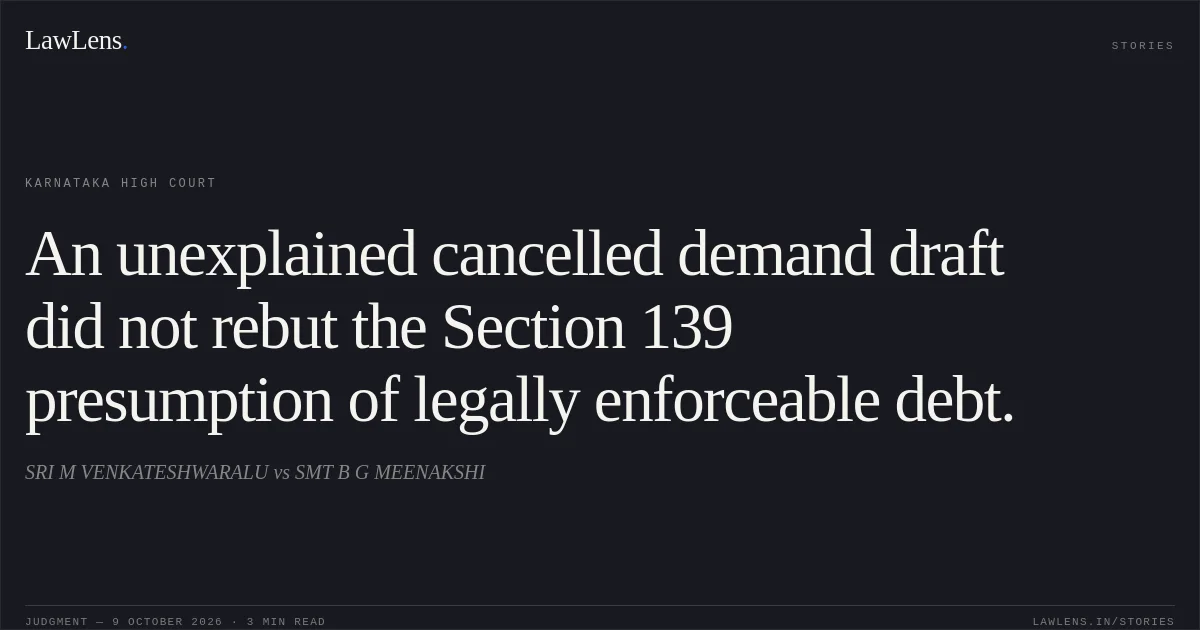
Source reference: p. 20–24However, it considered the complainant’s evidence that the disputed cheques represented a separate amount, and noted that the petitioner had drawn a demand draft for ₹18,00,000 in the complainant’s name during the proceedings and later cancelled it.
Source reference: p. 24–26The Court treated the draft evidence, together with the petitioner’s failure to establish that it related to the proposed purchase of the retained 11 guntas, as supporting the complainant’s case and held that the statutory presumptions had not been rebutted.
Source reference: p. 24–26Applying the restricted revisional standard, it declined to disturb the concurrent findings.
Source reference: p. 26–27The order states that the point for consideration was answered “in Affirmative”, although the ensuing reasoning and operative order dismiss the revisions; the judgment does not explain this apparent inconsistency.
Source reference: p. 14Holding
It held that the petitioner had not rebutted the NI Act presumptions and that the concurrent findings did not warrant interference in revision.
The High Court dismissed both revision petitions, thereby leaving in force the convictions and sentences confirmed by the appellate court.
Source reference: p. 27Acts & Sections Cited
9 provisions across 3 statutes referred to in this judgment. Each provision opens on LawLens.
Code of Criminal Procedure, 19734
Bharatiya Nagarik Suraksha Sanhita, 20232
Negotiable Instruments Act, 18813
Original Court PDF
SRI M VENKATESHWARALUvsSMT B G MEENAKSHI
Click to open original judgment
Original judgment, available to read, download and summarize on LawLens.in