Facts
The appellant filed an appeal under Section 23 of the Railway Claims Tribunal Act, 1987 against the Tribunal’s judgment dated 19 October 2022 dismissing her claim for compensation arising from the death of her son, Satpal Singh.
Source reference: p.1The deceased was allegedly travelling from Rohtak to Jhajjar on 4 August 2019 with a valid journey ticket and was subsequently found dead during the intervening night of 4/5 August 2019 between Dighal and Jhajjar.
Source reference: p.1Four railway tickets were recovered from his person, including a ticket bearing No. UAD93420235 for travel from Rohtak to Jhajjar, issued at Rohtak at approximately 17:54 hours on 4 August 2019; the ticket was later verified from Railway records.
Source reference: pp.2–3The Tribunal nevertheless held that the deceased had not been proved to be a bona fide passenger who died in an “untoward incident” under the Railways Act, 1989.
Source reference: p.2The Railway’s inquiry did not identify any eyewitness, particular train, or concrete evidence establishing whether the deceased had fallen from a train or had been run over; the manner of death was recorded as unknown.
Source reference: pp.3–4Issues
Whether the deceased was a bona fide passenger for the purposes of a claim under Section 124-A of the Railways Act, 1989.
Source reference: pp.2–3, para. 6Whether the deceased’s death constituted an “untoward incident” under Section 123(c) read with Section 124-A of the Railways Act, 1989, notwithstanding the absence of an eyewitness or conclusive proof of the precise manner of death.
Source reference: p.3, para. 7; pp.3–5, paras. 8–14Whether the Tribunal was justified in dismissing the claim merely because the deceased’s body was found on the railway track and the exact manner of death remained undetermined.
Source reference: pp.3–5, paras. 8–12Law Applied
The Court exercised appellate jurisdiction under Section 23 of the Railway Claims Tribunal Act, 1987.
Source reference: p.1Under Sections 123(c) and 124-A of the Railways Act, 1989, an accidental fall of a bona fide passenger from a train constitutes an “untoward incident” attracting the Railway’s strict-liability obligation, subject to the statutory exceptions.
Source reference: pp.3–5, paras. 7, 13–14In Union of India v. Prabhakaran Vijaya Kumar, (2008) 9 SCC 527, the Supreme Court recognised the beneficial nature of Section 124-A and held that an accidental fall from a train falls within the statutory expression “untoward incident”.
Source reference: p.5, para. 13The Court also relied on Bhoori Devi v. Union of India, 2026 SCC OnLine Del 7077, and Sh. Badshah v. Union of India, 2026 SCC OnLine Del 2015, for the principle that the location of a body on the railway track, without direct or concrete evidence of a person walking on the track and being run over, cannot by itself establish a “run-over” death.
Source reference: p.4, paras. 11–12Once bona fide passenger status is established, the absence of an eyewitness is not by itself fatal, particularly where the evidence does not affirmatively establish suicide, self-inflicted injury, intoxication, insanity, a criminal act, or deliberate entry onto the track.
Source reference: p.5, para. 14Reasoning
The Court held that the deceased’s bona fide passenger status was established by the contemporaneous recovery of the Rohtak–Jhajjar ticket from his person and its subsequent verification by the Railway Administration; there was no evidence that the ticket was fabricated, unrelated to him, or incapable of connecting him with the relevant journey.
Source reference: p.3, para. 6Regarding the manner of death, the Court rejected the Tribunal’s inference that the deceased had been run over merely because his body was found in the middle of the track.
Source reference: pp.3–4, paras. 8–9The Railway inquiry contained no eyewitness account, no statement from a Guard, Loco Pilot, or other railway official showing that the deceased had been on the track, and no identification of the train allegedly responsible.
Source reference: pp.3–4, paras. 8–9Since the DRM Report expressly treated the manner of death as unknown, it could not selectively be relied upon as proof of a run-over incident.
Source reference: p.4, para. 12Applying the beneficial and strict-liability framework under Section 124-A, the Court held that the claimant was not required to reconstruct the accident with mathematical precision or produce an eyewitness to an accidental fall.
Source reference: p.5, paras. 13–14Further, no statutory exception or affirmative evidence establishing deliberate entry onto the track or any other excluded conduct was shown.
Source reference: p.5, paras. 13–14Holding
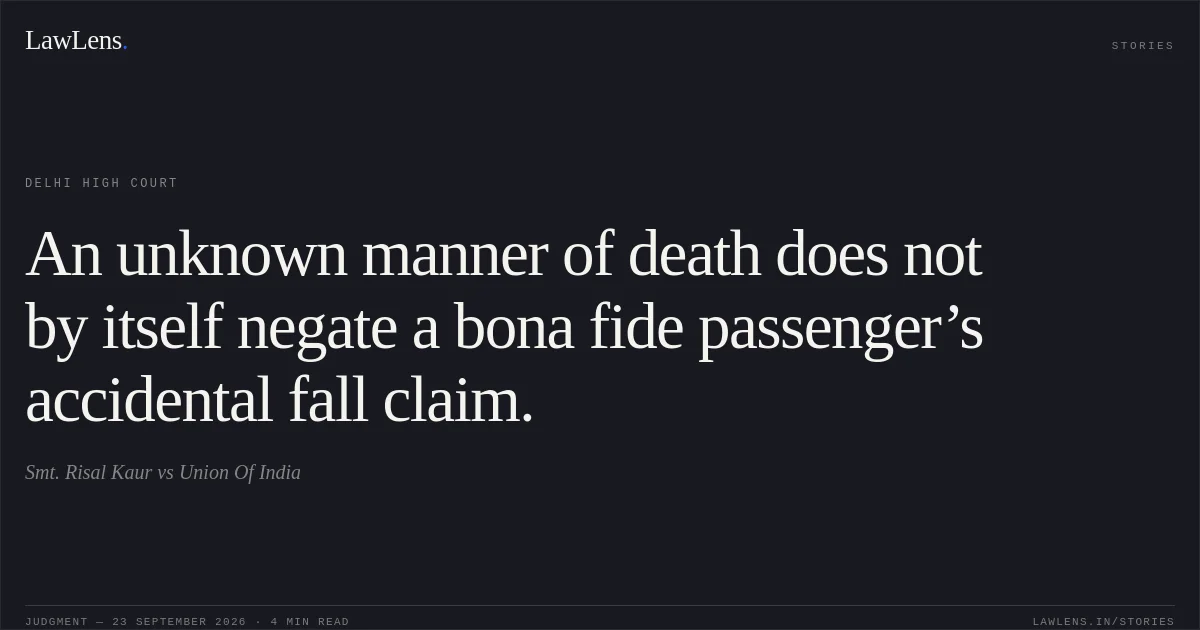
The Court held that the deceased was a bona fide passenger and that the Tribunal had erred in rejecting the claim on the basis that the precise manner of death was not proved.
The impugned judgment dated 19 October 2022 was set aside, and the matter was remanded to the Tribunal to assess the compensation payable in accordance with law and direct its disbursement within two months of receiving the Court’s order.
Source reference: p.5, para. 15The appeal was accordingly allowed and disposed of, with the matter directed to be listed before the Tribunal on 22 October 2026.
Source reference: p.6, paras. 15–17Acts & Sections Cited
2 provisions across 2 statutes referred to in this judgment. Each provision opens on LawLens.
Railway Claims Tribunal Act, 19871
Railways Act, 19891
Original Court PDF
Smt. Risal KaurvsUnion Of India
Click to open original judgment
Original judgment, available to read, download and summarize on LawLens.in