Facts
The respondent-workman, Uttam Singh, claimed that he had worked as a Store Incharge with M/s Vinu Auto Parts for approximately 38 years at a last-drawn salary of ₹14,000 per month.
Source reference: p. 2, para. 3He alleged that his services were terminated on 9 May 2017 after he demanded service benefits and after the management accused him of theft.
Source reference: p. 2, para. 3The management contended that the workman had committed theft and had tendered an apology, pursuant to which he was discharged from service.
Source reference: p. 2, para. 4The Labour Court framed the issue whether the termination was illegal or unjustified.
Source reference: p. 2, para. 5It found that the management had failed to prove the alleged apology letter, as only a photocopy was produced and the relevant witness was neither an eyewitness to the alleged theft nor the person who accepted the letter.
Source reference: p. 2, para. 6The Labour Court held that the workman had completed 240 days of service in the preceding year and that the termination amounted to retrenchment without compliance with Section 25F of the Industrial Disputes Act, 1947.
Source reference: p. 2, para. 6It consequently awarded compensation of ₹4,50,000, payable within two months, failing which interest at 9% per annum would accrue.
Source reference: p. 1, para. 1The management challenged the award under Articles 226 and 227 of the Constitution.
Source reference: no citationIssues
1. Whether the management was justified in terminating the workman without conducting a domestic inquiry on the basis of the alleged apology letter for theft.
Source reference: p. 3, paras. 7–92. Whether the Labour Court’s finding that the termination was illegal and that Section 25F of the Industrial Disputes Act, 1947, applied was perverse, without jurisdiction, or otherwise liable to interference in writ jurisdiction.
Source reference: pp. 3–4, paras. 6, 8–103. Whether the compensation awarded by the Labour Court was liable to be set aside.
Source reference: p. 1, para. 1; p. 4, paras. 10–12Law Applied
The Court applied Sections 2(oo) and 25F of the Industrial Disputes Act, 1947, holding that where a workman who has completed 240 days of service is retrenched, the statutory conditions governing retrenchment must be complied with.
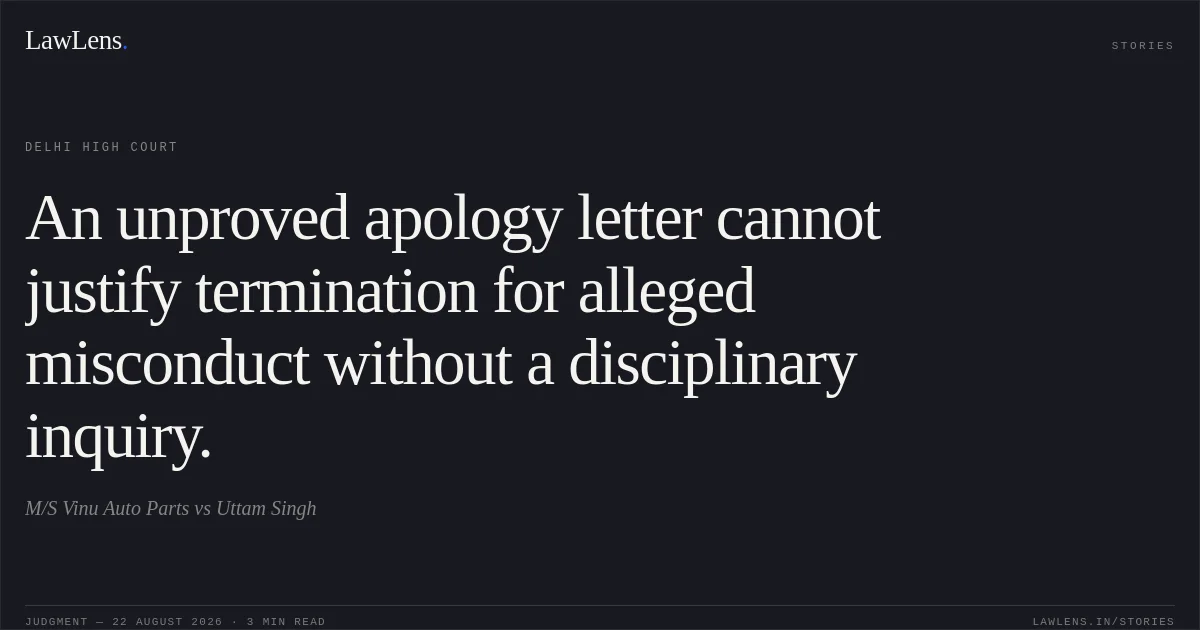
Source reference: p. 2, para. 6It further applied the principle that an alleged misconduct-based termination cannot be sustained merely on the basis of an unproved apology letter, particularly where the misconduct is disputed and the evidentiary foundation is deficient.
Source reference: pp. 2–3, paras. 6, 8–9In exercising jurisdiction under Articles 226 and 227 of the Constitution, the High Court does not sit as an appellate court over factual findings of the Labour Court and may interfere only where the decision is without jurisdiction, perverse, or contrary to principles of natural justice, as recognised in Syed Yakoob v. K.S. Radhakrishnan, International Airport Authority of India v. International Air Cargo Workers’ Union, and Ritz Theatre Private Limited v. Ramesh Chandra.
Source reference: p. 4, para. 10The authorities cited by the management concerning voluntary resignation letters were held inapplicable because the present case involved an alleged misconduct-based termination, not voluntary resignation.
Source reference: p. 4, para. 9Reasoning
The Court held that the management’s case depended substantially on the alleged apology letter, but the original document was not produced and the person who allegedly accepted it was not examined.
Source reference: p. 3, para. 8The management’s witness had neither seen the alleged theft nor independently established that the workman had voluntarily admitted the misconduct; he had himself written the letter and stated that the workman merely signed it.
Source reference: p. 2, para. 6The alleged theft was also inconsistently described as theft of auto parts in the written statement and theft of polythene rolls in the witness’s testimony.
Source reference: p. 3, para. 6Since the apology was not proved and the termination was not established as falling outside retrenchment under Section 2(oo), the Labour Court was justified in requiring compliance with Section 25F.
Source reference: no citationThe High Court found no perversity, jurisdictional error, or breach of natural justice warranting interference under Articles 226 and 227, and rejected the management’s reliance on cases concerning voluntary resignation.
Source reference: pp. 3–4, paras. 8–10Holding
The High Court answered the issues against the management and upheld the Labour Court’s award of ₹4,50,000 compensation to the workman.
The writ petition and pending application were dismissed.
Source reference: p. 5, para. 12The amount already deposited pursuant to the order directing deposit of 50% of the awarded sum was directed to be released as ordered, and the management was granted six weeks to pay the remaining balance to the workman.
Source reference: pp. 4–5, para. 11In default, the remaining amount would carry interest at 12% per annum.
Source reference: pp. 4–5, para. 11Acts & Sections Cited
2 provisions across 1 statute referred to in this judgment. Linked provisions open on LawLens.
Industrial Disputes Act, 19472
Original Court PDF
M/S Vinu Auto PartsvsUttam Singh
Click to open original judgment
Original judgment, available to read, download and summarize on LawLens.in