Facts
Opposite Party No. 1, the plaintiff in C.S. No. 20 of 2011, obtained an ex parte decree dated 17.02.2012 declaring his right, title and interest over the suit property with confirmation of possession.
Source reference: p.2, para. 2The present petitioners, who were not parties to the suit, sought to challenge the decree by filing RFA No. 164 of 2012 before the District Judge, Cuttack, along with an application seeking leave to appeal. The District Judge allowed the leave application on 28.01.2020.
Source reference: p.2, para. 2The plaintiff challenged that order in CMP No. 72 of 2021, which was allowed by the High Court on 24.12.2025. The petitioners thereafter sought review under Order XLVII Rule 1 CPC, contending that the earlier judgment incorrectly held that their pleadings did not disclose knowledge of the suit and its pendency.
Source reference: pp.4–7, paras. 6–7Although the leave application did not independently contain such an averment, it incorporated the memorandum of appeal, which stated that the appellant was unaware of the suit and ex parte decree until after the decree had been passed.
Source reference: pp.4–7, paras. 6–7Issues
Whether the High Court’s observation that the petitioners had not stated that they were unaware of the filing and pendency of the suit constituted an error apparent on the face of the record warranting review under Order XLVII Rule 1 CPC.
Source reference: pp.4–7, paras. 6–7Whether, after correcting that error, the order of the District Judge granting leave to appeal was nevertheless unsustainable for failure to disclose specific reasons for allowing the leave application.
Source reference: p.8, para. 8Law Applied
The Court applied Order XLVII Rule 1 CPC, under which a judgment may be reviewed for, inter alia, an error apparent on the face of the record.
Source reference: p.1The Court further applied the principle that a judicial order granting or refusing leave to appeal must disclose reasons, particularly where the proposed appellant was not a party to the original suit and claims prejudice, fraud, or an adverse effect from the decree.
Source reference: p.8, para. 8The Court also treated pleadings incorporated by reference into an application as material for determining the applicant’s case, since paragraph 2 of the leave application incorporated the averments in the memorandum of appeal.
Source reference: p.4, para. 6Reasoning
The Court found that its earlier conclusion was factually erroneous because the leave application expressly incorporated the memorandum of appeal, and the memorandum stated that the appellant was unaware of the suit and ex parte decree until after the decree and subsequent mutation proceedings came to light.
Source reference: pp.4–7, paras. 6–7This constituted an error apparent on the face of the record.
Source reference: pp.4–7, paras. 6–7However, correction of that error did not require automatic affirmation of the District Judge’s order. The District Judge had noted the Amin report indicating alleged encroachment before the suit and had also noted the claim that the decree was obtained by fraud, but had merely concluded that the proposed appellant was adversely affected without explaining why.
Source reference: p.8, para. 8Since the leave order lacked adequate reasons, the High Court held that it could not be sustained.
Source reference: p.8, para. 8Holding
The review application was allowed.
The judgment dated 24.12.2025 in CMP No. 72 of 2021 was modified by substituting paragraphs 7, 8 and 9.
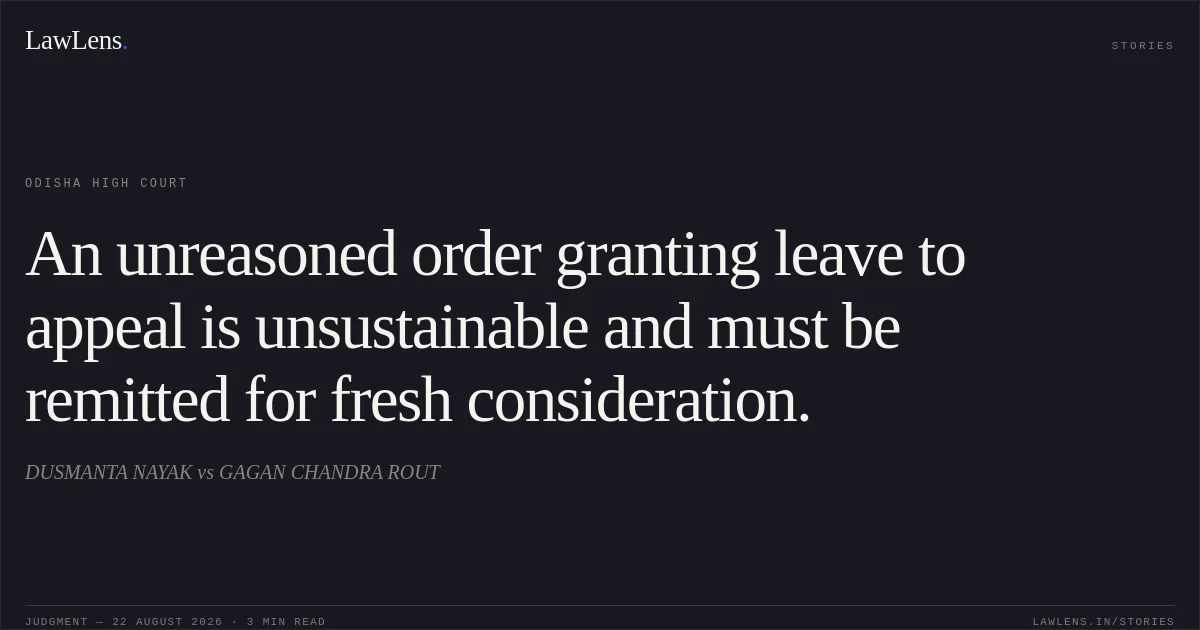
Source reference: p.9, para. 9The order of the District Judge granting leave to appeal was set aside, and the matter was remitted to the District Court to rehear the application for leave to appeal and pass a reasoned order after hearing the parties.
Source reference: p.9, para. 9Original Court PDF
DUSMANTA NAYAKvsGAGAN CHANDRA ROUT
Click to open original judgment
Original judgment, available to read, download and summarize on LawLens.in