Facts
The appellants instituted a suit for specific performance of an agreement for sale.
Source reference: no citationThe Trial Court dismissed the suit on the grounds that the agreement was unregistered, insufficiently stamped, unsupported by the signatures of attesting witnesses or an identifier, and did not sufficiently describe the boundaries of the property.
Source reference: paras. 2–3The Trial Court also considered the suit premature because, under the agreement, the sale deed was to be executed after certain events, including the vacation of the first-floor premises by March 2021.
Source reference: paras. 6–8The appellants contended that registration was not necessary for maintaining a suit for specific performance, that any stamp deficiency could be cured through impounding, that attesting witnesses were not legally mandatory, and that the property was sufficiently described in the schedule to the agreement.
Source reference: paras. 4–5The appeal challenged the judgment and decree dated 30 July 2026 passed by the Civil Judge (Senior Division), Additional Court at Bankura, in Title Suit No. 102 of 2021.
Source reference: no citationIssues
1. Whether an unregistered agreement for sale can form the basis of a suit for specific performance.
Source reference: para. 102. Whether deficiency in stamp duty rendered the suit non-maintainable without first impounding the agreement and permitting payment of the deficit stamp duty.
Source reference: para. 113. Whether the suit was premature when the contractual dates for execution of the sale deed had not arrived, but the defendants had repudiated the agreement and refused to perform it.
Source reference: para. 124. Whether the absence of specific boundaries in the agreement rendered the property description legally insufficient.
Source reference: paras. 13–145. Whether the suit was required to be remanded for adjudication on merits after excluding the grounds erroneously relied upon by the Trial Court.
Source reference: paras. 15–18Law Applied
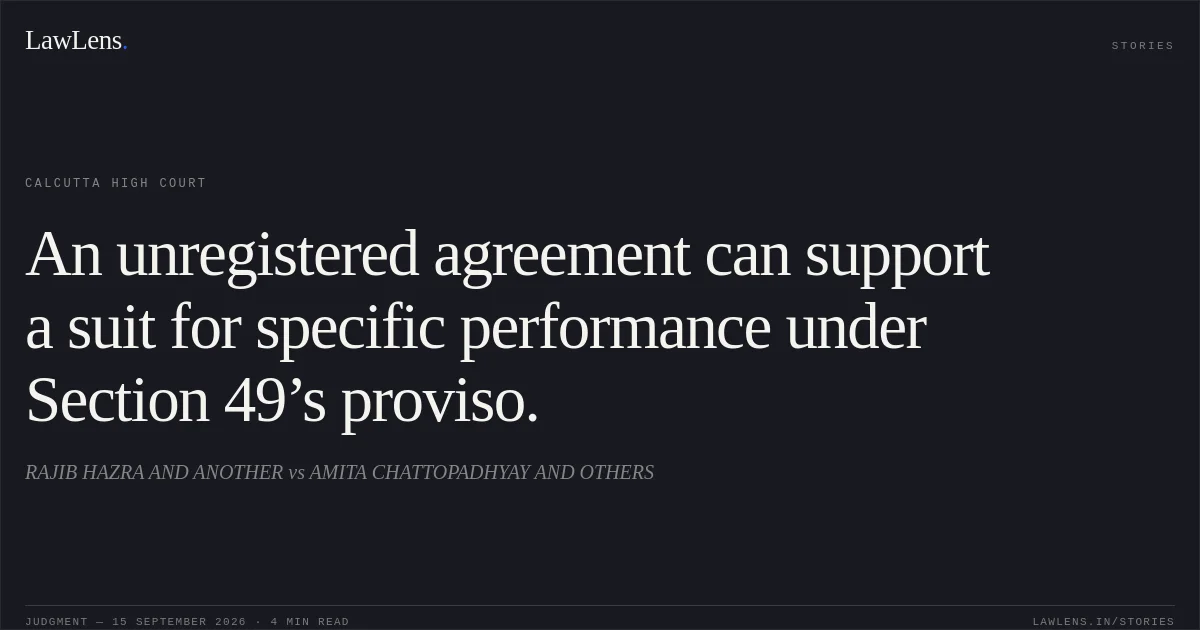
The Court applied the proviso to Section 49 of the Registration Act, 1908, which permits an unregistered document requiring registration to be received as evidence of a contract in a suit for specific performance.
Source reference: no citationIt held that an alleged deficiency in stamp duty does not by itself justify dismissal of the suit; the document may be impounded and the plaintiff directed to pay the deficit stamp duty before the matter proceeds.
Source reference: para. 11The Court further applied the principle that a suit for specific performance may be instituted upon a clear refusal to perform the contract, even before the originally stipulated date for performance, where the defendant has unequivocally repudiated the agreement.
Source reference: para. 12It also recognised that an agreement for sale need not contain attestation by witnesses unless such attestation is otherwise required by law, and that the property description is sufficient if the agreement and its schedule identify the subject matter with reasonable certainty.
Source reference: paras. 4–5, 13–14No specific judicial precedents were cited in the judgment.
Source reference: no citationReasoning
The High Court held that the Trial Court had incorrectly treated non-registration as fatal to the suit, because Section 49’s proviso permits reliance upon an unregistered agreement in proceedings for specific performance.
Source reference: para. 10Similarly, any stamp deficiency could have been addressed by impounding the agreement and directing payment of the deficit rather than dismissing the suit at the threshold.
Source reference: para. 11Although the contractual dates for performance had not fully elapsed, the defendants had responded to the appellants’ demand for performance by asserting that the agreement was void and refusing to perform it.
Source reference: para. 12This amounted to an anticipatory refusal, giving rise to a cause of action for specific performance.
Source reference: para. 12The Court also found that the agreement and its schedule sufficiently described the property, thereby rejecting the Trial Court’s objection regarding the absence of boundaries.
Source reference: paras. 13–14Since factual questions concerning the agreement’s interpretation and the parties’ evidence remained to be determined, the matter required a full trial on merits.
Source reference: paras. 15–18Holding
The appeal was partly allowed.
The High Court set aside the judgment and decree dated 30 July 2026 and remanded the suit to the Trial Court for fresh adjudication on merits.
Source reference: para. 15The Trial Court was directed not to reopen the issues decided by the High Court, but to examine the remaining factual and evidentiary questions through a full-fledged trial.
Source reference: paras. 16–18It was directed to impound the agreement and require the plaintiffs to pay any deficit stamp duty before proceeding with the trial.
Source reference: para. 17CAN 1 of 2026 was disposed of consequentially; there was no order as to costs.
Source reference: paras. 19–20The Trial Court was requested to endeavour to dispose of the suit preferably within eight months from communication of the judgment, and the parties were left free to seek legally maintainable interim relief before that Court.
Source reference: paras. 21–23Acts & Sections Cited
1 provisions across 1 statute referred to in this judgment. Each provision opens on LawLens.
Registration Act, 19081
Original Court PDF
RAJIB HAZRA AND ANOTHERvsAMITA CHATTOPADHYAY AND OTHERS
Click to open original judgment
Original judgment, available to read, download and summarize on LawLens.in