Facts
The respondent-plaintiff instituted a suit for specific performance of an agreement to sell.
Source reference: para. 2During the pendency of the suit, the petitioner-defendants challenged the admissibility of the agreement dated 24 January 2003, contending that it was neither registered nor duly stamped and therefore could not be admitted in evidence or exhibited without compliance with the Registration Act, 1908 and the Rajasthan Stamp Act, 1998.
Source reference: para. 2The trial court rejected the defendants’ application under Section 39 of the Rajasthan Stamp Act, 1998 read with Section 151 CPC by order dated 17 March 2026. The defendants consequently invoked the writ jurisdiction of the Rajasthan High Court.
Source reference: para. 1Issues
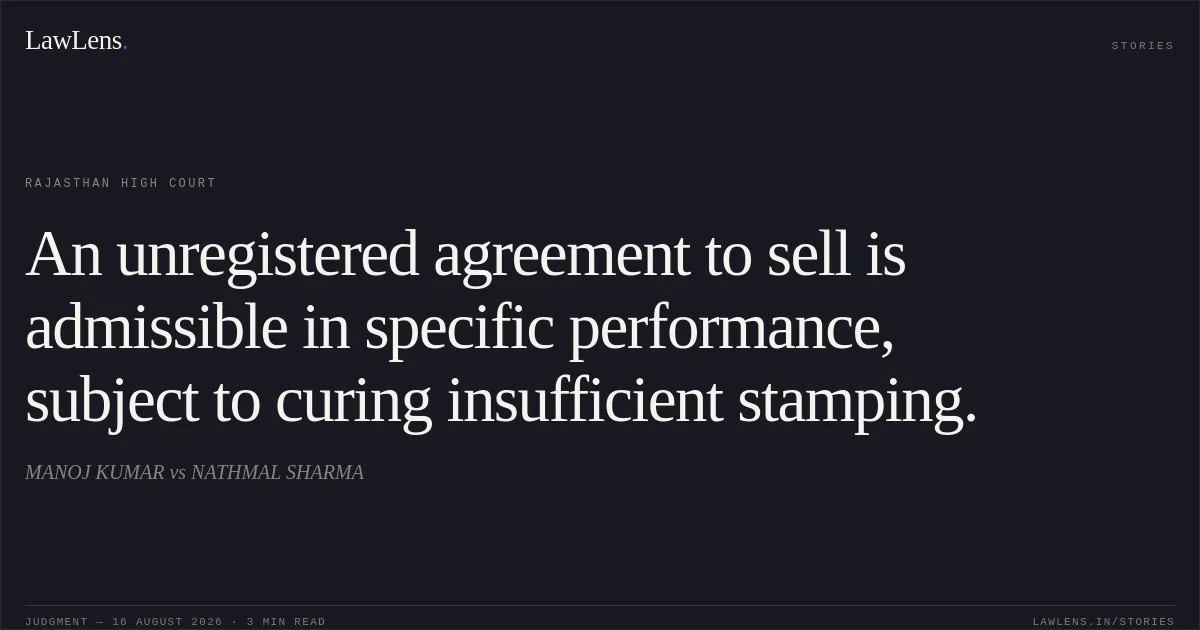
Whether an unregistered agreement to sell forming the basis of a suit for specific performance can be received in evidence despite non-registration under the Registration Act, 1908?
Source reference: para. 4; pp. 3–4Whether an agreement to sell that is insufficiently stamped can be admitted in evidence or exhibited without payment of the deficient stamp duty and applicable penalty under Section 39 of the Rajasthan Stamp Act, 1998?
Source reference: paras. 4, 5–6; pp. 3–6Law Applied
The Court applied Section 49 of the Registration Act, 1908, which generally bars an unregistered document required to be registered from affecting immovable property or being received in evidence of a transaction affecting such property, subject to the proviso permitting its use as evidence of a contract in a suit for specific performance or for a permissible collateral purpose.
Source reference: paras. 4.1–4.2; pp. 3–4The Court further applied Section 39 of the Rajasthan Stamp Act, 1998, which prohibits the admission, use, registration or authentication of an instrument chargeable with stamp duty unless it is duly stamped; the proviso makes an insufficiently stamped instrument admissible upon payment of the requisite duty or deficient duty together with the prescribed penalty.
Source reference: para. 5; pp. 4–5Thus, non-registration may be overcome for the limited purpose of proving the contract in a specific-performance suit, but insufficient stamping must first be cured in accordance with Section 39.
Source reference: paras. 5.1–6; pp. 5–6Reasoning
The Court distinguished the consequences of non-registration from those of inadequate stamping. Since the suit was one for specific performance, the proviso to Section 49 permitted the unregistered agreement to be received as evidence of the alleged contract, although it could not be relied upon to directly affect title or create rights in the immovable property.
Source reference: para. 4.2; p. 4However, Section 39 imposed an independent statutory bar: if the agreement was found to be insufficiently stamped, it could not be admitted or exhibited in its existing form. The defect was curable, but only after determination and payment of the deficient stamp duty and applicable penalty.
Source reference: para. 5.1; p. 5Accordingly, the trial court was required to examine the document’s stamp sufficiency when it was tendered and, if necessary, impound and forward it to the Collector (Stamps) or competent authority for determination.
Source reference: paras. 6–7; pp. 6–7Holding
The Court held that the agreement to sell could not be rejected merely because it was unregistered, as it was relied upon in a suit for specific performance and fell within the proviso to Section 49 of the Registration Act, 1908.
Nevertheless, its admission in evidence remained subject to compliance with Section 39 of the Rajasthan Stamp Act, 1998.
Source reference: paras. 7–8; p. 7The writ petition was disposed of with directions that, upon the plaintiff tendering the agreement dated 24 January 2003, the trial court must first determine whether it was duly stamped; if insufficiently stamped, the document must be impounded and forwarded to the competent authority for determination of the deficient duty and charges. It could thereafter be admitted and exhibited only upon payment of the amounts determined and if otherwise admissible in law.
Source reference: paras. 7–8; p. 7Acts & Sections Cited
5 provisions across 3 statutes referred to in this judgment. Each provision opens on LawLens.
rajasthan stamp act, 19982
Code of Civil Procedure, 19081
Registration Act, 19082
Original Court PDF
MANOJ KUMARvsNATHMAL SHARMA
Click to open original judgment
Original judgment, available to read, download and summarize on LawLens.in